

Guadalest from Benidorm: Is Alicante’s Famous Mountain Village Worth the Trip?
Guadalest is one of those places you have probably already seen before you visit it.
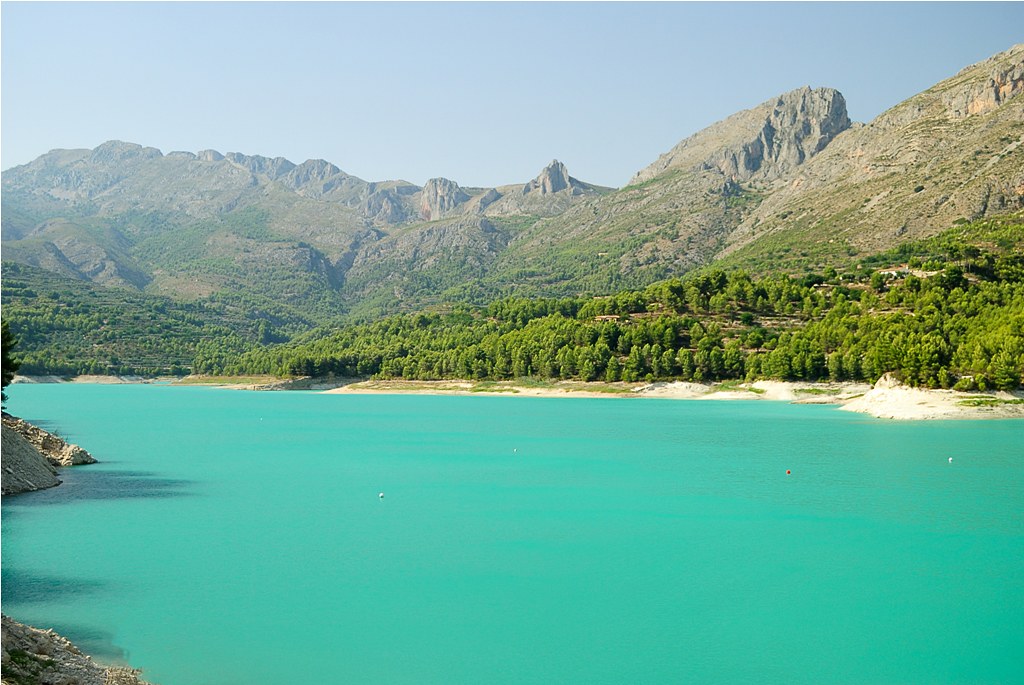
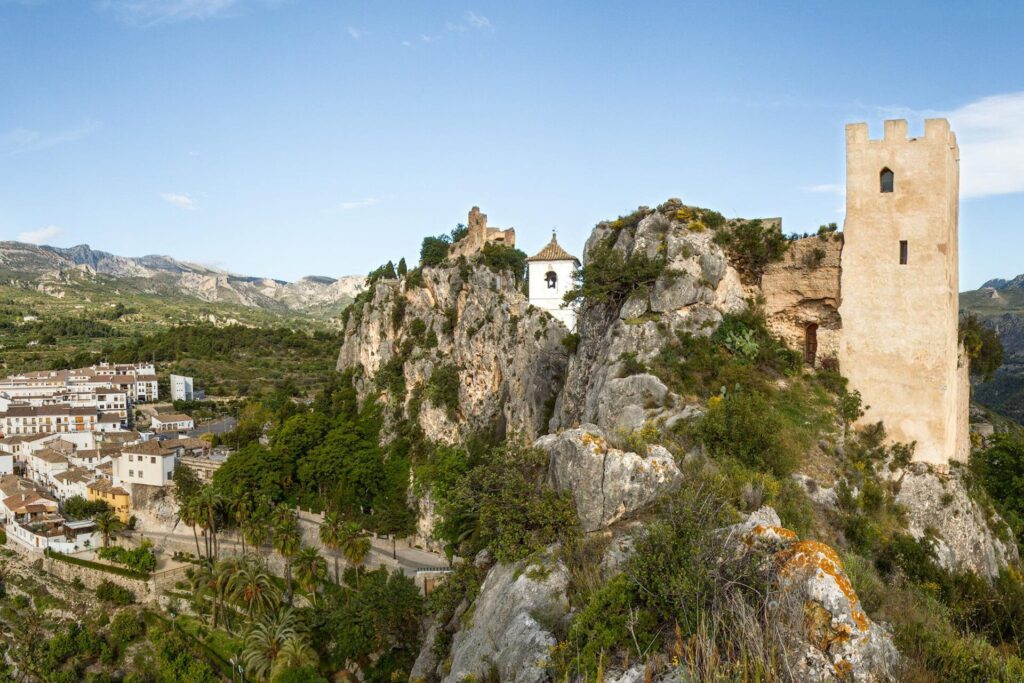
The turquoise reservoir below the village appears constantly in photographs of the Costa Blanca. The white houses seem to cling to the mountain. Above them, the remains of the castle rise from an almost impossibly narrow ridge of rock.
From Benidorm, Guadalest is one of the classic inland excursions.
That popularity creates both an advantage and a problem.
The advantage is obvious: the village is famous because the setting really is remarkable.
The problem is that it is easy to reduce Guadalest to a postcard.
Arrive with a tour group, walk through the old gate, photograph the reservoir, spend twenty minutes among souvenir shops and leave.
You will technically have visited Guadalest.
But you will have missed much of what makes it interesting.
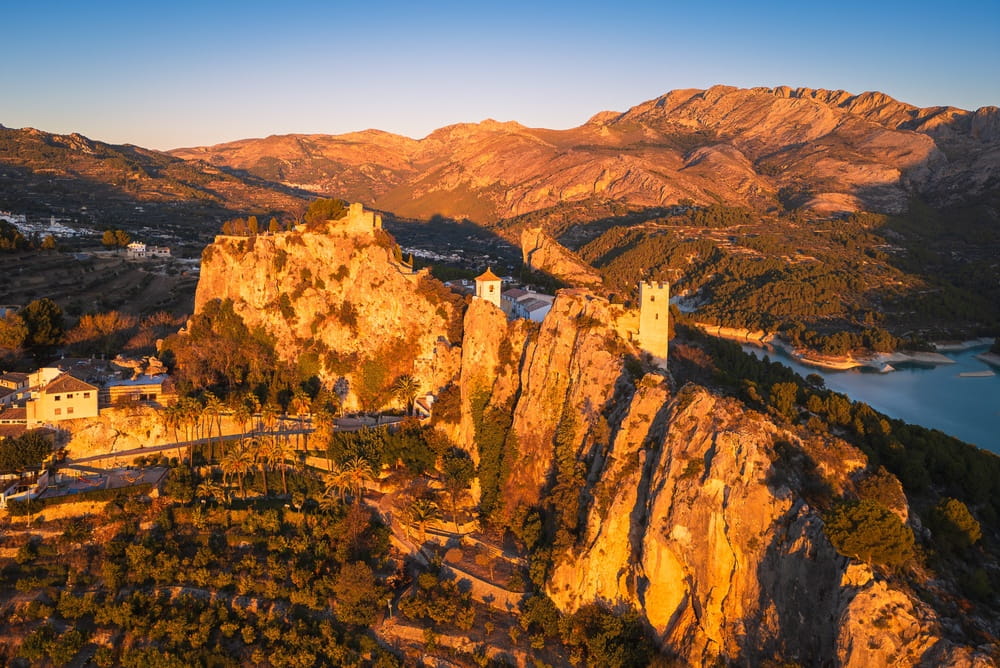
El Castell de Guadalest is a small historic settlement built in an extraordinary defensive position in the mountains inland from the Costa Blanca. Its old fortified quarter occupies a rocky outcrop overlooking the Guadalest Valley, with the reservoir below and mountain ranges surrounding it on almost every side.
The village existed during the Muslim period and later became an important feudal stronghold after the Christian conquest. Over the centuries it passed through the hands of powerful noble families, survived earthquakes, population upheaval and military conflict, and eventually evolved into one of the best-known visitor destinations in Alicante province. The municipality was declared a historic-artistic site in 1974 and today forms part of the association of the Most Beautiful Villages in Spain.
For someone staying in Benidorm, the appeal is not only historical.
Guadalest offers one of the sharpest contrasts you can find within a relatively short journey.
Benidorm is open to the sea, modern, dense and energetic.
Guadalest is enclosed by mountains, compact, historic and defensive.
In Benidorm, the skyline rises from beaches.
In Guadalest, buildings appear to grow directly from the rock.
That change of environment is a major reason the excursion works so well for long-stay residents.
It feels much farther from the coast than it really is.
The best way to approach Guadalest is therefore not as a collection of attractions that need to be ticked off.
Think of it as a place where the setting, the architecture and the route through the village are part of the attraction themselves.
The castle matters.
Casa Orduña matters.
The reservoir matters.
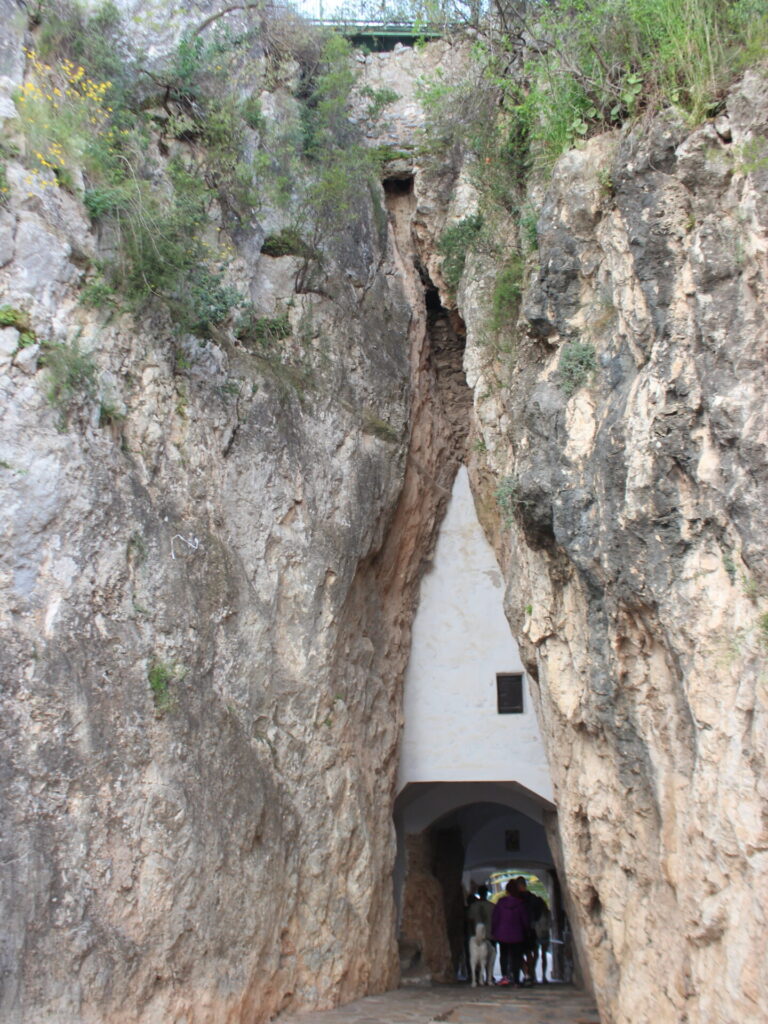
But so does the moment when you pass through the narrow entrance carved through the rock and realise that the old quarter was deliberately built to control access.
That is when Guadalest begins to make sense.
What Is Guadalest?
The full name of the municipality is El Castell de Guadalest, although almost everyone simply calls it Guadalest.
It lies in the mountainous interior of Alicante province, surrounded by some of the most dramatic terrain in the Marina Baixa.
The old village occupies a natural rocky stronghold above the valley.
This location was not chosen for aesthetics.
It was chosen for defence.
The origins of Guadalest go back at least to the Muslim period, when fortifications controlled this strategically important mountain valley. After the Christian conquest in the 13th century, the settlement remained under various feudal lords before becoming associated with the Sarrià, Cardona and later Orduña families.
For centuries, the castle and surrounding settlement functioned as the administrative and defensive centre of the valley.
That long history is still visible in the way the village is organised.
A Village Built Around Defence
The historic quarter is separated from the lower, more modern part of Guadalest by a dramatic natural barrier.
To enter the fortified area, you pass through a tunnel cut directly through the rock.
This is one of the most memorable features of the visit because it immediately explains the logic of the settlement.
There was no wide ceremonial entrance.
Access was narrow and controllable.
Once through the tunnel, the space opens into the old village, where Casa Orduña, the church, small streets and viewpoints occupy the limited area available on top of the rock.
The experience is surprisingly theatrical.
You approach along an ordinary village street.
The rock closes around you.
You pass through a narrow opening.
Then suddenly you emerge above the valley.
That sequence is one of the reasons Guadalest feels more interesting in person than it does in photographs.
The Castles Above the Village
Guadalest is associated primarily with the Castillo de San José, the ruined fortress occupying the highest part of the rock.
There is also the remains of the Castillo de la Alcozaiba, another defensive structure linked to the Muslim period.
Neither survives as a complete medieval castle with furnished rooms and intact towers.
That is important to understand before visiting.
You are mainly exploring ruins integrated into the rock rather than entering a fully preserved fortress.
But the condition of the buildings is almost secondary.
The value comes from the position.
From the higher areas, you look across the valley toward the reservoir and surrounding mountain ranges.
It is the kind of landscape that immediately explains why people built a fortress here.
Earthquakes Changed Guadalest
The ruined appearance of the castle is not only the result of age.
Guadalest suffered several major earthquakes.
Two particularly destructive earthquakes occurred in 1644, badly damaging the castle and settlement. Further seismic events followed in the 18th century.
This helps explain why the historic centre contains buildings from different periods rather than surviving as a perfectly preserved medieval complex.
Casa Orduña, for example, was constructed after the 1644 earthquake destroyed earlier structures associated with the castle.
Guadalest has therefore been rebuilt and adapted repeatedly.
What you see today is not a frozen medieval village.
It is a place shaped by centuries of destruction, rebuilding and changing uses.
The Orduña Family
One of the most important families in Guadalest’s later history was the Orduña family.
They arrived in connection with the powerful Cardona family and eventually became the permanent governors and administrators of the fortress.
Their influence lasted for centuries.
Casa Orduña reflects that status.
The building contains domestic rooms, historic furnishings, paintings and a particularly interesting private library. The collection includes more than a thousand volumes, with a substantial historic section dating from the 16th to 18th centuries.
But Casa Orduña is important for another practical reason.
It also provides access toward the Castillo de San José.
This means the museum and castle are not completely separate experiences.
The house forms part of the route into the upper historic area.
The Reservoir Changed the Landscape
One of the most surprising things about Guadalest is that its most famous view is relatively modern.
The reservoir below the village was not part of the historic medieval landscape.
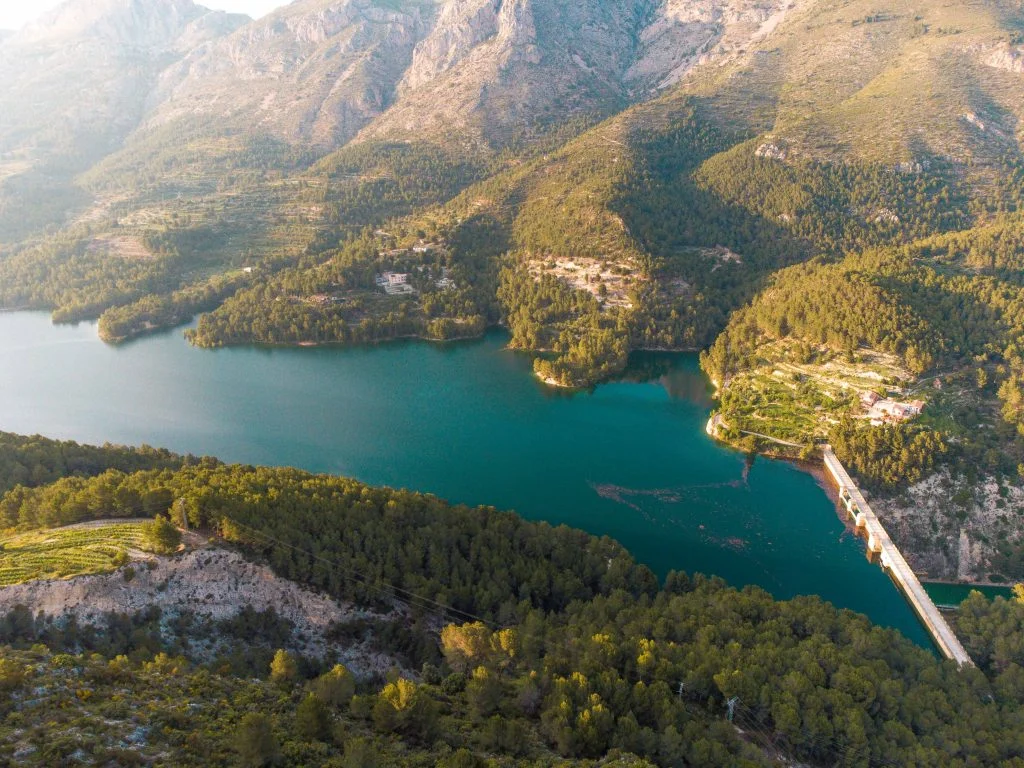
Construction began in the 1950s and the reservoir was completed in 1971.
Today, however, it is almost impossible to imagine Guadalest without it.
The green-blue water provides an extraordinary visual contrast with the dry Mediterranean mountains around it.
On clear days, the reservoir becomes the focal point of almost every viewpoint from the village.
That creates an interesting contradiction.
Visitors often come to see a medieval mountain village, but the feature dominating their photographs is a 20th-century reservoir.
The combination works remarkably well.
Why Visit Guadalest from Benidorm?
Guadalest is popular partly because it is easy to understand.
You do not need to be interested in medieval history, architecture or hiking to appreciate the first view.
The location does most of the work.
You arrive, walk upward and suddenly find a village balanced above a mountain valley.
But there are better reasons to visit than simply collecting the photograph.
The Journey Inland Changes the Day
One of the strongest aspects of the excursion is the transition away from the coast.
The road gradually leaves the dense development of the Marina Baixa and moves into an increasingly mountainous landscape.
The sea disappears.
The roads become quieter.
Small settlements replace apartment blocks.
By the time Guadalest appears, the atmosphere is completely different from Benidorm.
For a long-stay visitor, this matters.
A good day trip should not simply provide another attraction.
It should change your environment.
Guadalest does that very effectively.
The Village Has a Natural Sense of Arrival
Some historic towns reveal themselves gradually.
Guadalest is more dramatic.
The rocky outcrop and castle immediately tell you where the historic centre is.
As you walk upward, the village becomes increasingly confined by the rock until the tunnel leads you into the old fortified quarter.
That physical progression gives the visit structure without needing an itinerary.
You naturally move from the modern village toward the historic core.
Then upward toward the castle.
Finally, outward toward the views.
It is one of the reasons Guadalest works particularly well for first-time visitors.
You rarely feel unsure about where the main experience is.
The Views Are Genuinely Exceptional
Guadalest is sometimes described so enthusiastically that you might suspect the scenery has been exaggerated for tourism.
It has not.
The combination of:
- mountain ridges;
- terraced slopes;
- the reservoir;
- the castle ruins;
- the compact historic village
creates one of the most distinctive landscapes in inland Alicante.
The view also changes as you climb.
From lower streets, you mainly see the village and surrounding mountains.
From the old quarter, the reservoir begins to dominate.
From the castle area, the valley opens almost completely below you.
This progression is worth experiencing slowly rather than rushing directly to the highest viewpoint.
There Is More History Than the Village Initially Suggests
Because Guadalest is small and heavily visited, it can initially feel like a tourist village built around a viewpoint.
Its history is much deeper than that.
The Muslim origins, feudal lords, earthquakes, expulsion of the Moriscos, Orduña family and later development of tourism all contributed to the settlement visible today.
Even the souvenir-filled streets make more sense when you understand how tourism transformed Guadalest during the 20th century.
This is not an untouched mountain village accidentally discovered by visitors last year.
Tourism has been part of its modern identity for decades.
You Can Choose How Deep You Want to Go
Another strength is flexibility.
A casual visitor can spend two or three hours walking through the old quarter, seeing the views and visiting the castle.
Someone more interested in history can add Casa Orduña and the Ethnological Museum.
Visitors who enjoy unusual collections can spend much longer exploring Guadalest’s famously eccentric museum scene. The municipality currently lists museums devoted to subjects ranging from local ethnology and historic vehicles to microminiatures and miniature art.
That flexibility makes Guadalest suitable for very different kinds of visitors.
You do not need to see everything.
In fact, trying to see everything may be one of the worst ways to experience it.
The Tourist Popularity Is Both a Strength and a Weakness
There is no point pretending Guadalest is an undiscovered village.
It is one of the best-known inland destinations on the Costa Blanca, and the municipality itself describes it as one of the most visited municipalities in Spain.
At busy times, you can expect:
- coaches;
- tour groups;
- souvenir shops;
- crowded viewpoints;
- busy restaurants.
That can reduce some of the romantic mountain-village atmosphere.
But popularity does not automatically mean the destination is overrated.
The better question is whether the underlying place remains interesting once you remove the tourism infrastructure.
In Guadalest, it does.
The rock is still extraordinary.
The valley is still impressive.
The castle still occupies a remarkable defensive position.
The reservoir still transforms the landscape.
The solution is not to avoid Guadalest because tourists visit it.
The solution is to visit it intelligently.
Arrive earlier.
Stay longer than the average coach group.
Choose one or two museums rather than all of them.
Take time to look beyond the souvenir shops.
And, if possible, explore the reservoir or valley after leaving the historic centre.
A Particularly Good Excursion for Long-Stay Visitors
Guadalest is often sold as a compulsory half-day excursion for holidaymakers.
For someone living temporarily in Benidorm, it can be better than that.
You do not need to rush back for another scheduled activity.
You can arrive before the busiest period, explore at your own pace, have lunch and continue into the valley.
That extra time changes the experience.
Instead of simply “seeing Guadalest”, you begin to understand where the village sits within the surrounding landscape.
And that will be one of the central ideas of this guide:
the famous view is only the beginning of Guadalest, not the whole experience.
Entering the Historic Village
One of the best things about Guadalest is that the old quarter does not reveal itself all at once.
You approach through the lower village, where cafés, shops and museums occupy the more accessible streets. At this point, Guadalest can feel quite touristy. There are signs everywhere, people moving between attractions and plenty of businesses competing for attention.
Then the route narrows.
The rock begins to dominate.
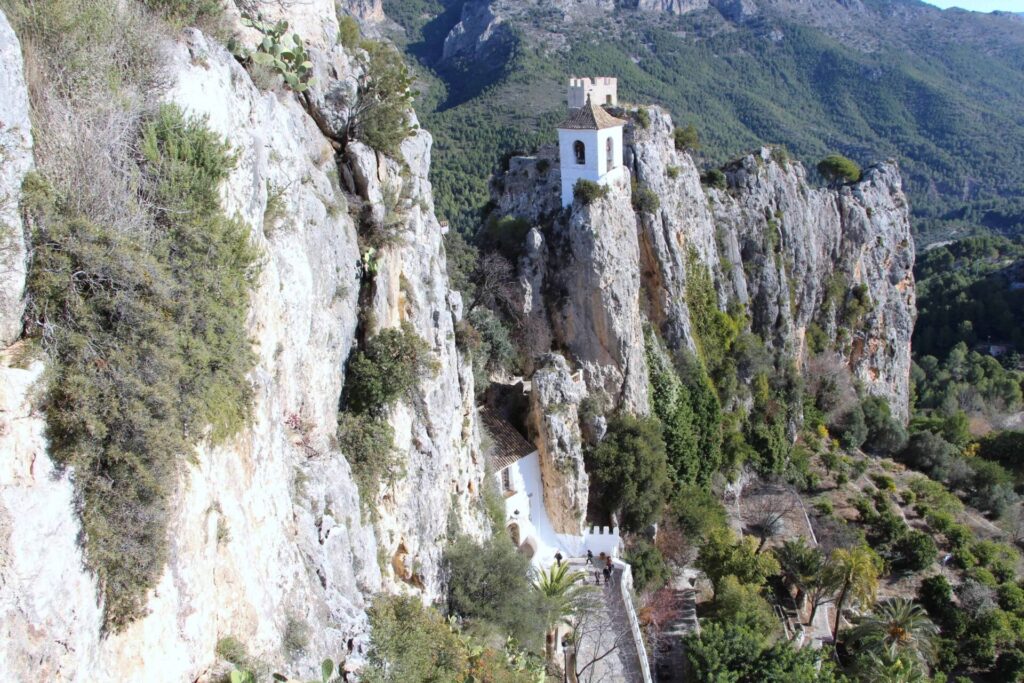
And finally you reach the Portal de San José, the tunnel carved through the mountain that gives access to the historic fortified quarter.
This is the moment when the visit changes.
The tunnel is not especially long, but its effect is powerful because it separates the commercial lower streets from the older defensive settlement above. Once you pass through it, the village suddenly feels more enclosed, more vertical and much more connected to the rock on which it was built.
It is worth slowing down here.
Many visitors walk through quickly because they are already thinking about the reservoir viewpoint. But the tunnel itself tells you more about Guadalest’s history than many information panels could.
A narrow entrance like this was easy to defend.
The settlement was designed around control of access, not convenience.
Once inside, the old quarter opens into a compact area of historic buildings, viewpoints and narrow streets. Casa Orduña stands immediately as one of the most important structures, while the church and castle remains occupy the upper levels.
The historic centre is small enough to explore without a detailed map.
That is part of its charm.
You do not need to march from attraction to attraction. Walking slowly, looking at how buildings interact with the rock and occasionally stopping at the edge of the village works much better.
Do Not Rush Straight to the Viewpoint
The reservoir is so visually dominant that many people head directly toward the first place where they can photograph it.
Resist that impulse for a few minutes.
Look back toward the entrance.
Notice how little space exists between the buildings and the rock.
Think about how difficult construction must have been before modern machinery.
The village becomes far more interesting once you stop seeing the rock as scenery and start seeing it as part of the architecture.
That relationship between natural terrain and human construction is probably Guadalest’s strongest characteristic.
The Castle, Casa Orduña and the Best Views
For most visitors, Casa Orduña and the Castillo de San José form the historical core of the experience.
If you only pay for one heritage attraction in Guadalest, this is the most logical choice.
Casa Orduña currently functions as a municipal museum and also provides access to the castle above. The building was constructed after the destructive earthquake of 1644 and belonged to the Orduña family, who served for centuries as governors and administrators of the Guadalest estate. The official municipal information describes rooms including the kitchen, dining room, bedrooms and historic library, along with exhibition spaces and access to the Castillo de San José.
That combination matters.
You are not paying simply to walk through a historic house.
The house forms part of the route toward one of the best elevated viewpoints in the village.
Is Casa Orduña Worth Visiting?
Yes, especially on a first visit.
The building gives you something that the castle ruins alone cannot provide: a sense of how Guadalest was actually inhabited by an influential family.
Without Casa Orduña, the village can become very abstract.
You see walls.
Rock.
Ruins.
Views.
The house adds domestic scale.
Rooms, furniture, paintings and books remind you that this was not merely a military outpost. People lived here, administered the surrounding territory and built lives inside an extremely unusual setting.
The library is one of the more interesting parts of the house, particularly for anyone who likes historic interiors. It contains a substantial collection of books and documents, and the rooms retain the atmosphere of a provincial noble residence rather than feeling like a reconstructed medieval attraction.
Do not expect Versailles.
That would be completely the wrong comparison.
Casa Orduña is interesting because it feels proportionate to Guadalest: important locally, historically connected to power in the valley and integrated directly into the fortified landscape.
How Much Time Do You Need?
For Casa Orduña and the castle together, around one to one and a half hours is a comfortable amount of time for most visitors.
You can move faster, but there is little reason to.
A better visit allows time to look through the house, climb gradually toward the castle and stop at the different viewpoints.
The official municipal site currently lists Casa Orduña as open every day, with longer hours in high and mid season and slightly shorter hours in low season. Because schedules can change, especially around holidays, it is still worth checking shortly before travelling.
Castillo de San José
The Castillo de San José occupies the highest and most dramatic part of the fortified village.
Its origins date back to the Muslim period, and the castle formed the principal defensive structure of Guadalest.
Today, you should think of it as a ruin in an extraordinary position, not as a preserved castle interior.
The walls and remains provide enough structure to understand the defensive role of the site, but the landscape is what transforms the visit.
As you climb, the reservoir and valley gradually open below you.
The mountains form a natural amphitheatre around the settlement.
The higher you go, the more obvious it becomes that Guadalest was built in a position chosen for control and visibility.
That is the real power of the castle.
You are not simply looking at old stone.
You are seeing the valley from the perspective of the people who once needed to defend it.
The Cemetery at the Top
One of the more unusual details is the cemetery located within the upper fortified area.
Its position among the castle ruins and high above the valley gives it an atmosphere unlike an ordinary municipal cemetery.
For some visitors, this is one of the most memorable parts of the climb because it reinforces the sense that Guadalest’s history has continued rather than ending when the castle lost its military importance.
As with any cemetery, treat it respectfully.
It is part of the living community, not simply another tourist feature.
Castillo de la Alcozaiba
The remains of the Castillo de la Alcozaiba represent another layer of Guadalest’s defensive history.
Municipal heritage information identifies both San José and Alcozaiba among the principal historic monuments of the village.
The Alcozaiba is smaller and less visually dominant than San José, but it is historically important because it also dates back to the Muslim defensive system.
You should not expect another major castle visit.
The surviving remains are limited.
Its value lies more in understanding that Guadalest was protected by a complex of fortifications rather than one isolated tower.
There is also an interesting current detail: municipal works funded in 2025 have focused on improving access and interpretation at the Castillo de la Alcozaiba, so the visitor experience around this part of the complex may continue evolving.
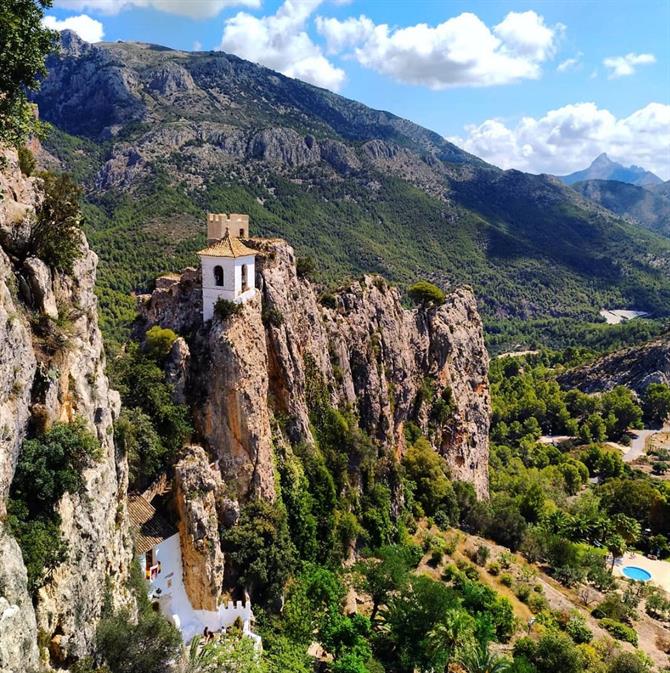
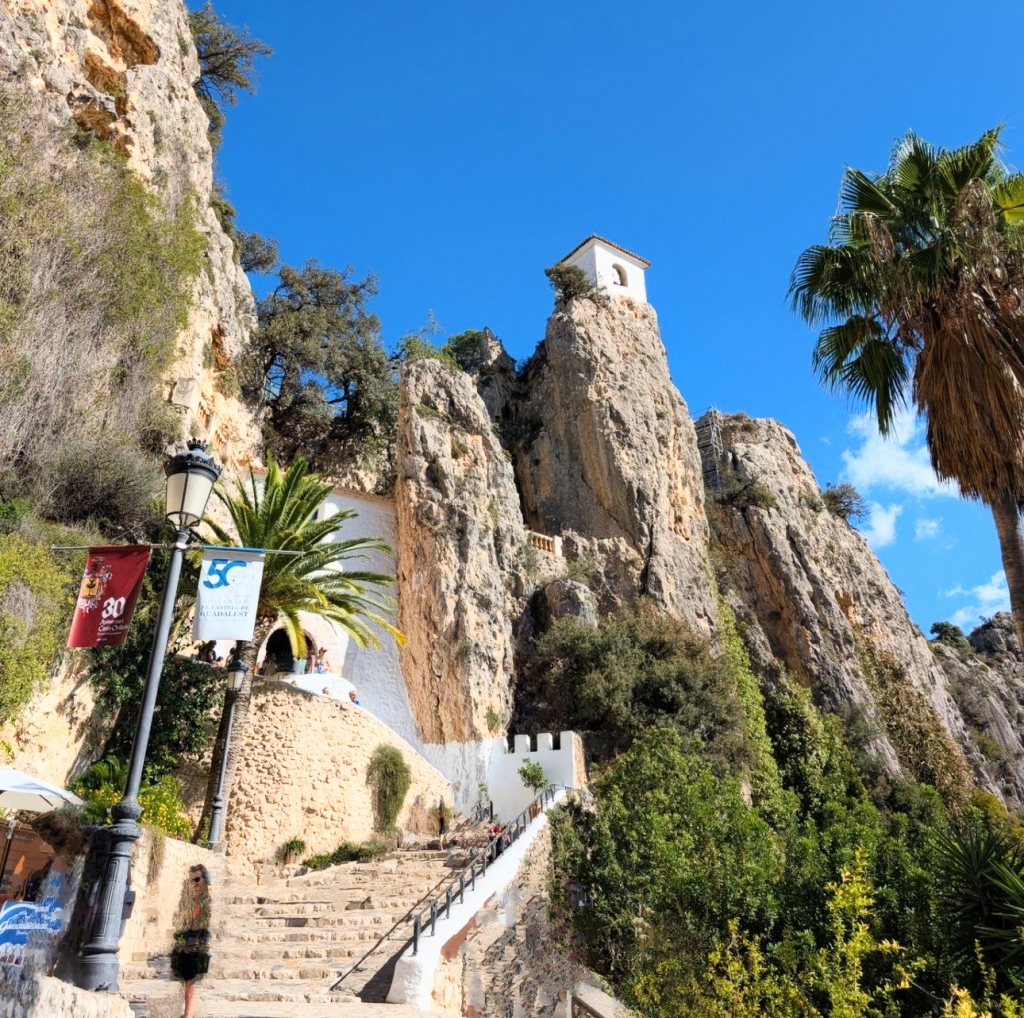
The Bell Tower
Another distinctive feature is the bell tower, which stands apart from the main body of the parish church.
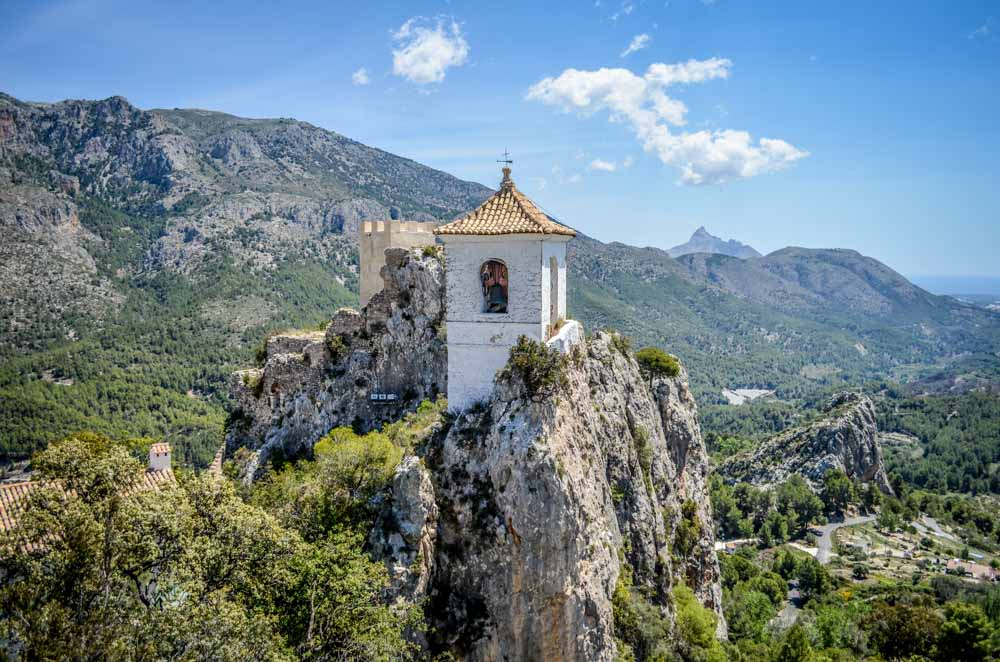
Its position on the rock makes it one of the elements that gives Guadalest its instantly recognisable silhouette.
From different angles, the tower appears almost to emerge directly from the mountain.
It is not necessarily something you need to “visit” as a separate attraction.
Its importance is visual.
Together with the castle ruins and white village buildings, it helps create the layered profile that makes Guadalest so photogenic from outside.
The Church of Nuestra Señora de la Asunción
The parish church occupies a central position in the historic quarter.
The current building dates largely from the 18th century and forms part of the compact ensemble behind the rock tunnel.
It is worth looking inside when open, particularly because the church provides a useful contrast with the ruined military structures above.
Again, Guadalest works best when you do not treat every building as a separate mission.
The church, Casa Orduña, castle and surrounding streets all belong to the same small historic space.
Take them together.
The Best Views in Guadalest
It is difficult to identify one single “best” viewpoint because the landscape changes as you move through the village.
That is actually an advantage.
The First Reservoir Views
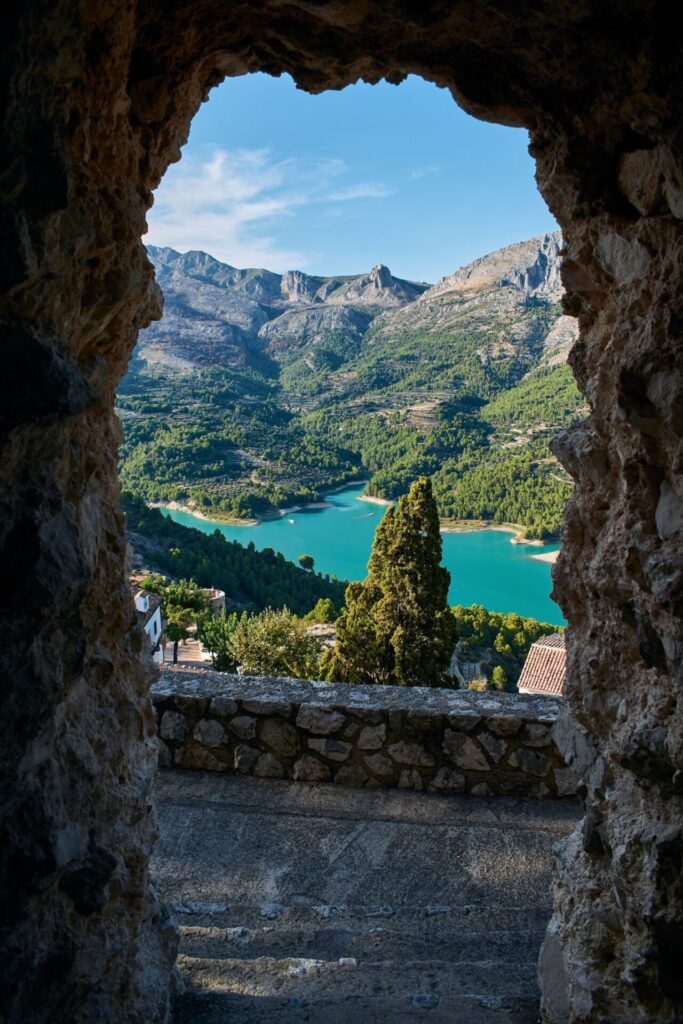
The first clear views over the reservoir are among the most dramatic because they arrive with little warning.
You move through narrow streets and stone walls, then suddenly find an opening where the water appears far below.
The colour can change considerably depending on:
- season;
- rainfall;
- water level;
- cloud cover;
- angle of the sun.
On bright days, the reservoir can appear almost unrealistically turquoise.
At other times, it looks darker and more subdued.
Do not be disappointed if your photograph does not match highly saturated images online.
The real value is the relationship between the water and the surrounding mountains.
Higher Castle Views
The castle area gives you the broadest perspective.
From here, the reservoir becomes only one part of a much larger landscape.
You can appreciate:
- the shape of the valley;
- surrounding ridges;
- agricultural terraces;
- nearby villages;
- the defensive position of Guadalest itself.
This is the viewpoint that best explains the geography of the place.
Look Back at the Village
One common mistake is constantly looking outward.
Some of the most interesting views are actually back toward Guadalest.
From the higher paths, you can see:
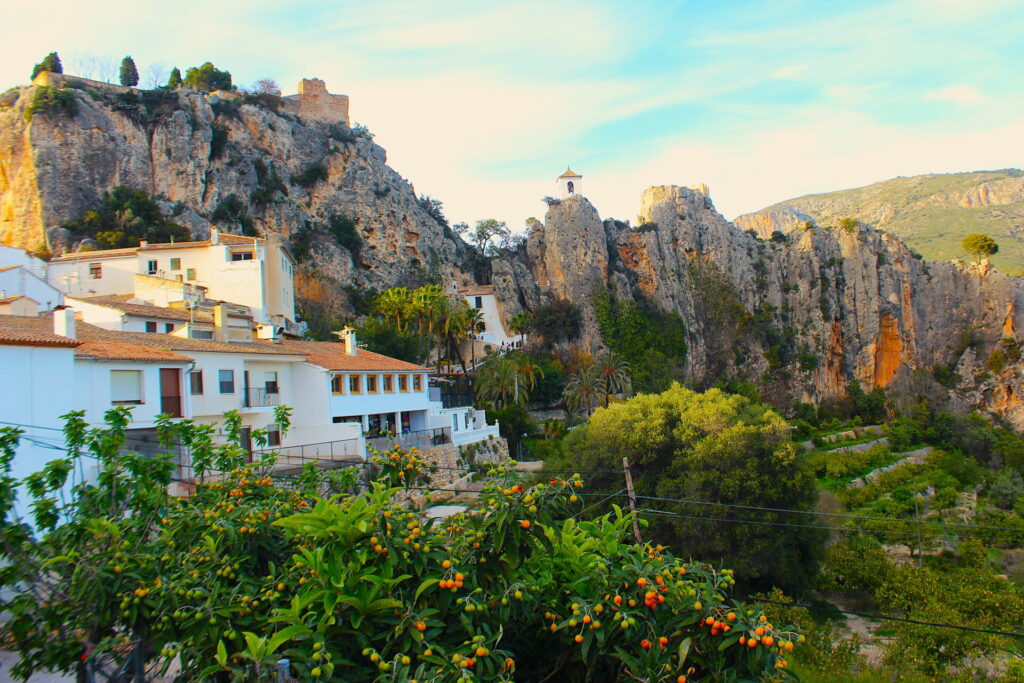
- white houses compressed against the rock;
- the bell tower;
- sections of fortification;
- buildings arranged on different levels.
These perspectives help reveal how unusually the village has been constructed.
Photography Advice
Guadalest is extremely photogenic, but the most famous compositions are also the easiest to reproduce badly.
Midday light can be harsh, especially in summer.
The reservoir may reflect strongly.
Deep shadows appear around the rock and buildings.
Phones usually handle the scene reasonably well, but avoid excessive digital zoom and aggressive filters.
If you have the flexibility, morning or later afternoon light generally gives the landscape more depth.
The other advantage of arriving early is simple:
fewer people in the frame.
Is the Castle Worth Paying For Just for the Views?
For a first visit, yes.
There are free viewpoints around the historic village, so you do not need to pay simply to see the reservoir.
But the paid Casa Orduña/castle experience adds both historical context and higher perspectives.
That makes it much better value than paying only for a conventional viewing platform.
If your budget is very tight, you can still enjoy Guadalest without entering every attraction.
But if you are choosing where to spend your money, Casa Orduña and Castillo de San José should come before the novelty museums for most first-time visitors.
They are the attractions most directly connected to why Guadalest exists in the first place.
And that distinction will become useful in the next part of the guide, because Guadalest has an extraordinary number of museums for such a small village — but they are definitely not all equally essential.
Is the Guadalest Reservoir Worth Visiting?
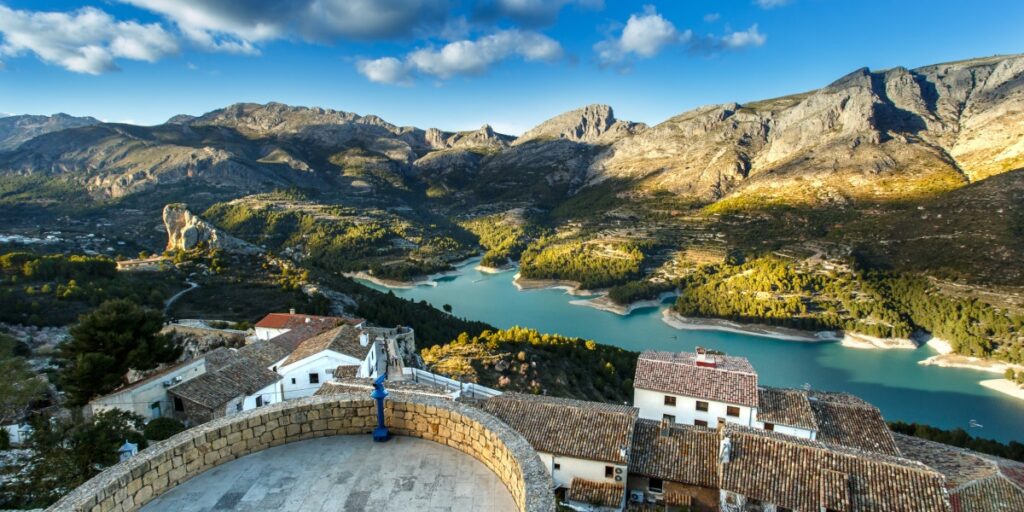
From the historic village, the reservoir is impossible to ignore.
It dominates the valley below, filling the landscape with a broad area of blue-green water surrounded by mountains. For many visitors, that view becomes the defining image of Guadalest.
But there is an important distinction between seeing the reservoir from above and actually visiting the reservoir itself.
Those are two different experiences.
The first is almost unavoidable. You see the water from multiple viewpoints around the historic centre and castle.
The second requires extra time, usually a car, and a deliberate decision to leave the village and descend into the valley.
Is the View from Above Enough?
For many visitors, yes.
If your main objective is to experience Guadalest as a historic mountain village, the viewpoints from the old quarter and castle already provide the most dramatic perspective.
From above, the reservoir becomes part of a much larger composition: mountains, terraced slopes, village architecture and water all fit together.
That is the postcard view.
Going down to the reservoir gives you something different rather than necessarily something better.
The scale changes.
From the village, you look over the entire valley.
From below, the village largely disappears behind the terrain and the reservoir becomes the main subject.
This is useful to understand before adding it automatically to the itinerary.
Why Go Down to the Reservoir?
The best reason is not simply to get closer to the water.
It is to experience the valley from another level.
Once you leave the village behind, the atmosphere becomes much quieter. The tourism infrastructure drops away, traffic decreases and the landscape starts to feel more rural.
That contrast can be especially valuable after spending the morning in a busy historic centre.
The reservoir area works well for:
- a relaxed walk;
- photography;
- a picnic;
- a quieter afternoon;
- appreciating the surrounding mountains from below.
If Guadalest has been crowded, the change in pace can be dramatic.
Walking Around the Reservoir
There are routes around parts of the reservoir and valley, but this should not be confused with a simple paved lakeside promenade.
The terrain is rural, and route conditions can vary.
For most visitors, the best approach is not necessarily to try to complete a long circuit. A shorter walk near the reservoir can provide enough contrast without turning the day into a hiking excursion.
If you want a proper route, check the current trail information before going rather than relying on a generic map screenshot.
The valley is easy to underestimate because the reservoir looks compact from the castle.
Once you are down there, distances feel much larger.
Is It Worth It Without a Car?
Usually, less so.
The village itself can be reached by organised excursion or limited public transport options, but the reservoir is much easier to include if you have your own vehicle.
Without a car, the practical priority should remain the historic village, castle and museums.
Trying to add the reservoir may create more logistical effort than the experience justifies.
Best Time to Visit the Reservoir
Late afternoon can be especially attractive.
The light becomes softer, the mountains gain more depth and the water often reflects the sky more effectively than under harsh midday sun.
This also fits naturally into the day.
Visit the village in the morning.
Have lunch.
Then descend into the valley when the main tourist pressure begins to ease.
In summer, however, heat matters.
The reservoir area can be very exposed, so a long afternoon walk at the hottest time of day is not a good idea.
Should You Swim?
Do not assume the reservoir functions like a recreational lake.
Reservoirs are managed infrastructure, and access or permitted activities can change according to water levels, safety measures and local regulations.
The attraction here is the landscape, not a guaranteed swimming stop.
If swimming is important to your day, the Costa Blanca coast offers much easier and more appropriate options.
Reservoir or Another Museum?
If you have limited time, choose according to what you want from the day.
Choose the reservoir if you want:
- more landscape;
- quiet;
- photography;
- walking;
- a break from crowds.
Choose another museum if you want:
- culture;
- local history;
- something indoors;
- a more structured visit.
There is no need to do both simply because they exist.
That kind of over-planning is exactly what can make Guadalest feel less enjoyable.
Guadalest’s Museums: Which Ones Are Actually Worth It?
Guadalest has an extraordinary number of museums for such a small village.
That is part of its charm.
It is also one of the easiest ways to lose perspective.
If you walk through the lower streets without a plan, almost every few minutes another sign seems to advertise a different collection.
Some are genuinely connected to Guadalest’s history.
Others are highly specialised.
A few are best understood as curiosities.
The right approach is not to ask:
“How many museums can I fit into the day?”
A better question is:
“Which one or two will actually improve my understanding or enjoyment of Guadalest?”
Casa Orduña
For a first visit, this remains the most important museum.
Its value comes from context.
It explains the social and political history of Guadalest, shows how an influential local family lived and forms part of the route toward the castle.
If you only enter one museum, this is the safest choice.
It is the museum most directly connected to the identity of the village.
Ethnological Museum
The Museo Etnológico is another strong option for visitors interested in how people actually lived in the valley.
Instead of focusing on nobles, fortifications or dramatic views, it looks at everyday life, traditional work and domestic culture.
That gives it a very different role from Casa Orduña.
For long-stay visitors, this kind of museum can be particularly valuable because it adds context to rural Alicante beyond tourism.
You begin to understand the relationship between the landscape and the people who depended on it.
If local culture interests you more than unusual collections, this is one of the better choices.
Microminiatures and Microgigante
These are among Guadalest’s most famous curiosity museums.
The idea is simple and very different from conventional heritage attractions.
Tiny works and miniature objects are displayed so that visitors need magnification to appreciate them properly.
For some people, this becomes one of the most entertaining parts of the day.
For others, it feels completely optional.
That is exactly how these museums should be treated.
They are not essential to understanding Guadalest.
They are there because they are unusual.
If you enjoy miniature art, optical curiosities or attractions you are unlikely to see elsewhere, they can be fun.
If you are short on time, you lose nothing by skipping them.
Museum of Historic Vehicles
The Museo de Vehículos Históricos Vall de Guadalest is located outside the historic centre rather than inside the main village experience.
It focuses on motorcycles, cars and other vehicles from earlier decades.
This is a much more specialised attraction.
For anyone interested in classic vehicles, it can easily justify the extra stop.
For everyone else, it is less essential than the castle, Casa Orduña or the reservoir.
The important thing is not to confuse specialist appeal with universal importance.
Medieval Historical Museum
Guadalest also has a museum focused on medieval instruments of punishment and torture.
This is probably the most polarising attraction in the village.
Some visitors find the subject fascinating.
Others find it unpleasant or sensationalist.
It is certainly not necessary for understanding Guadalest.
If the topic interests you, it is there.
If it does not, skip it without feeling that you have missed an essential historical experience.
The Dollhouses and Miniatures Museum
Another of the village’s niche collections focuses on dollhouses and miniature scenes.
Like the microminiature museums, this is more about personal interest than historical importance.
Families, collectors or people who enjoy detailed miniature craftsmanship may love it.
Others may prefer to spend the same time sitting at a viewpoint.
Both choices are valid.
Why Does Guadalest Have So Many Museums?
Part of the explanation is tourism.
Guadalest receives far more visitors than its resident population would suggest.
Over time, specialised attractions developed around that visitor flow.
The result is unusual.
Instead of one large municipal museum dominating the cultural offer, you find many smaller private collections competing for attention.
This gives Guadalest a slightly eccentric personality.
The museum scene is not polished in the way you might expect in a large heritage city.
It feels more individual.
Sometimes quirky.
Occasionally old-fashioned.
But that is part of the experience.
How Many Museums Should You Visit?
For most first-time visitors:
one or two is enough.
A very balanced combination would be:
Casa Orduña + Ethnological Museum
if you are interested in history.
Or:
Casa Orduña + one curiosity museum
if you want a mixture of heritage and entertainment.
Visiting four or five museums in a row can make them blur together and leaves less time for the thing Guadalest does best: being outside and looking at the landscape.
What If the Weather Is Bad?
This is where the museum concentration becomes a real advantage.
On a cloudy, windy or rainy day, Guadalest remains more viable than many outdoor destinations.
You can move between:
- Casa Orduña;
- ethnological collections;
- miniature museums;
- cafés;
- shops.
The views may be less dramatic, but the village still offers enough indoor content to justify the trip.
This makes Guadalest more weather-resistant than a pure hiking destination.
Are the Museums Expensive?
Individually, most smaller museums are relatively inexpensive.
The problem comes when you start adding several together.
A few euros here and a few euros there can turn a low-cost village visit into a surprisingly expensive afternoon.
That is another reason to choose deliberately.
Do not pay simply because a museum happens to be on the next street.
Ask whether the subject genuinely interests you.
The Best Approach for a First Visit
A good first visit should still revolve around the village itself.
The museums are supporting experiences.
They should deepen the day, not dominate it.
A very natural sequence would be:
start with the historic quarter and viewpoints;
visit Casa Orduña and the castle;
have lunch;
choose one additional museum if something genuinely appeals to you;
then either descend toward the reservoir or simply spend more time enjoying the village.
That leaves space in the day.
And Guadalest benefits from space.
It is much easier to appreciate the setting when you are not constantly checking whether you still have time for museum number six.
How to Get There from Benidorm
Guadalest is close enough to Benidorm to feel easy, but far enough inland for the journey to feel like a real change of scenery.
That balance is one of its strengths.
You do not need to organise an expedition, yet the landscape changes so much on the way that the day quickly stops feeling like an extension of Benidorm.
For most visitors, the car is the simplest option.
By Car
Driving from Benidorm usually takes around 30 to 40 minutes, depending on your starting point and traffic.
The route heads inland through the Marina Baixa and gradually climbs toward the Guadalest Valley.
It is not a difficult drive, but it is much more rural and winding than the coastal roads around Benidorm.
That is part of the appeal.
As you gain altitude, apartment blocks disappear, mountains become increasingly dominant and small inland settlements begin to replace the urban coastline.
By the time you reach Guadalest, the Mediterranean feels surprisingly far away.
Is the Road Difficult?
Not for an average driver.
The roads are paved and Guadalest receives a large number of visitors, including coaches.
There are bends and elevation changes, but this is normal mountain-road driving rather than a difficult or technical route.
The main thing is to avoid rushing.
Cyclists are common in the area, and slower vehicles or coaches can occasionally reduce speeds.
If you leave Benidorm with enough time, there is no reason for the drive to feel stressful.
Parking in Guadalest
Parking areas are concentrated around the lower part of the village, before you climb toward the historic centre.
This is another reason the visit is easy to understand.
You park below.
Then you explore on foot.
During quieter periods, finding a space is normally straightforward.
At busy times, especially summer weekends and peak excursion hours, the car parks can become much more crowded.
Arriving early therefore solves two problems at once:
you find parking more easily and experience the historic quarter before the largest groups arrive.
Once parked, there is little reason to move the car until you have finished the village visit.
By Organised Excursion
Guadalest is one of the most common organised excursions from Benidorm.
For visitors who do not drive, this can be the easiest solution.
A typical excursion removes several practical problems at once:
- no mountain driving;
- no parking;
- no need to coordinate limited transport;
- direct return to Benidorm.
The disadvantage is equally obvious.
You lose control of the schedule.
If the group gives you two hours in Guadalest, you have two hours.
That may be enough to walk through the village, see the main viewpoints and perhaps visit one attraction.
It is less suitable if you want to:
- take your time at Casa Orduña;
- eat slowly;
- visit several museums;
- descend toward the reservoir;
- wait for crowds to disappear.
For a short-stay tourist, an organised excursion can be perfectly sensible.
For someone spending several weeks or months in Benidorm, independent travel usually gives you a better experience if you have access to a car.
Can You Get There by Public Transport?
This is where Guadalest becomes less convenient.
Unlike Altea, Alicante or El Campello, Guadalest is not connected to Benidorm by a simple high-frequency rail service.
Public transport options into the valley are much more limited and can change according to season or timetable.
That means you should not assume that because Guadalest is geographically close, it is easy to reach independently without a car.
If you are relying on buses, check the current timetable shortly before travelling and pay particular attention to the return service.
Missing the last useful connection in a mountain village creates a much bigger problem than missing a TRAM along the coast.
For most non-drivers, an organised excursion is therefore often more practical than trying to build the entire day around sparse public transport.
Car or Tour: Which Is Better?
For this particular guide, the choice is fairly clear.
Choose a car if you want:
- maximum flexibility;
- an early arrival;
- the reservoir;
- a long lunch;
- additional museums;
- nearby villages or viewpoints;
- the ability to leave when you want.
Choose an organised tour if you want:
- simple transport;
- no driving;
- a relatively short visit;
- the main Guadalest experience without logistical planning.
Neither option is automatically better.
The important thing is matching the transport to the kind of day you actually want.

Planning Your Visit
Guadalest is small enough that planning may seem unnecessary.
In reality, timing has a huge effect on the experience.
A quiet morning in Guadalest and a busy midday visit can feel like two completely different places.
How Long Do You Need?
For the historic village alone, around three hours is a comfortable minimum for a first visit.
That gives you time to walk through the old quarter, enjoy the viewpoints and visit Casa Orduña and the castle without constantly checking the clock.
If you add one or two museums and lunch, the visit easily becomes four to five hours.
Add the reservoir or more of the valley and Guadalest becomes a full-day excursion.
This flexibility is useful.
You do not need to decide in advance that the trip must last exactly six hours.
A good strategy is to leave Benidorm early and allow the day to expand naturally.
Best Time of Day
Early morning is the strongest recommendation.
Guadalest’s popularity means coach groups and day visitors become increasingly noticeable as the morning progresses.
Arriving around the opening period of the main attractions gives you a chance to walk through the historic streets before they become busiest.
The difference can be substantial.
A narrow medieval access route that feels atmospheric with ten people can feel completely different with several large groups moving through it at once.
Early arrival also improves photography.
You are more likely to find clear viewpoints and quieter streets.
What If You Cannot Arrive Early?
Late afternoon can also work well, particularly outside winter.
Some day-trip groups begin leaving after the main lunch period, and the village can regain some of its quieter character.
The limitation is opening hours.
Museums and heritage attractions generally close before the village itself becomes empty.
So late afternoon is better for:
- walking;
- viewpoints;
- photography;
- atmosphere.
Morning is better if you want to see the interiors.
Best Days to Visit
If you have flexibility, choose a weekday.
Weekends naturally attract more local visitors in addition to international tourists.
Public holidays can be particularly busy.
This does not mean you should avoid Guadalest entirely on a Saturday.
It simply means you should compensate by arriving earlier.
For someone working remotely from Benidorm, this is one of the advantages of a flexible schedule.
A Tuesday morning can provide a noticeably better experience than Sunday lunchtime.
Best Time of Year
Guadalest works throughout the year, but each season changes the character of the visit.
Spring
Probably one of the best overall periods.
The temperatures are comfortable, the surrounding landscape is greener and walking around the village or reservoir is much easier than in midsummer.
Summer
Summer is perfectly viable, but crowds and heat become the main problems.
The old village offers some shade between buildings, but viewpoints and the castle areas can be exposed.
An early start becomes especially valuable.
The combination of heat, narrow streets and large midday groups can make the village feel much less attractive than it really is.
Autumn
Another excellent period.
Temperatures become more comfortable, the strongest summer tourism drops away and the valley often feels much calmer.
For long-stay residents, autumn may be one of the best times to discover Guadalest.
Winter
Winter can be surprisingly rewarding.
The mountains may feel much cooler than Benidorm, but clear winter days can provide excellent visibility.
There are also fewer visitors.
Bring an extra layer and do not assume that the temperature in Benidorm accurately represents conditions inland and at higher elevation.
What Should You Bring?
You do not need specialist equipment.
Comfortable footwear is the most important thing because Guadalest involves:
- slopes;
- steps;
- uneven historic surfaces;
- castle paths.
Normal trainers are sufficient for most people.
Bring water, particularly in summer, although cafés and shops make resupply easy.
Sun protection is useful for the exposed viewpoints.
And if photography matters to you, make sure your phone or camera has enough battery before reaching the castle rather than discovering at the best viewpoint that you have spent it all on the lower streets.
Accessibility
Guadalest’s geography creates genuine limitations for visitors with reduced mobility.
The historic fortified area includes steep streets, steps and terrain that cannot simply be redesigned without altering the site itself.
However, the municipality identifies several attractions and areas as accessible, including the Museum of Salt and Pepper Shakers, Micro-Gigante Museum, Antonio Marco Museum, Historic Vehicle Museum and the reservoir dam. Accessible parking spaces are also provided around the Tourist Info area.
Anyone with significant mobility requirements should therefore plan the visit around accessible attractions rather than assuming that the entire castle route will be practical.

Food and What Else to Do Nearby
Guadalest has enough cafés and restaurants to make lunch easy, but food is another area where a little planning improves the experience.
The village receives large numbers of day visitors, and restaurants around the main tourist streets naturally serve that market.
That does not mean you cannot eat well.
It simply means you should avoid automatically choosing the first terrace you see because you are hungry.
Eating in Guadalest
The current municipal visitor guide lists a substantial range of restaurants and cafés, both in the village itself and along the roads through the surrounding valley.
You can find everything from sandwiches, tapas and simple menus to more substantial traditional meals.
For a relaxed visit, lunch works particularly well after completing the castle and main historic quarter.
By that point, you have already seen the essential sights and no longer need to worry about rushing to an attraction before it closes.
Sit down.
Take your time.
Then decide whether you still want another museum or whether the reservoir sounds more appealing.
That flexibility makes the afternoon much more enjoyable.
What Kind of Food Fits the Area?
Guadalest sits inland enough for mountain cuisine to make sense.
Rice remains important, as you would expect in Alicante province, but the valley also suits dishes based on meat, stews and traditional local ingredients.
Regional products such as:
- honey;
- jams;
- wines;
- liqueurs;
- olive products
appear frequently in local shops and restaurants.
The municipality’s current business listings specifically highlight local honey, jams, wines and liqueurs among the regional products sold in Guadalest.
This is one area where the souvenir trade and genuine local food culture overlap.
Not every bottle with a picturesque label is necessarily an essential purchase, but local agricultural products make more sense as souvenirs than another generic refrigerator magnet.
Do You Need a Reservation?
For a casual café or simple lunch, usually not.
For a particular restaurant, larger group or busy weekend, reserving can be sensible.
Current municipal restaurant listings show that requirements vary by establishment: some accept casual walk-ins while others explicitly recommend or require reservations.
If lunch is an important part of your day rather than something you will improvise, booking removes uncertainty.
How Much Should You Budget?
Guadalest can be either a very inexpensive excursion or a surprisingly costly one.
The village itself costs nothing to walk around.
The spending begins when you add:
- parking;
- Casa Orduña and castle access;
- several private museums;
- lunch;
- drinks;
- souvenirs.
The biggest trap is usually not one expensive attraction.
It is accumulating many small costs.
A museum ticket here.
Another one there.
Coffee.
Parking.
A bottle of local liqueur.
Lunch.
Suddenly a cheap mountain excursion is no longer particularly cheap.
For a sensible first visit, I would budget approximately:
€20–€35 per person for a fairly economical day with one main paid attraction and simple food.
A more comfortable day with several attractions and a restaurant lunch could easily reach €40–€60+ per person.
These are planning ranges rather than fixed prices, but they help keep expectations realistic.
Should You Buy Souvenirs?
Only if something genuinely interests you.
Guadalest has a high concentration of souvenir shops, and browsing them can be part of the experience.
Local honey, jams and regional products make more sense than buying something generic simply because you are there.
There is no need to treat shopping as another attraction that must be completed.
What Else Can You Combine with Guadalest?
The reservoir is the most obvious extension because it belongs directly to the landscape you have been looking at all morning.
But if you have a car and a full day, the wider valley offers other possibilities.
Nearby mountain villages such as Benimantell, Beniardà and Benifato can provide a quieter counterpoint to Guadalest’s tourism.
You do not necessarily need another formal attraction.
Sometimes simply driving through the valley, stopping for coffee or taking a short walk gives you more understanding of the area than adding another museum.
This is especially worthwhile for long-stay visitors.
There is no requirement to maximise the number of sights.
The real advantage of having the whole day is that you can allow Guadalest to lead naturally into the surrounding landscape rather than treating it as an isolated tourist stop.
The Best Overall Strategy
For a first visit from Benidorm, I would organise the day around one simple principle:
do the most popular part before it becomes popular.
Arrive early.
Enter the historic quarter.
Visit Casa Orduña and the castle.
Enjoy the main viewpoints.
Only then slow the day down.
Choose a museum if one genuinely interests you.
Have lunch.
Explore the reservoir or valley afterwards.
That order gives Guadalest its best chance to show you why it became famous before the crowds, shops and busy terraces begin competing for your attention.
Common Mistakes
Guadalest is easy to visit, but it is also easy to experience badly.
The most common problem is trying to consume it too quickly. Because the historic centre is compact, visitors often assume they can “do Guadalest” in an hour. Technically, you can walk through the old quarter, take a photograph of the reservoir and leave in that time.
But that version of the visit misses almost everything that gives the place depth.
Guadalest works better when you allow the village to unfold gradually.
Arriving at the Busiest Time of Day
Midday is often when Guadalest feels most crowded.
Coach groups, independent visitors and lunch traffic can all overlap.
The narrow streets amplify that pressure because there is very little space for people to spread out.
Arriving earlier changes the experience dramatically.
You can pass through the rock tunnel without a queue, enjoy the castle area with fewer people and take photographs from the viewpoints without constantly waiting for others to move.
Trying to Visit Every Museum
Guadalest’s museum concentration can make the village feel like a challenge.
It is not.
You do not need to collect museums.
Choose one or two that genuinely interest you and leave the rest.
For most first-time visitors, Casa Orduña should remain the priority because it connects directly with the village’s history and the castle.
After that, choose according to personal interest rather than fear of missing something.
Ignoring the Village Because of the Reservoir
The reservoir is beautiful, but Guadalest is not simply a viewing platform above blue water.
The tunnel, historic houses, castle ruins and defensive position are what make the village distinctive.
If you spend the entire visit searching for the perfect reservoir photograph, you miss the architectural logic of the place.
Assuming the Castle Is a Complete Fortress
The Castillo de San José is a ruin.
That does not make it disappointing, but expectations matter.
Do not arrive imagining furnished medieval halls, towers and reconstructed interiors.
The value comes from the remains, the position and the views.
Visiting Only with a Tour Group and Assuming You Have Seen Everything
Organised excursions are convenient, especially for non-drivers.
But their schedules usually prioritise the core village experience.
If you enjoyed Guadalest on a short tour, it can still be worth returning independently later to explore the reservoir, museums or valley more slowly.
Treating Souvenir Shopping as Part of the Sightseeing Checklist
There are many shops.
Browse them if you enjoy it.
Buy local products if something appeals to you.
But do not let souvenir stops consume the time you could spend on the castle, views or village itself.
Forgetting That Guadalest Is Cooler Than Benidorm
The village is inland and higher than the coast.
In winter or on windy days, the temperature difference can be noticeable.
A sunny morning in Benidorm does not always mean T-shirt weather in Guadalest.
Underestimating the Heat in Summer
The opposite applies in July and August.
Castle paths and viewpoints are exposed.
The historic streets provide some shade, but climbing around at midday can still become uncomfortable.
Water, sun protection and an early start make a major difference.
Planning Too Much
This is perhaps the most subtle mistake.
A timetable containing:
- castle;
- Casa Orduña;
- four museums;
- reservoir;
- lunch;
- neighbouring villages;
- shopping
may look efficient.
In reality, it can turn Guadalest into a sequence of appointments.
Leave some empty time.
That is when you notice the place.
Suggested Half-Day and Full-Day Itineraries
Guadalest works very well as a half-day excursion, but long-stay visitors can get considerably more from it by allowing a full day.
Half-Day: The Essential Guadalest Experience
Leave Benidorm early and aim to arrive before the busiest period.
Start in the lower village and walk directly toward the historic entrance rather than spending too much time in shops.
Pass through the rock tunnel and take a few minutes to absorb the layout of the old quarter.
Visit Casa Orduña and continue toward the Castillo de San José.
Spend time at the upper viewpoints rather than simply taking one photograph and descending.
After the castle, wander through the historic centre and choose one additional museum only if something genuinely interests you.
Finish with coffee or an early lunch before returning to Benidorm.
This gives you the most important parts of Guadalest without making the visit feel rushed.
Full Day: Village, Lunch and Reservoir
For someone staying in Benidorm for several weeks or months, this is the version I would recommend.
Arrive early enough to experience the historic centre before the main crowds.
Spend the morning exploring Casa Orduña, the castle and the viewpoints.
If you want another museum, add it before lunch.
Then stop.
Have a proper meal.
Do not immediately move on to another attraction.
After lunch, return to the car and descend into the valley toward the reservoir.
Spend the afternoon walking, photographing the landscape or simply enjoying the quieter environment below the village.
If you still have energy, drive through one or two of the smaller nearby villages before returning to Benidorm.
The contrast is what makes this version work.
The morning is historic and busy.
The afternoon is rural and slower.
A Rainy-Day Version
Guadalest remains surprisingly practical when the weather is poor.
You lose some of the landscape impact, but the concentration of museums becomes an advantage.
Start with Casa Orduña, then choose one or two additional indoor attractions.
Have lunch in the village and leave the reservoir for another day.
This makes Guadalest a much more resilient day-trip option than destinations dependent entirely on hiking or beach weather.
Is Guadalest Worth Visiting for Digital Nomads?
Yes.
In fact, Guadalest is almost ideally suited to long-stay residents because it offers a strong sense of escape without requiring complicated planning.
You can leave Benidorm in the morning, spend the day in a completely different environment and still be back by evening.
That makes it easy to fit into a remote-work lifestyle.
Can You Work There?
Technically, yes.
Practically, I would not recommend building the day around it.
There are cafés and places where you could open a laptop, but Guadalest is much better used as a genuine break from work.
The main value comes from changing environment, walking, looking outward and spending several hours away from screens.
If you urgently need to answer messages, you can.
But this is not a destination where remote work improves the experience.
Should You Bring Your Laptop?
Probably not.
Unless you have a specific reason to work later, leave it in Benidorm.
The village involves steps, slopes, crowds and changing locations.
Carrying expensive equipment adds responsibility without providing much benefit.
Who Will Enjoy Guadalest Most?
Guadalest has broad appeal because it combines history, scenery and easy sightseeing.
It works particularly well for people who enjoy:
- historic villages;
- mountain landscapes;
- photography;
- castles and ruins;
- local museums;
- slow day trips;
- places with a strong sense of setting.
It is also a very good choice for visitors who want dramatic scenery without committing to a serious hike.
Who Might Be Disappointed?
Visitors expecting an untouched medieval village may find the tourism infrastructure distracting.
There are plenty of shops, signs, museums and coach groups.
People who strongly dislike popular destinations may struggle with that.
The village may also feel small to someone expecting a large historic town.
And if you arrive at the busiest time, spend twenty minutes at the viewpoint and leave, you may wonder why everyone makes such a fuss.
Guadalest rewards timing and attention.
Is It Too Tourist-Oriented?
Yes and no.
Tourism is impossible to ignore.
But the village has not become famous because someone invented a clever marketing campaign around an ordinary place.
The underlying setting really is exceptional.
The castle really does occupy a dramatic position.
The reservoir really does transform the valley.
The history is real.
The better way to think about it is that tourism sits on top of a genuinely worthwhile destination.
Your job as a visitor is simply not to let the tourism infrastructure become the entire experience.
BenidormNomads Verdict
Guadalest is one of the easiest Costa Blanca day trips to recommend because it combines immediate visual impact with enough history and variety to justify more than a quick stop.
Scenery: 9.5/10
The setting is exceptional.
The reservoir, mountain ranges and castle combine into one of the most distinctive inland landscapes near Benidorm.
Historic Interest: 9/10
The Muslim origins, feudal history, earthquakes, Casa Orduña and surviving fortifications provide much more depth than the village’s size initially suggests.
Accessibility from Benidorm: 9/10
By car, Guadalest is very easy to reach.
Organised excursions also make it accessible for non-drivers, although independent public transport is less convenient.
Value for Money: 9/10
The village itself and its main views are free.
You only spend significantly more if you begin adding multiple museums, a restaurant meal and shopping.
Photography: 9.5/10
One of the strongest destinations in the series for general travel photography.
The reservoir, castle, white houses and mountains provide an enormous range of compositions.
Walking Experience: 7.5/10
There is plenty of walking around the village, but this is not primarily a hiking destination.
Adding the reservoir improves the walking possibilities.
Cultural Variety: 9/10
Few villages of this size offer such an unusual range of museums and heritage attractions.
Crowd Management: 6.5/10
This is the main weakness.
At peak times, Guadalest can become very busy.
Arriving early makes a substantial difference.
Food and Nearby Facilities: 8.5/10
There are plenty of places to eat and drink, although the tourism focus means it is worth choosing carefully.
Remote Work Compatibility: 5/10
You can work if necessary, but there is little reason to make Guadalest part of a workday.
It is much better as a real break.
Atmosphere: 9/10
When the crowds are manageable, the combination of rock, old buildings and mountain views gives the village a very strong identity.
Overall Rating: 9.1/10
Guadalest deserves its popularity.
It is not perfect, and tourism can occasionally overwhelm the small historic centre, but the underlying village remains one of the strongest inland excursions from Benidorm.
Is Guadalest Really Worth the Trip from Benidorm?
Yes.
And unlike some famous attractions, Guadalest does not require much qualification.
The journey is short.
The scenery is genuinely impressive.
The historic centre is unusual.
The castle adds context rather than simply providing another viewpoint.
Casa Orduña gives the village human history.
And the reservoir allows you to turn a compact sightseeing visit into a much more complete inland day.
The main risk is not that Guadalest will disappoint you.
The main risk is visiting it badly.
Arrive at midday with several coach groups, rush through the tunnel, take the same reservoir photograph as everyone else and leave after an hour, and you may come away thinking the village is attractive but overhyped.
Arrive early, walk slowly, visit the castle, choose your museums carefully and allow the valley to become part of the experience, and Guadalest makes far more sense.
For someone spending weeks or months in Benidorm, it should be very high on the list.
Not because it is one of the excursions everyone tells tourists to take.
But because within a short drive you can move from the dense Mediterranean coast into a mountain settlement whose entire history has been shaped by rock, altitude and isolation.
That contrast is exactly what a good day trip from Benidorm should provide.