
Cova Tallada is one of those places that immediately creates expectations.
A sea cave hidden beneath limestone cliffs.
Rocky Mediterranean water entering directly into its chambers.
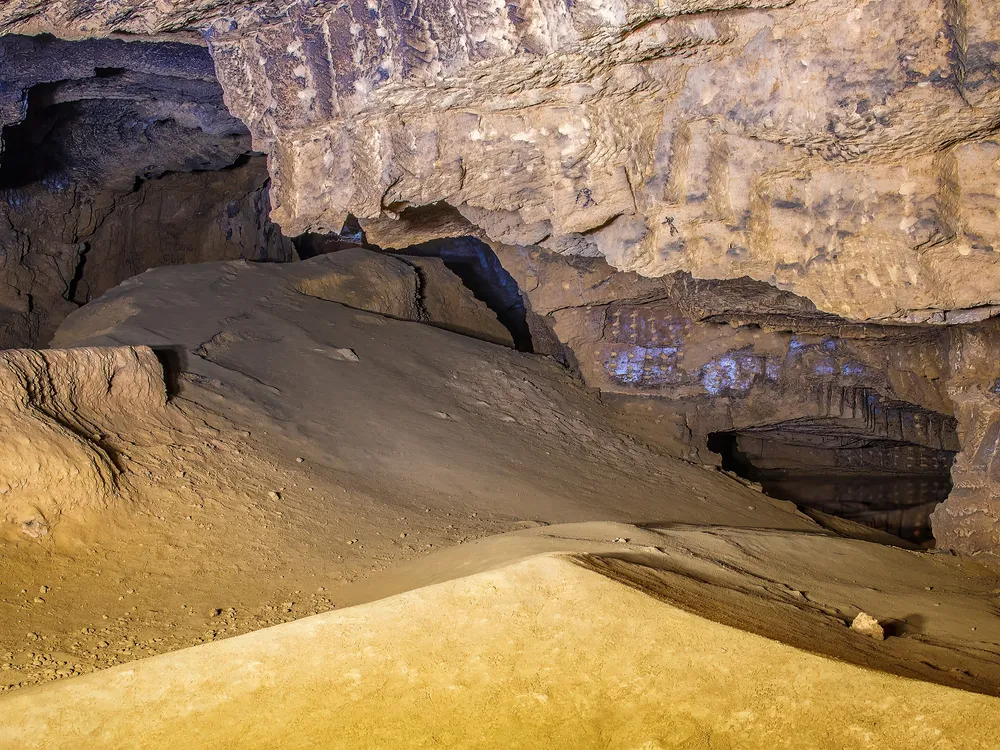
Dark interior spaces cut into the mountain.
And an approach that requires either a coastal hike or a journey by kayak.
It sounds like an adventure.
And, to a certain extent, it is.
But Cova Tallada is also a destination where expectations need to be managed carefully.
This is not an easy-access cave with lighting, walkways and guided interior routes. There are no ticket barriers, polished paths or visitor facilities waiting at the entrance.
Nor is it simply a picturesque cove where you can arrive in sandals, swim for an hour and leave.
Cova Tallada sits in a protected section of coastline beside Montgó Natural Park and within the marine environment of Cape San Antonio. Reaching it requires some effort, conditions at the entrance can change with the sea, and seasonal access regulations mean that visitors cannot always turn up without planning.
That makes it completely different from Canelobre Caves.
Canelobre is a developed underground attraction.
Cova Tallada is a natural coastal experience.
And that distinction should shape the entire day.
For someone staying in Benidorm, the main question is therefore not simply whether the cave is beautiful.
It is whether the combination of travel, hiking or kayaking, physical effort and environmental conditions is worth it.
For many people, the answer will be yes.
But not for everyone.
What Is Cova Tallada?
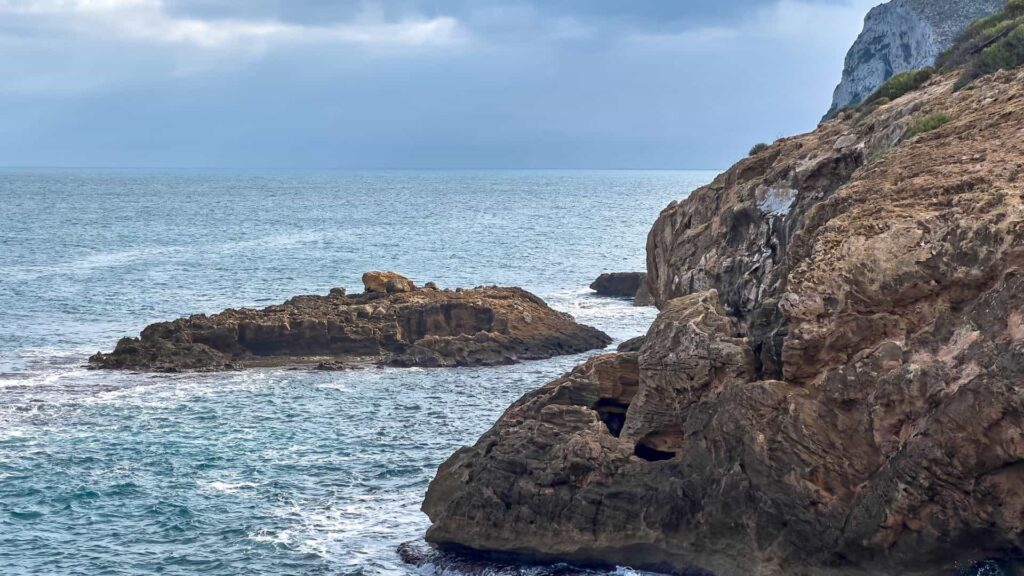
Cova Tallada is a large sea cave carved into the limestone coastline between Dénia and Xàbia, on the eastern side of Montgó.
Its entrance opens directly towards the Mediterranean, giving the cave an unusually dramatic setting.
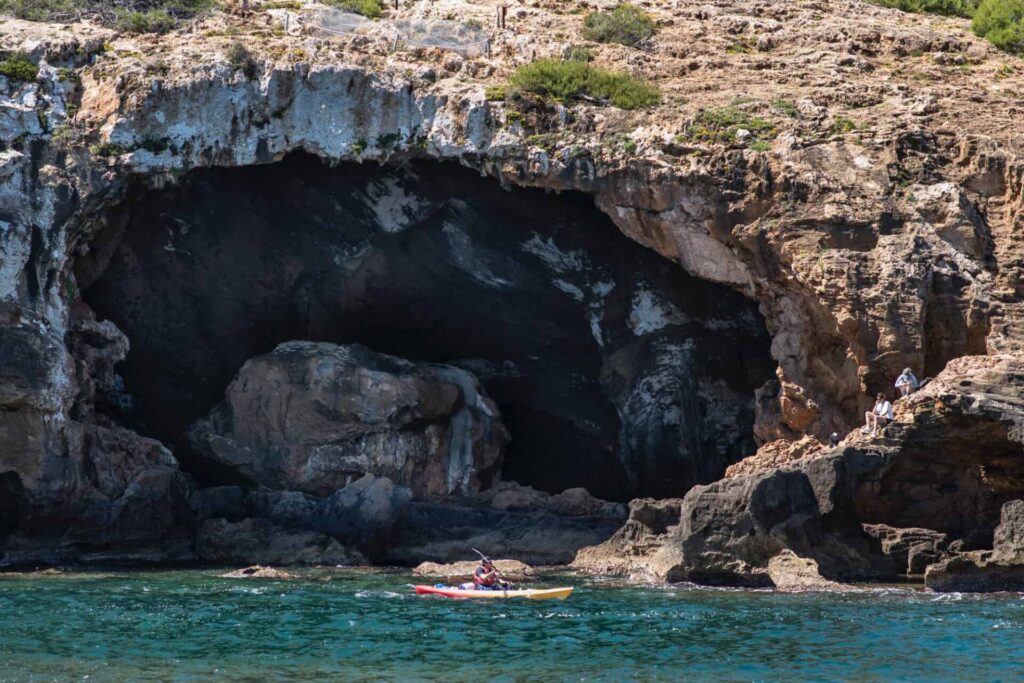
From the sea, the cliffs appear almost continuous until the dark entrance becomes visible in the rock.
From land, the approach follows a rugged coastal path above and beside the cliffs before descending towards the cave.
Both perspectives feel very different.
The sea approach emphasises the scale of the coastline.
The hiking route emphasises the remoteness of the location.
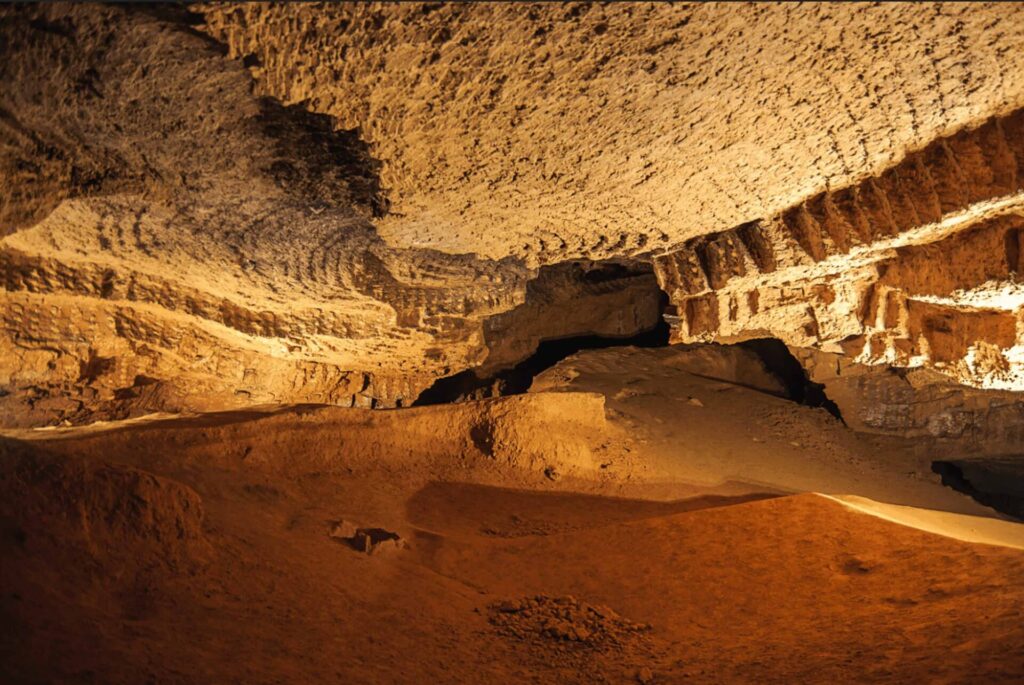
Once inside, the cave becomes even more unusual because it is not entirely natural.
Its shape has been modified over centuries by stone extraction.
That combination of geology and human activity is what gives Cova Tallada its distinctive appearance.
More Than a Single Chamber
Cova Tallada is not simply one open cavern.
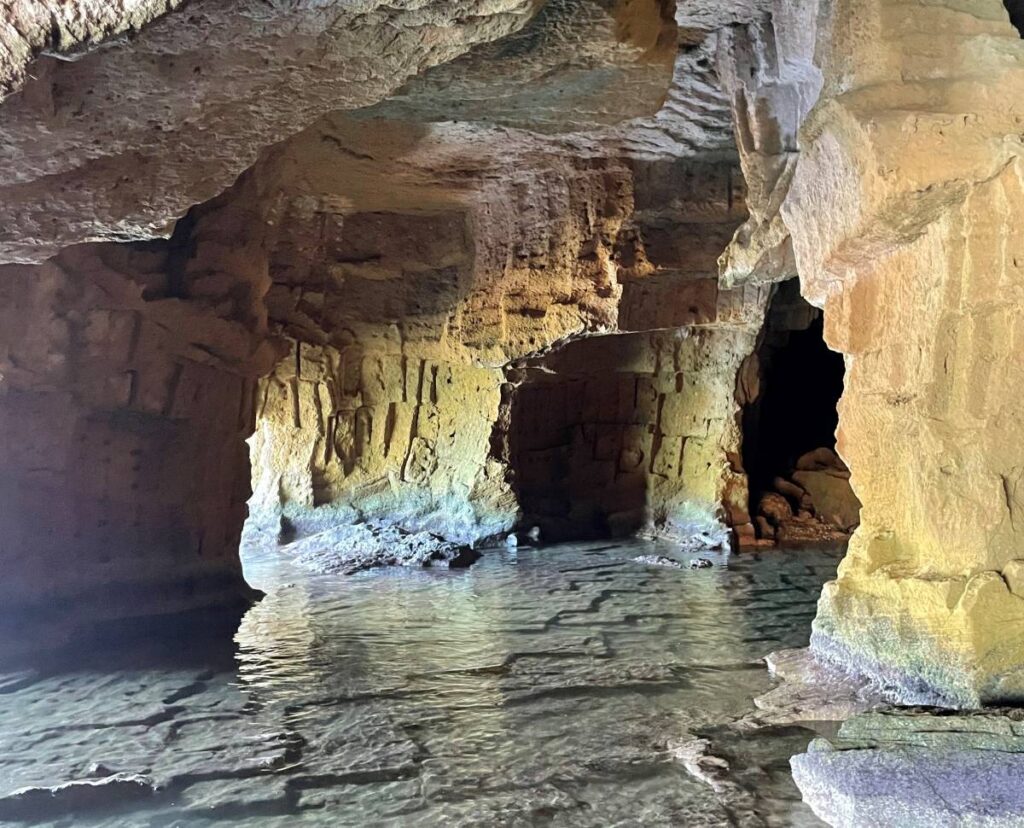
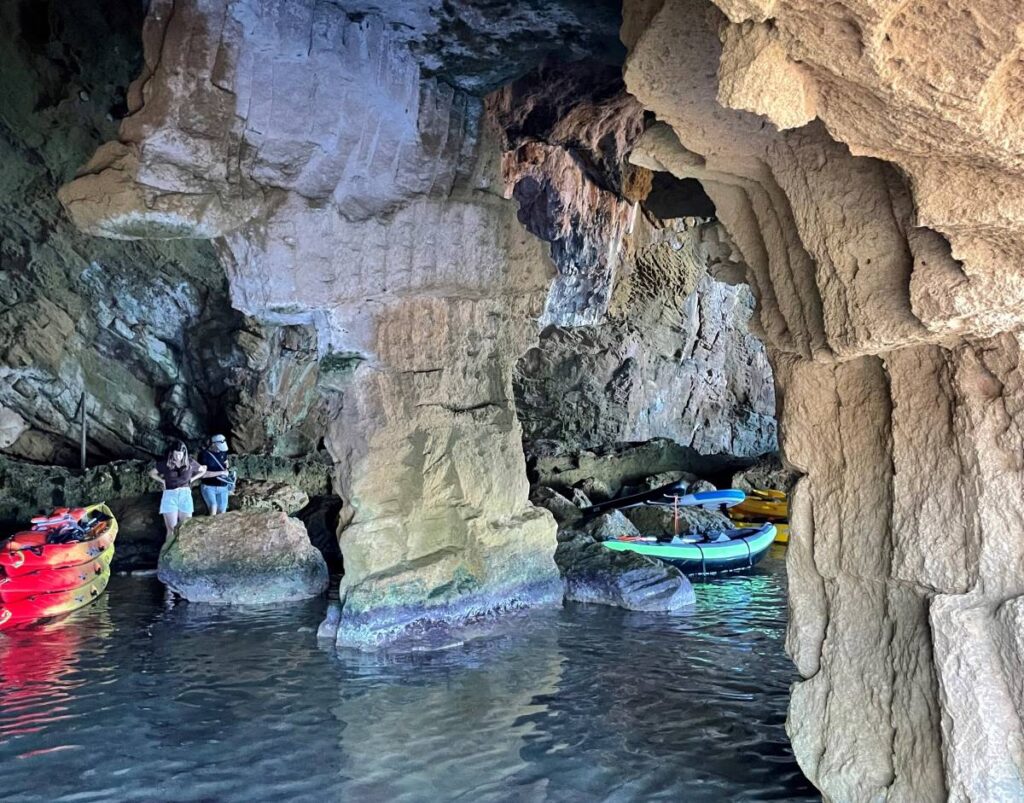
The interior contains several different spaces, including areas reached directly by seawater and darker chambers farther inside.
Some sections remain relatively open and illuminated.
Others become much darker, with very little natural light.
This creates a strong contrast between the bright Mediterranean outside and the interior spaces.
Visitors arriving from the sea often experience this transition very suddenly.
One moment you are surrounded by blue water and sunlight.
The next, you are entering a shadowed limestone chamber where the sound of the sea becomes amplified against the rock.
That contrast is one of the strongest parts of the experience.
A Cave Connected to the Sea
The Mediterranean is not simply outside the cave.
It enters it.
Water reaches directly into several of the interior areas, which means sea conditions affect the visit far more than they would at a normal inland cave.
On calm days, access can feel relatively straightforward for visitors arriving by kayak or carefully approaching the entrance on foot.
When the sea becomes rough, the situation changes completely.
Waves break directly around the entrance, making access and exit significantly more difficult.
This is why Cova Tallada should never be treated as a destination where the plan automatically goes ahead simply because you have driven from Benidorm.
The sea always has the final say.
Part of a Protected Coastal Environment
Cova Tallada belongs to a sensitive natural landscape associated with Montgó Natural Park and the Cape San Antonio marine environment.
That matters because the cave is not managed as a recreational beach.
Visitors are entering a protected space whose geological and ecological value is part of the reason access is regulated.
The surrounding coastline is rugged, relatively undeveloped and visually very different from the beaches most people associate with the Costa Blanca.
Instead of sand and promenades, you find limestone cliffs, low Mediterranean vegetation and exposed rock descending towards the sea.
This setting gives the cave much of its atmosphere.
It also explains why visitors need to behave differently here.
The objective is to experience the place without damaging it.
Not a Conventional Tourist Attraction
This is perhaps the most useful way to understand Cova Tallada.
Nothing about the visit is especially controlled once you leave the main access areas.
There is no guide waiting at the entrance.
No lifeguard.
No illuminated path through the interior.
No café.
No changing rooms.
No one managing your time.
That freedom is part of the appeal.
But it also means responsibility shifts to the visitor.
You need to judge whether the route suits your ability.
You need to check conditions.
You need appropriate equipment.
And you need to know when turning back is the sensible choice.
That is precisely what gives Cova Tallada its sense of adventure.

Why Visit Cova Tallada from Benidorm?
Benidorm already has dramatic coastline nearby.
Serra Gelada offers cliffs and hiking.
Cape San Antonio provides panoramic coastal views.
Sierra de Bernia delivers a much more substantial mountain experience.
So Cova Tallada needs to offer something different to justify the journey north.
It does.
The combination of cave, sea and physical approach creates an experience that none of those destinations provides.
The Journey Is Part of the Experience
You do not simply arrive at Cova Tallada.
You reach it.
That distinction matters.
If you walk from the Les Rotes side of Dénia, the route gradually leaves the easier coastal environment behind and becomes rougher.
The cave appears only after you have committed to the path.
If you arrive by kayak, the Mediterranean coastline becomes your route.
You paddle beneath cliffs and approach the cave from the same direction that sailors would have seen it historically.
In both cases, reaching the destination creates a sense of reward.
The cave feels more impressive because you have had to make an effort to get there.
A More Adventurous Costa Blanca Experience
Cova Tallada is not extreme.
You do not need mountaineering equipment.
You are not undertaking a technical expedition.
But compared with many ordinary Costa Blanca day trips, there is considerably more uncertainty and physical involvement.
The path may feel uncomfortable in places.
The rocks can be slippery.
The sea may force plans to change.
And moving around inside the cave requires more attention than walking through a conventional attraction.
For visitors who enjoy a little adventure without wanting a major mountain challenge, that balance can be very appealing.
The Cave Feels Genuinely Different
There are many beautiful viewpoints and beaches along the Costa Blanca.
There are fewer places where you can stand inside a cavern that opens directly onto the Mediterranean.
That visual experience alone makes Cova Tallada memorable.
The interior light changes constantly.
Sunlight reflects from the water onto the stone.
The entrance frames the sea.
Dark quarry chambers disappear behind you.
And the sound of waves echoes through the rock.
It feels much more immersive than looking at a cave from outside.
It Works Especially Well for Active Visitors
Cova Tallada is best suited to people who enjoy doing something as part of the excursion.
If your ideal day involves driving to a viewpoint, taking photographs and having lunch, Cape San Antonio may suit you better.
If you enjoy walking over uneven terrain, exploring natural places or paddling along the coast, Cova Tallada has much more to offer.
The physical element is part of what separates it from ordinary sightseeing.
That also makes the final experience feel more personal.
You have not simply been shown something.
You have made your way there.
A Strong Digital Detox Day
For remote workers, the cave has another advantage.
This is not an excursion that encourages multitasking.
You need to pay attention to where you place your feet.
You need to watch the sea.
You need to navigate the route.
You need to move carefully inside the cave.
There is very little space left mentally for checking email.
For someone who spends most of the week working online, that kind of forced attention can be refreshing.
You are outdoors, physically engaged and somewhere that feels completely removed from the rhythm of everyday work.
Why the Cave Is Part Natural and Part Human-Made
The name Cova Tallada offers a clue to its history.
“Tallada” refers to something cut or carved.
And that describes what happened here.
The cave began as a natural geological formation, but people later used it as a source of building stone.
For centuries, workers extracted local sandstone-like limestone known as tosca, cutting blocks directly from the interior.
The quarrying changed the shape of the cave.
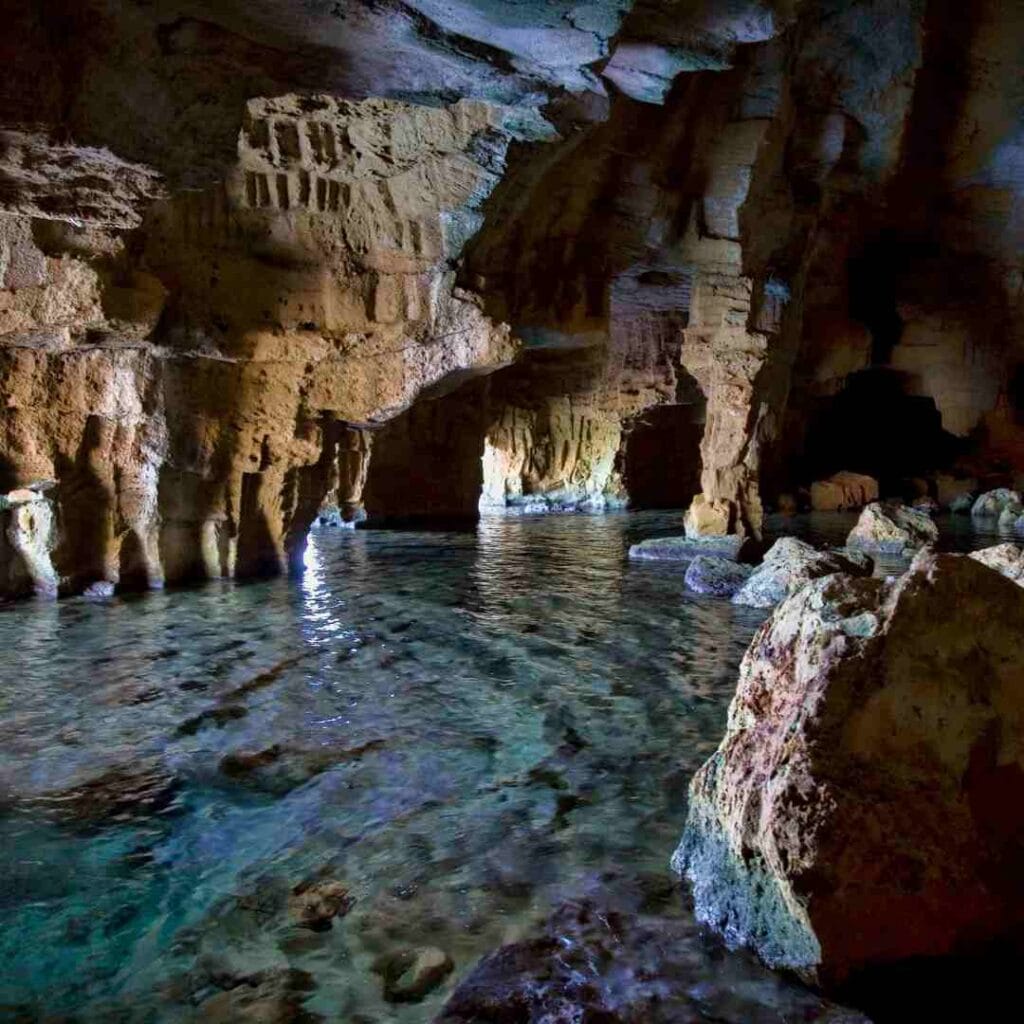
Straight edges, vertical cuts and geometric surfaces now appear beside natural rock formations.
That mixture is one of the most fascinating things about the interior.
Reading the Walls
Once you know the history, the cave looks completely different.
At first glance, some interior walls may appear naturally flat.
Then you begin noticing repeated cut marks.
Rectangular shapes.
Sections where blocks have clearly been removed.
Surfaces that are far too regular to have been created entirely by erosion.
The cave becomes a record of labour.
People once worked here removing heavy stone from a dark coastal environment and transporting it elsewhere for construction.
That makes the interior feel far more human than you might expect from a protected sea cave.
Building Stone From the Coast
Tosca stone was historically used in buildings around Dénia, Xàbia and other nearby settlements.
Its texture made it relatively workable compared with harder limestone, which allowed blocks and architectural pieces to be shaped more easily.
Cova Tallada became one source of this material.
Imagine the process.
Stone had to be identified.
Cut manually.
Separated from the rock.
Moved through the cave.
And then transported away from an isolated coastal location.
There were no modern access roads leading to the entrance.
The logistical effort involved must have been substantial.
That historical reality adds an entirely different dimension to the visit.
Traces of Earlier Visitors
The cave also preserves evidence that people were entering it long before modern hikers and kayakers discovered it.
Historical finds inside have included medieval oil lamps dating from around the eleventh and twelfth centuries.
There is also an inscription connected with the visit of King Philip III in 1599.
These details suggest that Cova Tallada has attracted human activity for a very long time.
People came here for practical reasons.
For stone.
For work.
Possibly for shelter or navigation.
Modern visitors arrive for scenery and adventure, but they are entering a place with a much longer human history.
Why the History Improves the Experience
Without this context, Cova Tallada could easily be understood as simply an attractive sea cave.
That would still make it worth visiting.
But the quarrying history explains many of its most unusual features.
The straight walls are no longer mysterious.
The interior chambers become working spaces rather than random geological formations.
The name starts to make sense.
And the cave becomes a place where natural processes and human activity have shaped the same landscape over centuries.
That combination is what makes Cova Tallada particularly distinctive.
It is not purely natural.
It is not purely historical.
And it is certainly not an ordinary beach attraction.
You are entering a cave created first by geology, transformed by people and now protected because of the landscape and environment surrounding it.
That is why reaching it should be approached with a little more preparation than simply choosing a sunny day and following a map.
The next question is the most important practical one:
How difficult is the hike to Cova Tallada really?

Hiking to Cova Tallada
Reaching Cova Tallada on foot is one of the main reasons the visit feels memorable.
The route is not particularly long, but it is much more demanding than the distance might suggest. From the Dénia side, the usual approach begins near the end of the Les Rotes area, close to Vía Láctea, and follows a marked mountain path towards the cave. The walking time itself is often around 30 to 40 minutes each way, although the total excursion can become considerably longer depending on where you park and how much time you spend inside the cave.
That relatively short duration can be misleading.
This is not a flat coastal promenade.
The path crosses uneven limestone terrain, includes narrow sections and requires careful movement in places. The official guidance classifies the route as medium difficulty overall, rising to medium-high or high difficulty in some sections.
For someone accustomed to mountain paths, that description is fair.
For someone expecting an easy seaside walk, it can feel much harder.
The Route Starts Easily Enough
The first part of the approach does not immediately reveal the difficulty ahead.
You leave the more developed surroundings of Les Rotes and gradually move into a rougher coastal landscape. Mediterranean vegetation replaces houses, the path becomes more natural and the cliffs begin to dominate the scenery.
This transition is one of the enjoyable parts of the hike.
The urban coastline quickly disappears behind you, and the route begins to feel surprisingly remote despite being relatively close to Dénia.
At first, the path may seem straightforward enough.
That is exactly why some visitors underestimate what follows.
As the route approaches the cave, the terrain becomes more irregular and exposed. You need to pay more attention to your footing, and the path becomes less forgiving than an ordinary coastal trail.
A Short Route That Feels Longer
Distance is not the main challenge here.
The challenge is the type of terrain.
On a smooth path, 30 or 40 minutes of walking would be insignificant for most reasonably active people.
At Cova Tallada, progress is slower because you cannot simply walk at a normal rhythm from beginning to end.
You stop.
Look where you are placing your feet.
Adjust your balance.
Wait for other hikers to pass through narrower sections.
And sometimes use your hands for support.
That changes the experience completely.
The route feels more adventurous precisely because it demands attention.
The Coastline Makes the Walk Worthwhile
One of the advantages of approaching on foot is that the scenery builds gradually.
You are not simply walking towards a hidden cave.
You are following one of the more rugged sections of coastline around Montgó and Cape San Antonio.
The Mediterranean remains close for much of the route, and the cliffs create a strong contrast with the quieter residential coastline you leave behind near Les Rotes.
This means the hike has value even before you reach the cave.
You are already experiencing the protected landscape rather than simply using the trail as transport.
That is one reason the walking option appeals so much to active visitors.
The journey itself becomes part of the destination.

How Difficult Is the Route?
The official description is sensible: medium difficulty overall, with sections that can feel significantly harder.
The most important thing is understanding what “difficulty” means here.
The route does not involve technical climbing.
You do not need ropes.
You do not need specialised mountaineering equipment.
But you do need confidence on uneven terrain and a reasonable tolerance for exposed coastal paths.
That is a very different type of challenge from ordinary walking.
Who Will Probably Be Comfortable?
Hikers who regularly walk on mountain trails should find the route manageable in good conditions.
If you are used to loose rock, irregular paths and occasionally using your hands for balance, nothing here should feel especially unusual.
The route becomes more interesting than intimidating.
For reasonably fit visitors with some hiking experience, the main requirement is simply to move carefully and avoid rushing.
Who May Struggle?
The route is much less suitable for people who rarely walk outside urban or prepared environments.
Someone can be physically fit and still feel uncomfortable here.
Running on a treadmill, walking long distances around a city or cycling regularly does not automatically prepare you for moving across uneven coastal rock.
Balance and confidence matter as much as stamina.
The official guidance specifically advises caution for people who suffer from vertigo or who are not accustomed to mountain paths.
That warning should be taken seriously rather than interpreted as bureaucratic overcaution.
There are exposed sections where the sea and cliffs are very present.
If heights make you uncomfortable, the route may feel considerably more demanding than its length suggests.
Children
This is another area where families should think carefully.
The route is not automatically suitable for young children simply because it is short.
Official guidance generally recommends it only for older children who already have experience walking on mountain trails.
That distinction makes sense.
A child who regularly hikes with their family may manage the route confidently.
A child whose outdoor experience consists mainly of beaches and paved paths may find the uneven and exposed sections much more difficult.
Age alone is not the best measure.
Experience matters more.
Fitness Is Only Part of the Equation
Cova Tallada is a good example of why hiking difficulty cannot be reduced to kilometres.
A person with excellent cardiovascular fitness may still dislike the route if they are uncomfortable with rough terrain.
Another person with average fitness but years of hiking experience may find it relatively straightforward.
The practical question is not simply:
“Can I walk for forty minutes?”
It is:
“Am I comfortable moving slowly over uneven coastal rock, using my hands occasionally and dealing with exposed sections?”
That gives you a much better idea of whether the walking route suits you.

The Most Challenging Sections
The route becomes more demanding as you approach the cave.
This is where the character changes from a normal coastal path into something more rugged.
There are narrower passages, rockier surfaces and sections where careful foot placement becomes essential.
These are not dramatic climbing obstacles, but they are enough to slow the pace and make some visitors nervous.
Narrow and Exposed Terrain
Some sections of the path run through areas where the terrain falls away more sharply.
You are not walking along an extreme ridge, but the exposure is noticeable.
For anyone comfortable in mountain environments, this generally adds excitement rather than concern.
For someone with vertigo, it can become the defining feature of the route.
There is no benefit in forcing yourself through a section that makes you genuinely uncomfortable.
Turning back is always an option.
Slippery Rock
Limestone can become polished through repeated use.
Combined with loose dust, humidity or sea spray, some surfaces may feel slippery even when the weather is otherwise good.
After rain, the problem becomes more obvious.
This is one of the reasons footwear matters so much.
A shoe with reliable grip gives you far more confidence than a smooth casual trainer.
The route is short enough that some people are tempted to wear ordinary beach footwear.
That is a poor choice.
Using Your Hands
There are places where using your hands for balance is useful and, depending on the exact conditions, may feel almost necessary.
Again, this is not climbing in the technical sense.
You are not ascending a vertical wall.
But the terrain occasionally requires more than simply putting one foot in front of the other.
That makes the route feel more physical and gives it much of its adventurous character.
Entering the Cave
Reaching the cave does not mean the difficult part is automatically over.
The immediate entrance area is rocky and influenced by the sea.
Conditions change depending on waves, tide-like water movement and recent weather.
On a calm day, the transition may feel straightforward.
When the sea is rough, the same area can become significantly less comfortable.
This is why the route and the cave should be treated as one continuous natural environment rather than two separate activities.
The state of the sea matters even when you approach by land.
Inside the Cave
Once inside, the terrain remains uneven.
Some chambers are dry.
Others are affected by seawater.
The floor can be rocky, damp and slippery.
Natural light does not reach every part of the interior, so moving deeper into darker sections without a torch is a bad idea.
A phone flashlight can help, but a proper small torch or headlamp is much more practical because it leaves your hands free.
The most interesting historical quarry marks are often easier to appreciate when you can actually see the surfaces clearly.
The Return Matters Too
One common psychological mistake is treating arrival at Cova Tallada as the end of the physical challenge.
It is only halfway.
You still need to return along the same kind of terrain.
That matters particularly in warm weather.
If you arrive tired, spend a long time inside the cave and then discover that the afternoon heat has increased, the return can feel considerably harder.
Keep enough water and energy for the walk back.
The route is short, but it deserves the same basic discipline as a longer hike.
Why You Should Not Rush
Because the route is relatively short, there can be a temptation to move quickly.
That rarely improves the experience.
The safest and most enjoyable pace is deliberately slow.
Let faster hikers pass.
Wait at narrow sections.
Take time when descending.
And stop occasionally to enjoy the coastline.
Cova Tallada is not a route where speed adds anything.
The whole point is that reaching the cave should feel like part of the adventure.
When Walking Is the Better Choice
For active visitors, the walking route is probably the most satisfying way to reach Cova Tallada.
You experience the cliffs before you experience the cave.
You see the coastline change.
You feel the distance from the developed areas around Dénia.
And when the entrance finally appears, it feels earned.
That sense of arrival is difficult to reproduce any other way.
However, walking is not automatically the best option for everyone.
If the exposed terrain makes you uncomfortable, if you have limited mountain experience or if you simply prefer being on the water, arriving by kayak may provide a completely different — and potentially more enjoyable — version of the same destination.
That is what we will explore next.
Visiting Cova Tallada by Kayak
Reaching Cova Tallada by kayak creates a completely different experience from the hike.
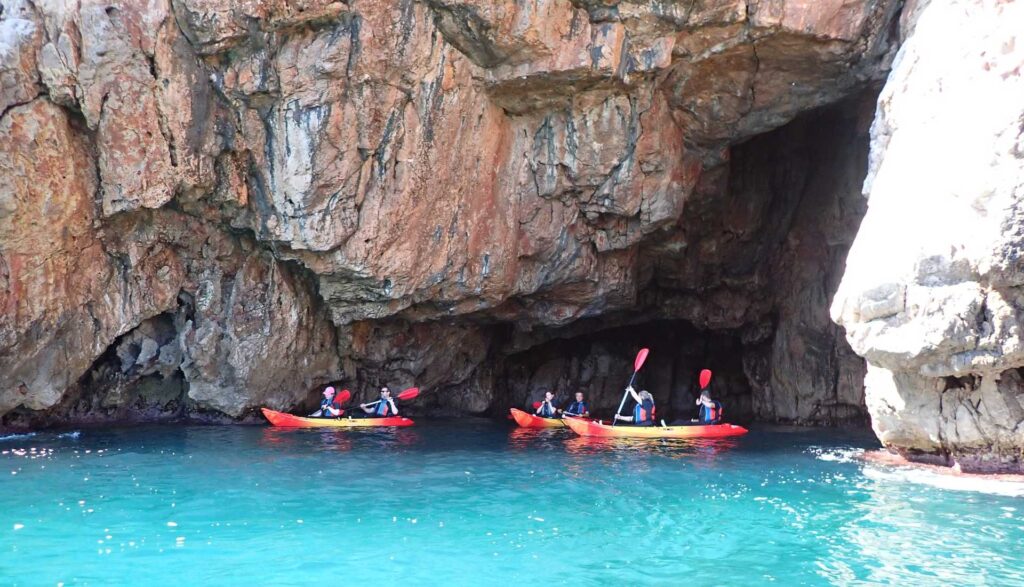
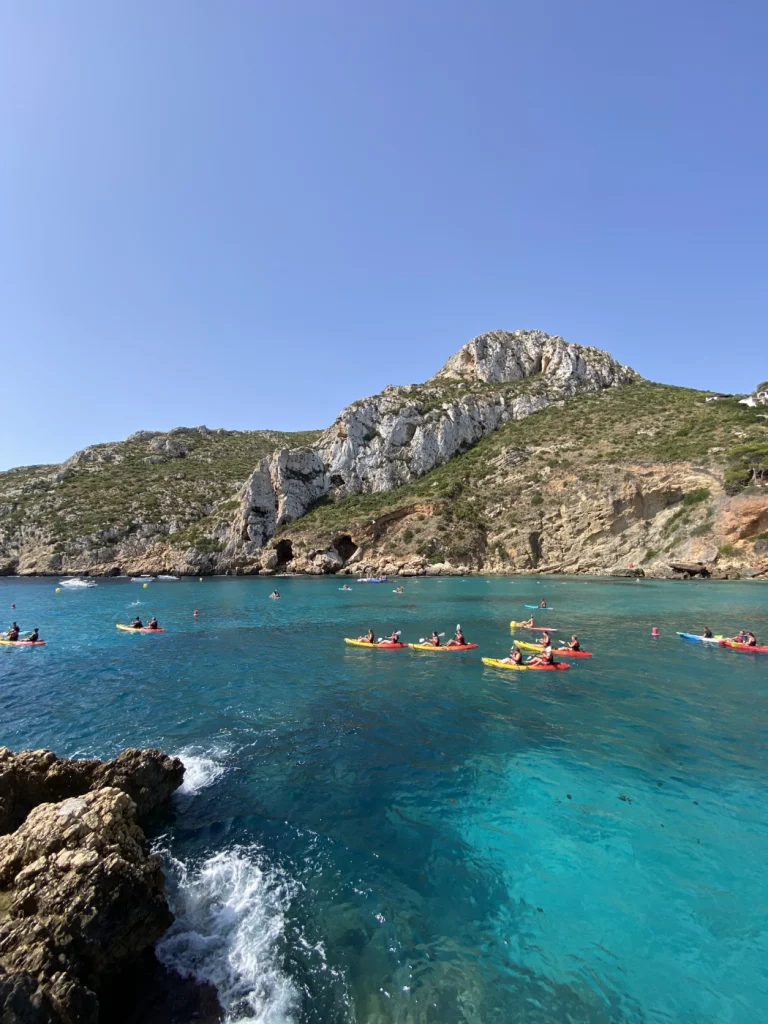
On foot, the adventure comes from negotiating a rugged coastal path and gradually approaching the cave through the landscape. By kayak, the coastline becomes the route itself. You leave the shore, paddle beneath the cliffs of Cape San Antonio and approach the cave from the Mediterranean.
For many visitors, this is the more spectacular way to arrive.
The entrance appears directly from the water, framed by rock and shadow, and the scale of the cliffs becomes much easier to appreciate from sea level. Instead of looking down towards the coast from a path, you are travelling through the same marine environment that surrounds the cave.
This approach also removes the most exposed sections of the hiking route, which can make the experience more appealing to people who dislike rough mountain terrain.
But kayaking is not automatically easier in every sense.
It introduces a different set of requirements.
You need to be comfortable on the water, able to follow instructions and prepared for the possibility that sea conditions may force the excursion to change or be cancelled.
A Different Kind of Physical Effort
The kayak route does not require mountain balance, but it still demands some effort.
Paddling for two or three hours is not the same as sitting passively in a boat.
You use your arms, shoulders and core continuously, and wind can make the return journey noticeably harder.
That said, most guided excursions use stable recreational kayaks and are designed for people with a normal level of fitness rather than experienced sea kayakers.
The activity becomes more about endurance and coordination than technical skill.
A beginner can usually manage the experience if conditions are calm and the guide considers the route suitable.
What matters more is confidence.
If you are nervous about being on open water or uncomfortable swimming, the kayak option may feel more stressful than the hike.
Why a Guided Tour Makes Sense
For most first-time visitors, I would strongly favour a guided kayak excursion rather than trying to organise the route independently.
A guide adds much more than local knowledge.
They understand the coastline.
They know how the sea behaves around the cave.
They know where entry is possible.
And they can judge whether conditions are deteriorating before an inexperienced visitor notices the problem.
This is especially important because the cave entrance is directly exposed to the Mediterranean.
A calm morning can provide straightforward access.
A change in wind or swell can make the same entrance significantly more difficult.
Guided operators also provide the necessary equipment, which normally includes the kayak, paddle and buoyancy aid, while some excursions add snorkelling equipment and wetsuits when needed.
That makes the whole experience much simpler for someone travelling from Benidorm.
The Sea Approach Changes the Cave
One of the strongest reasons to choose the kayak option is that Cova Tallada feels like a genuine sea cave when you approach it from the water.
The cliffs rise above you.
The entrance looks darker and larger.
And the transition from open Mediterranean to the interior happens gradually as you paddle closer.
You also appreciate the coastline itself rather than treating it as scenery seen from above.
Small coves, rock formations and the base of the cliffs become part of the journey.
This perspective is impossible to reproduce from the hiking path.
For photographers and anyone who enjoys marine landscapes, that alone may justify choosing the kayak.
Kayak and Snorkelling
Many organised excursions combine the visit with snorkelling when conditions allow.
This makes sense because the cave lies within the protected marine environment of Cape San Antonio, where the clear water and rocky seabed can be as interesting as the cave itself.
However, the snorkelling component should always be treated as dependent on sea conditions.
A guided operator may change the exact location or reduce the time in the water if safety requires it.
That flexibility is a positive sign, not a disappointment.
The Mediterranean may look calm from shore while still producing swell or currents around exposed rocky sections.
Reservations and Seasonal Access Rules
Cova Tallada is one of those destinations where old online advice can become misleading very quickly.
Access rules are not identical throughout the year.
During periods of high and medium-high demand, the number of visitors is controlled and prior authorisation is required.
This applies both to people arriving on foot and to access from the sea.
In 2026, the main summer restriction period ran from 15 June to 15 October, with visitors required to obtain permission in advance.
That is a long enough period that anyone planning a warm-weather visit should assume regulation may apply and check the current rules before leaving Benidorm.
Why Access Is Controlled
The restriction is not simply designed to make visiting more complicated.
Cova Tallada has become extremely popular.
Without limits, large numbers of hikers, kayakers and boats could converge on a relatively small natural space.
That creates obvious safety problems.
It also increases erosion, disturbance and environmental pressure inside the cave and along the access routes.
Managing numbers allows people to continue visiting while reducing the impact on the protected environment.
Once you see how confined some interior spaces are, the logic becomes obvious.
The cave would be much less enjoyable with uncontrolled crowds.
How Early Should You Plan?
During regulated periods, permission may need to be requested up to around ten days in advance.
That means Cova Tallada is not always a destination you can decide to visit spontaneously on a summer morning.
If you already know you will be staying in Benidorm during the busy season, check the booking system early.
The important point is not memorising one particular calendar date forever.
Regulations can change from year to year.
What matters is building the habit of checking the current Montgó Natural Park access rules before you travel.
Does Booking Guarantee the Visit?
No.
This is one of the most important things to understand.
A reservation controls visitor numbers.
It does not control the sea.
You can have the correct authorisation, arrive at the right time and still discover that conditions are unsuitable.
That can be frustrating, especially after travelling from Benidorm, but there is no sensible alternative.
Cova Tallada is exposed to the Mediterranean.
Safety has to take priority over the itinerary.
Kayak Operators During Restricted Periods
During regulated seasons, authorised operators can organise access under the conditions established for the natural park.
For someone unfamiliar with the area, booking through one of these companies is often the simplest approach.
The operator handles the activity around the permitted times and understands the access rules.
That removes much of the uncertainty associated with organising the trip independently.
It also gives you someone local who can advise you if weather conditions are likely to cause problems.

Sea Conditions and Safety
The state of the sea is the single most important factor in a kayak visit.
It matters more than sunshine.
More than temperature.
And more than whether you have a reservation.
Cova Tallada sits directly beside an exposed section of Mediterranean coastline, and waves can break around the entrance.
When the sea is calm, the cave may feel inviting and relatively easy to approach.
When the swell increases, entering and leaving can become difficult or impossible.
Calm Water Can Be Deceptive
Visitors who do not spend much time around the sea often judge conditions visually from the beach.
If the surface looks blue and relatively smooth, they assume everything will be fine.
The reality is more complicated.
Wind direction, swell and local rock formations can create very different conditions farther along the coast.
The cave entrance may be affected even when the starting beach looks comfortable.
This is another reason a local guide is valuable.
They are making decisions based on the route as a whole, not simply the water directly in front of you.
Weather Forecasts Are Not Enough on Their Own
Checking the forecast is essential, but a general weather app does not tell the whole story.
A sunny icon says almost nothing about kayaking conditions.
Wind strength and direction matter.
Wave height matters.
Changes expected during the next few hours matter.
Experienced operators pay attention to these details because the return journey can be very different from the outward trip.
A route that begins easily can become significantly harder if wind increases while you are inside the cave.
Do Not Pressure an Operator to Go
If a kayak company cancels because of conditions, accept the decision.
Do not assume they are being overly cautious because the beach happens to look calm.
Professional guides have far more to lose by taking unnecessary risks than by cancelling one excursion.
For visitors coming from Benidorm, the temptation to insist can be stronger because you have already made the journey.
That does not change the sea.
Build some flexibility into your plans instead.
If the excursion cannot take place, Dénia and the surrounding coast still offer enough alternatives to avoid wasting the day.
Swimming Ability Still Matters
A buoyancy aid significantly increases safety, but it does not replace basic comfort in the water.
Some guided experiences expect participants to know how to swim.
That is entirely reasonable.
You may need to enter or leave the kayak in the water, and snorkelling may form part of the excursion.
Anyone who is genuinely afraid of being in the sea should think carefully before choosing this option.
A kayak tour should feel adventurous.
It should not feel terrifying from the moment you leave the beach.
No Lifeguard Inside the Cave
Cova Tallada is not a supervised bathing area.
There is no lifeguard stationed inside.
Mobile coverage can also be unreliable or absent.
That changes the level of responsibility involved.
A guided group benefits from professional supervision and established safety procedures.
Independent visitors need to be even more cautious.
The fact that the cave appears frequently on tourism websites and social media does not make it equivalent to a managed beach.
Kayak or Hiking: Which Is Better?
There is no universal answer.
The hike gives you a stronger sense of approaching through the protected landscape. It feels more like a coastal adventure on foot, and reaching the cave provides a clear sense of achievement.
The kayak gives you the most dramatic view of the coastline and allows you to experience the cave as a truly marine environment.
For confident hikers, the walking route may feel more rewarding.
For visitors who enjoy the sea, the kayak may be the more memorable experience.
And for anyone who dislikes exposed mountain paths but is comfortable on the water, kayaking can be the obvious choice.
What I would not do is choose purely based on which option sounds easier.
They are different activities with different challenges.
Choose the one that fits your experience and confidence.
The result will be much better than forcing yourself into the version that looks most impressive on social media.
How to Get There from Benidorm
Cova Tallada is not especially far from Benidorm, but the final approach requires more planning than simply entering the cave name into a navigation app.
The usual land access is from the Les Rotes area of Dénia, where the coastal road gradually narrows and gives way to a quieter residential and natural environment. From there, the walking route begins near the end of the developed coastline and continues towards the cave through the protected landscape.
For visitors travelling by car, this is the most practical approach.
The drive from Benidorm normally takes around an hour, depending on traffic and your exact starting point. During busy summer periods, the journey can take longer, particularly around coastal access roads near Dénia.
That means Cova Tallada works best when you treat it as the main activity of the day rather than something to squeeze between other stops.
Driving to Les Rotes
The first part of the journey is straightforward.
Once you reach Dénia, follow signs towards Les Rotes and continue along the coast. The scenery becomes noticeably quieter as you move away from the town centre, with rocky coves, low cliffs and residential areas replacing the busier urban waterfront.
The final section requires a little more attention because parking and access are more limited.
You should never assume you will be able to leave the car immediately beside the start of the path.
In busy periods, you may need to park farther away and walk an additional distance before the actual hiking route begins.
This is worth factoring into the day.
A route that looks short on paper can become longer once parking is included.
Parking and Seasonal Restrictions
Parking around Les Rotes can be constrained during summer, and local traffic-management measures may affect how close you can drive.
This is another reason an early start is useful.
You gain a better chance of finding a suitable space and avoid beginning the hike when temperatures are already high.
If seasonal shuttle services or temporary access controls are operating, use them rather than trying to force your way closer to the trailhead.
The objective is to arrive relaxed.
Spending forty minutes circling narrow residential roads looking for a parking space is a poor way to begin the excursion.
Reaching the Cave by Kayak
If you have booked a guided kayak excursion, your starting point may be different.
Operators generally use coastal launch points around Dénia or the Les Rotes area, depending on the route and conditions.
In that case, follow the instructions provided by the company rather than trying to organise the access independently.
One advantage of a guided activity is that parking, equipment and launch logistics are usually much easier to understand in advance.
The operator tells you where to meet.
You arrive.
And the activity begins from there.
That simplicity is valuable if you are travelling from Benidorm and do not know the Dénia coastline well.
Can You Visit Without a Car?
It is possible, but significantly less convenient.
Dénia can be reached by public transport from Benidorm, including the TRAM network, but the journey is much slower than driving.
Once in Dénia, you still need to reach Les Rotes.
Depending on current local services, that may involve a bus, taxi or additional walking.
For a destination where timing, weather and seasonal access already require planning, adding multiple transport connections can make the excursion unnecessarily complicated.
If you do not drive, a guided kayak tour that includes clear meeting instructions may actually be easier to organise than the hiking route.

What to Bring
Cova Tallada requires relatively little equipment, but the items you do bring matter.
This is not a destination where carrying more automatically makes the day better.
The goal is to take enough for safety and comfort without overloading yourself on the rough coastal path.
Footwear Is the Most Important Choice
For the hiking route, footwear with good grip is essential.
Trail shoes or light hiking shoes are ideal.
You do not necessarily need heavy mountain boots, but you should avoid smooth trainers, sandals and flip-flops.
The path includes loose rock, polished limestone and uneven surfaces.
Good footwear improves both safety and confidence.
It also makes the return journey much more comfortable after you have spent time inside the cave.
Water
Bring enough water for the complete excursion.
There are no facilities at the cave.
You should not expect fountains or places to buy drinks once you leave the developed coastline.
In summer, this becomes especially important.
A short route can still require significant hydration when the terrain is exposed and temperatures are high.
Sun Protection
The approach includes open sections with little shade.
Use sunscreen, sunglasses and a hat.
The Mediterranean may make the route feel breezy, but that does not reduce sun exposure.
In fact, visitors often underestimate it because the sea creates a false sense of coolness.
A Torch or Headlamp
This is one of the most useful items for exploring the interior.
Natural light reaches the entrance and some of the larger chambers, but darker sections remain difficult to appreciate without additional lighting.
A small headlamp is particularly practical because it keeps your hands free.
That matters when the floor is uneven or damp.
A phone flashlight works as a backup, but relying entirely on your phone is not ideal.
Clothing That Can Get Wet
Even if you arrive on foot and have no intention of swimming, parts of the cave may be damp or affected by seawater.
Wear clothing that you do not mind getting dirty or wet.
Quick-drying fabrics make the experience much more comfortable.
For kayak visitors, the same principle obviously applies.
Waterproof Protection for Electronics
A waterproof phone case or dry bag is a sensible investment.
Sea spray, wet hands and slippery surfaces create plenty of opportunities for electronics to get damaged.
If you bring a camera, protect it properly.
Trying to balance an expensive device while moving over wet rock is rarely worth the risk.
Food
A small snack is enough for most visitors.
There is no need to carry a full picnic unless you intend to spend a long time in the area.
Remember that everything you bring in must leave with you.
The cave and surrounding coastline should not become a place where visitors leave wrappers, bottles or food waste.
Common Mistakes
Cova Tallada is one of those places where small planning errors can have a disproportionate effect on the experience.
The route is not long enough to seem intimidating, so visitors sometimes prepare less carefully than they would for a mountain hike.
That is usually where problems begin.
Treating It Like an Easy Coastal Walk
The most common mistake is underestimating the hiking route.
The short distance creates a false sense of security.
People arrive in casual footwear, carrying very little water and expecting something similar to a beach path.
The terrain is different.
You need balance, grip and attention.
Approach the route with the same respect you would give any other mountain trail.
Ignoring the Sea Because You Are Walking
Even hikers need to pay attention to sea conditions.
The cave entrance is directly affected by waves, and rough conditions can make access uncomfortable or unsafe.
Do not assume that the marine forecast only matters to kayakers.
The final part of the experience happens at sea level.
If conditions are poor, turning back may be the correct decision.
Arriving Without the Required Reservation
During regulated periods, access may require prior authorisation.
Do not travel from Benidorm assuming you can arrange everything once you arrive.
Check the current rules before leaving.
This is especially important in summer, when demand is high and available places can fill.
Entering the Cave Without Light
The entrance can create the impression that the entire interior is naturally illuminated.
It is not.
If you want to explore beyond the brightest areas, bring proper lighting.
Moving through dark, uneven rock with only the glow of a phone screen is unnecessarily awkward.
Wearing Beach Shoes
This deserves repeating because it is such an avoidable mistake.
The fact that you are visiting a sea cave does not make this a beach walk.
Use proper footwear for the approach.
If you want water shoes inside the cave, carry them separately.
Staying Too Long Without Thinking About the Return
The cave is the destination, but the day does not end there.
You still need enough time, water and energy to return to Les Rotes.
In summer, the return can feel much harder if temperatures have increased while you were inside.
Keep the second half of the journey in mind.
Chasing Risky Photographs
Cova Tallada is extremely photogenic.
That does not justify climbing onto unstable rock or moving into exposed positions near waves.
Sea caves create exactly the kind of dramatic backgrounds that encourage bad decisions.
A photograph is not worth losing your footing.
Trying to Combine Too Much
Cova Tallada may appear to fit easily into a busy itinerary because the hike itself is not very long.
In practice, parking, walking, cave exploration and the return can occupy much of the morning.
If you add a long lunch, Dénia, Cape San Antonio and several other attractions, the day quickly becomes rushed.
Choose one or two additions at most.
Suggested Half-Day and Full-Day Plans
The experience works well in two formats.
A focused half-day is ideal if the cave is your main objective.
A full day makes more sense if you want to combine the adventure with Dénia or another relaxed coastal stop.
Half-Day: Hike to Cova Tallada
Leave Benidorm early and drive directly to Les Rotes.
Park as close as reasonably possible to the route and begin walking before temperatures rise.
Follow the coastal path carefully and allow more time than the official walking estimate suggests.
There is no reason to hurry.
Once you reach the cave, explore the accessible interior, take time to appreciate the old quarry marks and enjoy the view back towards the Mediterranean.
Afterwards, return along the same route and stop for lunch in Les Rotes or Dénia.
This creates a very satisfying half-day.
You get the complete hiking experience without turning the excursion into an all-day schedule.
Half-Day: Kayak Version
For the kayak alternative, book an authorised guided excursion and organise the day around the meeting time.
The activity itself will typically occupy several hours, including preparation, paddling, time around the cave and the return.
This version is particularly attractive in summer, provided sea conditions are suitable.
After the tour, change clothes, have lunch nearby and return to Benidorm.
The day remains simple and focused.
Full Day: Cova Tallada and Dénia
If you want to make the journey north more worthwhile, combine Cova Tallada with Dénia.
Complete the cave experience in the morning.
Then return to town for lunch.
The afternoon can be as relaxed as you want.
Walk around the marina.
Explore the historic centre.
Visit the castle if you still have energy.
Or simply sit somewhere near the waterfront and enjoy the fact that the demanding part of the day is finished.
This combination works because the two experiences contrast well.
The morning is physical and adventurous.
The afternoon is urban and relaxed.
Full Day: Cova Tallada and Cape San Antonio
It is also possible to combine the cave with Cape San Antonio because they belong to the same wider natural environment.
However, I would only recommend this if you still have energy after the hike or kayak excursion.
The lighthouse viewpoint works well as a short scenic addition.
Trying to add the complete Les Planes circuit on the same day would be unnecessary for most visitors.
You already have a substantial outdoor experience at Cova Tallada.
The cape should complement it, not compete with it.
The Plan I Would Choose
For a first visit from Benidorm, I would choose the morning hike or guided kayak excursion followed by lunch in Dénia.
That is enough.
It gives the cave the attention it deserves and leaves the second half of the day flexible.
If conditions are excellent and you still feel energetic, you can add Cape San Antonio.
If not, Dénia provides an easy and enjoyable way to finish.
That balance is one of the keys to Cova Tallada.
The experience already contains enough adventure.
You do not need to prove anything by filling every remaining hour.
Is Cova Tallada Worth It for Digital Nomads?
Cova Tallada fits particularly well into the BenidormNomads philosophy because it offers something that remote workers often need more than another attraction: a genuine change of mental state.
This is not a place where you can half-visit while replying to messages.
The route demands attention.
The cave changes your pace.
The sea forces you to stay aware of conditions.
And whether you arrive on foot or by kayak, the experience removes you from the rhythm of ordinary work almost immediately.
That makes Cova Tallada especially valuable for anyone who spends much of the week indoors, online or following a repetitive routine.
A Strong Screen-Free Experience
The hiking route requires enough concentration that work usually disappears from your mind naturally.
You watch where you are placing your feet.
You negotiate uneven sections.
You look ahead towards the coastline.
Then, once inside the cave, the atmosphere changes again.
The light is lower, the sound of the sea becomes more noticeable and the interior feels far removed from the kind of environment where anyone would think about opening a laptop.
The kayak version has an even stronger effect.
Paddling, following the coastline and entering the cave from the Mediterranean create a continuous physical experience that leaves very little space for distraction.
For remote workers, that is a genuine advantage.
Can You Work During the Day?
Not realistically at the cave.
Nor should you try.
Cova Tallada is not a remote-work location.
There are no facilities, no reliable reason to expect connectivity and no benefit to carrying unnecessary equipment over rough terrain.
If you need to combine work with the excursion, Dénia is the logical place to do it.
You could work for a while before the activity, although an early start usually makes more sense for the hike.
More realistically, finish the cave experience, have lunch and then spend an hour or two working from an appropriate café or other suitable place in town.
That gives you the best of both worlds without forcing work into an environment where it does not belong.
The Advantage of Flexible Scheduling
Long-stay visitors have another important advantage here.
Cova Tallada is highly dependent on conditions.
A short-stay tourist may have only one available day and feel pressured to go regardless of the weather.
If you are staying in Benidorm for several weeks or months, you can choose better.
Wait for calm sea conditions.
Avoid extreme heat.
Visit on a weekday.
And, during regulated periods, book for a date that gives you a realistic chance of enjoying the experience properly.
This flexibility can dramatically improve the day.
Cova Tallada rewards people who choose the right conditions rather than simply the first available date.
Who Will Enjoy Cova Tallada Most?
The destination is particularly well suited to active visitors who enjoy outdoor experiences with a small sense of adventure.
Hikers will appreciate the approach.
Kayakers will enjoy the marine perspective.
Photographers will find plenty of interest in the cave interior, the coastline and the transition between rock and sea.
History enthusiasts will appreciate the quarry marks and the evidence of centuries of human activity.
And long-stay residents may find it especially rewarding because it reveals a side of the Costa Blanca that has little to do with beaches, nightlife or conventional tourism.
Who Might Find It Disappointing?
Cova Tallada is not suitable for everyone.
Visitors looking for a simple, easy-access attraction may find the logistics excessive.
People uncomfortable with exposed terrain may dislike the hiking route.
Those nervous around open water may find kayaking stressful rather than enjoyable.
And anyone who arrives expecting a fully managed tourist cave may be surprised by how natural and unsupervised the environment feels.
This is not a weakness.
It is simply the character of the place.
The experience works best when you choose it because you want a little adventure.
BenidormNomads Verdict
Cova Tallada is one of the most distinctive outdoor experiences on this side of the Costa Blanca because it combines physical effort, sea, geology and history in a single destination.
Uniqueness: 9.5/10
There are few comparable places where you can reach a historic sea cave either by hiking through rugged coastal terrain or by kayaking beneath Mediterranean cliffs.
Scenery: 9.5/10
The combination of limestone cliffs, blue water and the cave entrance creates one of the strongest coastal settings in the region.
Hiking Experience: 8.5/10
Short but varied, with enough difficulty to feel adventurous without becoming a major mountain route.
Kayak Experience: 9.5/10
Arguably the most visually impressive way to approach the cave, especially in calm conditions.
Historical Interest: 9/10
The quarrying history gives the cave genuine depth and makes the interior much more interesting than a purely natural cavern.
Photography: 9.5/10
The contrast between darkness, reflected water, stone and Mediterranean light creates excellent photographic possibilities.
Accessibility from Benidorm: 7.5/10
The drive itself is manageable, but the final access, parking and seasonal regulations require more planning than a conventional day trip.
Accessibility Without a Car: 5/10
Possible, but considerably less convenient because you still need to organise the final approach from Dénia.
Difficulty Balance: 8/10
The hike is short enough to remain accessible to experienced walkers, but rough enough to demand respect.
Value for Money: 9/10
The hiking experience itself is inexpensive, while guided kayak excursions cost more but add equipment, safety and local knowledge.
Digital Detox Value: 10/10
One of the strongest in the series.
This is a place where attention naturally moves away from work and towards the environment.
Relaxation: 7/10
Beautiful, but not especially passive.
The experience involves enough concentration and physical effort that it feels more adventurous than relaxing.
Overall Rating: 9.2/10
Cova Tallada is one of the strongest Costa Blanca Experiences for active visitors.
It is unusual, memorable and genuinely different from a normal beach or viewpoint excursion.

Is Cova Tallada Worth the Trip from Benidorm?
Yes, provided the type of experience suits you.
That qualification matters.
Cova Tallada is not universally appealing.
It requires more planning than many other day trips.
The hiking route is rougher than its distance suggests.
The kayak option depends heavily on sea conditions.
Seasonal access may require advance booking.
And the cave itself offers very few conventional comforts.
But those same characteristics are exactly what make it memorable.
You do not simply arrive.
You approach.
You adapt.
You pay attention.
And when you finally enter the cave, the experience feels earned.
The hiking route gives you the strongest sense of arrival.
The kayak route gives you the most dramatic perspective.
Both work.
The right choice depends on your confidence, physical experience and relationship with the sea.
For someone staying in Benidorm for an extended period, Cova Tallada is particularly worthwhile because it offers a completely different side of the region.
The coastline feels wilder.
The environment feels less controlled.
And the cave itself combines natural beauty with traces of human history in a way that very few nearby attractions can match.
If you want an easy day, choose somewhere else.
If you want a memorable one, Cova Tallada deserves serious consideration.
Just choose the right conditions, prepare properly and let the cave be the main event.