

Planning a digital nomad stay is not the same as planning a normal holiday.
When you travel for a few days, you usually focus on flights, accommodation, restaurants and things to see. But when you are working remotely from a destination, the planning becomes more practical. You need to think about accommodation, internet, budget, work routines, time zones, useful places, transport, documents, checklists and the small daily details that make a stay comfortable or stressful.
That is true whether you are coming to Benidorm, exploring the Costa Blanca, spending a few months in Valencia, working from Lisbon, trying a base in the Canary Islands or moving between destinations in Asia or Latin America.
This guide uses Benidorm and the Costa Blanca as examples, but the same planning system works for almost any digital nomad destination in the world. The goal is simple: to help you organize your stay before, during and after your time in a place, so your remote work lifestyle feels less chaotic and more intentional.

Start with the destination and the type of stay
The first step is not only choosing where you want to go. It is understanding what kind of stay you are planning.
A two-week workation in Benidorm is very different from a three-month remote work base in Alicante or a full winter stay somewhere on the Costa Blanca. The longer the stay, the more important the practical details become.
Before booking anything, define the basic frame of your stay:
- destination or possible destinations;
- arrival and departure dates;
- length of stay;
- reason for choosing that place;
- expected work intensity;
- accommodation needs;
- budget range;
- whether the stay is a test or a serious base.
For example, Benidorm can work well for digital nomads who want services, beach, walkability, public transport, cafés, restaurants and a large international community. Alicante may feel more urban and connected. Guardamar can be quieter and more residential. Other Costa Blanca towns may work better for slower stays, especially outside peak season.
But the same logic applies anywhere. Before choosing Chiang Mai, Lisbon, Bali, Mexico City or Tenerife, the question is not only “is this place popular with digital nomads?” The better question is: “does this place fit the way I actually live and work?”
A destination can look perfect online and still be wrong for your routine. Maybe it is too noisy, too expensive, too isolated, too touristy in summer, too quiet in winter or not comfortable for the type of work schedule you need.
That is why a digital nomad stay should start with a clear base plan, not just a booking confirmation.
Estimate your monthly budget before you arrive
Budget is one of the easiest things to underestimate.
A destination may look affordable at first, but the real monthly cost depends on the season, accommodation type, eating habits, transport, coworking needs, lifestyle and how often you move around.
For a digital nomad stay, it is useful to separate your budget into categories:
- accommodation;
- food and groceries;
- cafés and restaurants;
- coworking or workspace;
- local transport;
- flights, trains or buses;
- health insurance;
- phone and data;
- visas or administrative costs;
- leisure and activities;
- emergency margin.
In a place like Benidorm, accommodation prices can vary significantly depending on the season. A long stay outside the summer months may be much more realistic than a short stay in peak tourist season. The same applies to many coastal destinations around the world: timing can change the entire budget.
A practical mistake many remote workers make is to calculate only the visible expenses: rent, flights and food. But nomad life often includes hidden costs. You may need a better phone plan, a backup workspace, a taxi at the wrong moment, extra luggage, a replacement charger, medical insurance, laundry services or a more comfortable apartment than expected because you are working from it every day.
That does not mean you need to track every cent obsessively. But having a clear budget before you arrive helps you make better decisions and reduces stress during the stay.
Prepare your remote work setup
A normal traveler can tolerate bad Wi-Fi for a few days. A digital nomad usually cannot.
Your remote work setup is one of the most important parts of the stay. It can define whether a destination feels easy and productive or frustrating and unreliable.
Before arriving, think about:
- internet quality in the accommodation;
- whether you need a desk or only a table;
- noise levels;
- video call requirements;
- time zone differences;
- backup internet options;
- coworking spaces nearby;
- cafés suitable for laptop work;
- power outlets and adapters;
- comfortable working hours;
- weekly workload.
Benidorm and the Costa Blanca can be attractive for remote workers because daily life is relatively easy: many services, cafés, supermarkets, public transport, international residents and a climate that encourages outdoor breaks. But even in a comfortable destination, your work setup still needs planning.
A sea-view apartment may look ideal, but if the chair is uncomfortable, the table is too small and the Wi-Fi is unstable, it may not work for a serious remote work routine. On the other hand, a simple apartment near useful services can be much better if it lets you work properly.
The same principle applies globally. Whether you are in Spain, Portugal, Thailand or Mexico, a good digital nomad base is not only a beautiful place. It is a place where you can actually live, work and maintain your routine.

Save useful places before and during the stay
One of the most underrated parts of nomad planning is saving useful places.
Before arriving, most people save accommodation and maybe a few restaurants. But during a longer stay, you will probably need much more than that:
- cafés where you can work;
- coworking spaces;
- supermarkets;
- gyms;
- pharmacies;
- health clinics;
- quiet restaurants;
- transport stations;
- beaches or walking areas;
- neighborhoods to explore;
- laundry services;
- places to avoid;
- possible future accommodation areas.
In Benidorm, this might include cafés near the old town, quiet places outside peak tourist areas, supermarkets close to your apartment, bus or tram connections, gyms, beaches for walking breaks and nearby towns you may want to visit.
In other destinations, the list will change, but the idea is the same. The useful places you collect during a stay become part of your personal knowledge of the destination.
This is especially valuable if you might return. After a few months, it is easy to forget which café was actually comfortable for work, which area felt too noisy, which supermarket was convenient or which part of town suited your routine best.
Good nomad planning is not only about the next destination. It is also about building your own memory of the places you have tested.
Use checklists for documents, arrival and departure
Digital nomads often repeat similar processes again and again: preparing a trip, arriving in a new place, setting up work, managing documents and leaving for the next destination.
That makes checklists extremely useful.
A basic digital nomad checklist may include:
- passport or national ID;
- visa or entry requirements;
- health insurance;
- accommodation confirmation;
- travel tickets;
- emergency contact;
- bank cards;
- backup card or payment method;
- phone data plan;
- laptop charger;
- adapters;
- work documents;
- client or employer requirements;
- medication;
- local transport information.
Then you can have specific checklists for arrival and departure.
An arrival checklist may include checking the Wi-Fi, testing the workspace, locating the nearest supermarket, saving the address, finding transport options, confirming check-in details and identifying a backup place to work.
A departure checklist may include closing accommodation details, checking transport, backing up important notes, reviewing expenses, saving useful places, rating the destination and writing down what you would do differently next time.
This may sound basic, but checklists reduce mental load. They stop you from relying on memory when you are tired, traveling, working and dealing with unfamiliar surroundings.
Track tasks and notes during the stay
Every stay creates small tasks.
Some are related to travel: confirm accommodation, book transport, check documents, find a SIM card, organize laundry or compare neighborhoods.
Others are related to work: finish a project, schedule calls, manage time zones, prepare files, find a quiet workspace or protect focus time.
Then there are personal notes: things you liked, places to revisit, problems with the apartment, contacts, ideas, costs, mistakes, future plans and reminders for the next destination.
The problem is that these details often end up scattered across different places:
- Apple Notes;
- Google Docs;
- WhatsApp messages;
- screenshots;
- email confirmations;
- spreadsheets;
- map pins;
- random reminders.
That works for a while, but it becomes messy when you move between destinations.
A digital nomad lifestyle creates context. A task is not just a task; it is usually linked to a destination. A note is not just a note; it belongs to a stay. A useful place is not just a map pin; it belongs to a city where you may return.
That is why organizing information by stay can be more useful than keeping everything in one generic list.
Review the destination before moving on
This is one of the most valuable habits for long-term digital nomads.
Before leaving a place, take a few minutes to review it properly.
Not emotionally, not only with “I liked it” or “I didn’t like it”, but practically:
- Was the cost of living manageable?
- Was the internet reliable?
- Could you work productively?
- Did the area feel safe and comfortable?
- Was it easy to walk around?
- Did you find good places to work?
- Was the social life good for you?
- Did the destination fit your routine?
- Would you return?
- What would you change next time?
This is where digital nomad planning becomes more strategic.
Every destination teaches you something. Maybe you discover that you work better in quieter towns. Maybe you need a more urban base. Maybe you prefer walkable coastal cities. Maybe you like tourist destinations outside peak season but not during summer. Maybe you need a coworking space nearby, or maybe you work better from home.
Benidorm, for example, may be excellent for one person because it is walkable, sunny, practical and full of services. Another person may prefer Alicante for a more urban atmosphere. Someone else may choose Guardamar or a smaller Costa Blanca town for a quieter stay.
There is no universal perfect destination. There is only the destination that works for your lifestyle, budget and work rhythm.
Keeping a record of your own experience helps you make better decisions over time.
A simple way to organize everything: Nomad Journey
After planning different stays, one thing becomes obvious: digital nomad life can easily become fragmented.
Your destination details are in one place, your tasks in another, your budget in a spreadsheet, your useful places in maps, your notes in a notes app and your travel documents somewhere else.
That is exactly why I created Nomad Journey.
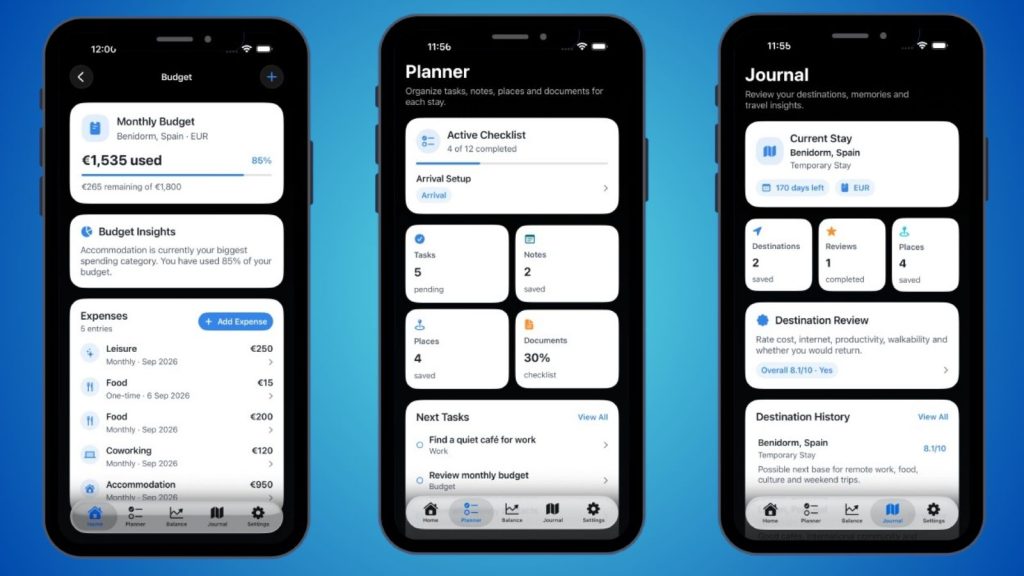
Nomad Journey is a simple iPhone and iPad app for digital nomads, remote workers and frequent travelers. It helps you organize stays, tasks, notes, budgets, checklists, useful places and destination memories in one private app.
It is not designed only for Benidorm or the Costa Blanca. You can use it for any destination: Spain, Portugal, Mexico, Thailand, Bali, the Canary Islands, Latin America or wherever you work remotely from.
The idea is simple: each stay becomes a practical planning hub.
You can use Nomad Journey to:
- create stays with destination, dates, currency and budget;
- organize tasks by destination;
- save useful notes;
- keep important places connected to each stay;
- prepare travel and document checklists;
- track expenses;
- review destinations after your stay;
- remember what worked and what did not.
Nomad Journey is also designed to be simple and private. It does not require an account, does not use ads and does not collect your data. Your planning stays on your device.
Plan your digital nomad stay with Nomad Journey
Organize stays, tasks, notes, budgets, checklists and useful places in one simple private app for iPhone and iPad.
Download Nomad Journey on the App StoreFinal digital nomad stay checklist
Before you start your next digital nomad stay, use this simple checklist as a practical base.
Destination
Choose your destination, define why you are going there and decide whether it is a short test, a workation or a longer base.
Dates
Write down your arrival date, departure date and total length of stay. Check whether your stay falls into high season, low season or shoulder season.
Accommodation
Check location, internet, workspace, noise, transport, kitchen, laundry options and cancellation conditions.
Budget
Estimate accommodation, food, transport, coworking, cafés, insurance, phone data, travel costs and an emergency margin.
Remote work setup
Confirm Wi-Fi, backup internet, time zone, video call needs, work hours and quiet places where you can focus.
Useful places
Save cafés, coworking spaces, supermarkets, pharmacies, gyms, restaurants, transport stops and important local services.
Documents
Prepare ID, passport, insurance, bookings, bank cards, emergency contacts, visas if needed and work-related documents.
Tasks
Create a task list for before arrival, during the stay and before departure.
Notes
Keep practical notes about the accommodation, neighborhoods, costs, work conditions, useful places and anything you would want to remember.
Destination review
Before leaving, review the destination. Think about cost, internet, productivity, safety, comfort, social life, walkability and whether you would return.
A good digital nomad stay is not only about choosing an attractive destination. It is about building a temporary life that works.
Benidorm and the Costa Blanca can be excellent examples because they combine beach, services, international communities, transport and a lifestyle that can suit many remote workers. But the same planning principles apply anywhere.
The more clearly you organize each stay, the easier it becomes to compare destinations, control your budget, protect your work routine and remember what each place was really like.
Whether your next base is Benidorm, Alicante, Valencia, Lisbon, Bali, Mexico City or somewhere completely different, the goal is the same: plan better, stay organized and learn from every destination.
Organize your next digital nomad stay
Nomad Journey helps you plan and remember your stays, tasks, notes, budgets and useful places from one private app.
Download Nomad Journey on the App Store