
Santa Pola Salt Lakes from Benidorm: Flamingos, Salt Pans and a Different Costa Blanca Day Trip
The Santa Pola Salt Lakes offer one of the most unusual landscapes you can visit on a day trip from Benidorm.
There are no dramatic mountain summits, waterfalls or famous historic monuments.
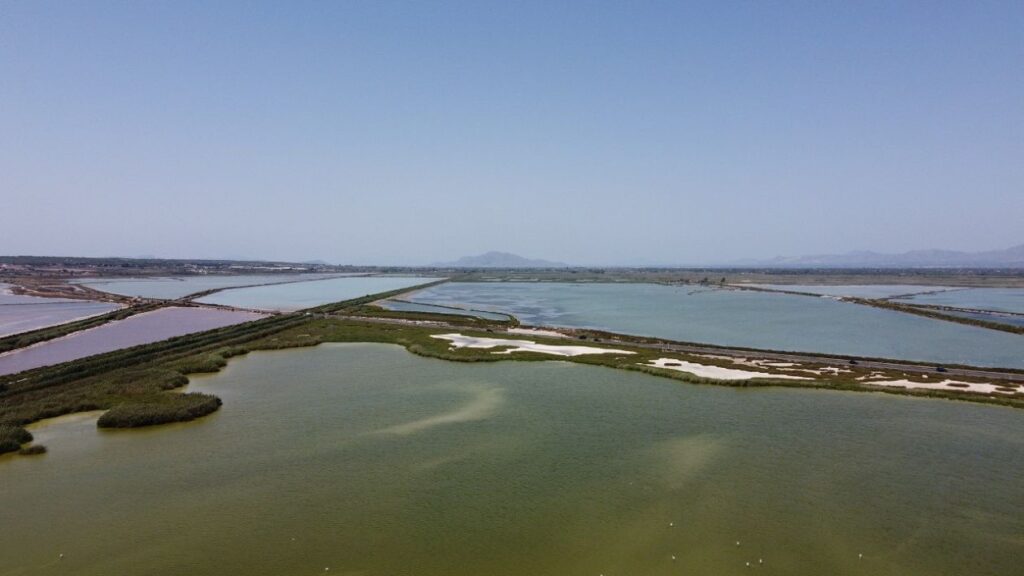
Instead, you find shallow lagoons, salt ponds, open skies, wetland vegetation and large numbers of birds living alongside an active salt-producing landscape.
At first glance, it may appear less spectacular than places such as Peñón de Ifach or Serra Gelada.
That is exactly why expectations matter.
The Salinas de Santa Pola Natural Park is not a conventional tourist attraction where you buy a ticket, follow one clearly defined circuit and leave after seeing the main feature.
It is a large protected wetland covering approximately 2,470 hectares across the municipalities of Santa Pola and Elche. The landscape includes salt ponds, wetlands, dunes and coastal habitats, while salt production continues to form an important part of how the area functions.
It is also one of the most important birdwatching areas on this part of the Costa Blanca.
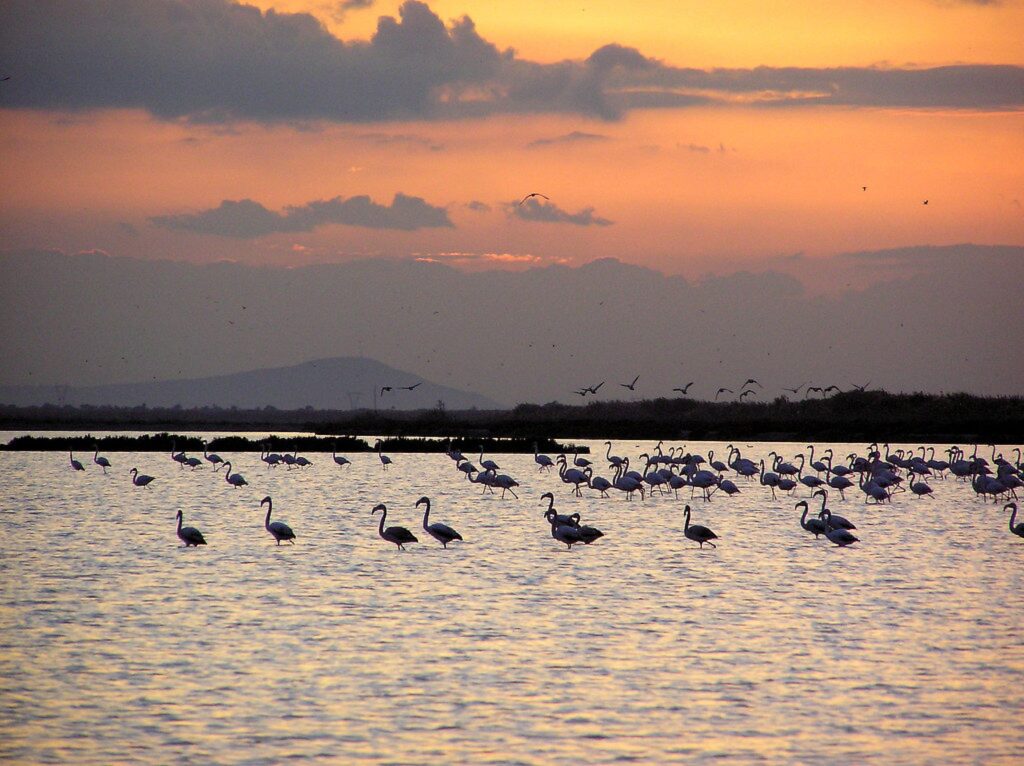
Common flamingos are resident in the park, alongside species such as black-winged stilts, pied avocets, shelducks, herons and numerous other waterbirds. Migratory and wintering species add considerable variety at different times of year.
For digital nomads, remote workers and long-stay residents in Benidorm, the attraction lies largely in that contrast.
Benidorm is dense, vertical and energetic.
The Salinas are flat, open and quiet.
The skyline is replaced by horizons.
Traffic and apartment towers give way to salt ponds, birds and wide expanses of sky.
This is not an excursion for someone looking for constant entertainment.
It is better suited to people who enjoy observing landscapes, photography, wildlife and slower experiences.
And if you approach it with the right expectations, it can be one of the most distinctive day trips south of Benidorm.
What Are the Santa Pola Salt Lakes?
The Salinas de Santa Pola Natural Park is a protected wetland immediately south and west of Santa Pola.
Its identity is closely connected to salt.
Seawater is managed through a network of ponds where evaporation gradually increases salinity until salt can eventually be harvested.
That industrial process has shaped the landscape for generations.
But the important point is that salt production and wildlife conservation are not completely separate activities here.
The Natural Park
The protected area covers around 2,470 hectares and includes several different habitats rather than a single continuous lake.
You will encounter:
- salt ponds;
- shallow lagoons;
- reedbeds;
- marsh vegetation;
- dunes;
- coastal areas;
- areas associated with active salt production.
The official park guide places the natural park across both Santa Pola and Elche and identifies the Salt Museum as its interpretation centre.
This scale explains why a visitor cannot simply “walk around the lake.”
The Salinas are a landscape rather than one compact attraction.
Some areas are accessible through official routes and observation points.
Others belong to sensitive wildlife habitat or salt-production zones where unrestricted access would be inappropriate.
Understanding that before you arrive will make the visit much easier to plan.
Why the Salt Industry Matters
Salt production is one of the defining characteristics of the park.
The ponds are deliberately managed so that seawater moves through areas of increasing salinity.
As water evaporates, the concentration of salt rises.
Eventually, salt can be harvested commercially.
From an ecological perspective, this controlled movement of water also creates a mosaic of shallow ponds with different salinity levels.
Those varying conditions support different organisms and feeding environments.
For birds, that means an unusually rich wetland habitat.
The relationship is therefore more complex than:
industry on one side, nature on the other.
The salt-working landscape itself has helped create and maintain conditions used by large numbers of waterbirds.
That is one of the most interesting aspects of Santa Pola.
Why Is the Wetland So Important for Birds?
Wetlands are among the most productive habitats for birdlife because they provide food, shelter and breeding areas.
Santa Pola is especially valuable because it combines several types of shallow-water environment within a relatively compact coastal zone.
Birding Comunitat Valenciana identifies a wide range of resident species, including:
- common flamingo;
- black-necked grebe;
- common shelduck;
- red-crested pochard;
- white-headed duck;
- marbled duck;
- pied avocet;
- Kentish plover;
- black-winged stilt;
- several species of gull and heron.
Spring and summer bring additional breeding or migratory species, while autumn and winter introduce another range of birds moving through or remaining in the wetland.
Official birding information recommends spring, autumn and winter as particularly good seasons for visiting.
You do not need to recognise every species to enjoy the experience.
For most visitors, simply seeing the number and variety of birds is enough to make the landscape feel alive.
Flamingos
Flamingos are naturally the birds most people associate with the Santa Pola Salt Lakes.
And yes, they genuinely live here.
The common flamingo is listed among the park’s resident species.
However, this needs an important qualification.
Resident does not mean:
“You will always find hundreds of flamingos standing close to the viewpoint.”
Birds move.
Water levels change.
Feeding conditions change.
Groups may be concentrated in distant ponds.
At some times, the flamingos may be immediately obvious.
On another visit, you may need binoculars to appreciate them properly.
That uncertainty is part of birdwatching.
It is also why this guide will not present Santa Pola as a guaranteed flamingo attraction.
If your entire definition of a successful visit is obtaining a close-up photograph of fifty flamingos, you could leave disappointed.
If you are interested in the whole wetland landscape, the salt industry and the wider birdlife, the experience becomes much more reliable.
Why Visit Santa Pola Salt Lakes from Benidorm?
The main reason is simple:
they offer something Benidorm does not.
This is one of the strongest arguments for any excursion aimed at long-stay residents.
If you are spending several weeks or months in Benidorm, you do not necessarily need another destination offering a similar beach, marina or promenade.
The Salinas provide a completely different environment.
A Different Kind of Costa Blanca Landscape
Much of the Costa Blanca is associated with:
- beaches;
- rocky coves;
- mountains;
- resort towns;
- Mediterranean cliffs.
Santa Pola’s salt landscape is different.
The terrain is almost completely flat.
The visual interest comes from:
- reflections;
- colour;
- birds;
- water;
- salt mounds;
- long horizons;
- changing light.
This makes it particularly interesting for photographers and anyone who appreciates minimalist landscapes.
You Do Not Need to Be a Birdwatcher
Birdwatching can sound specialised.
It does not need to be.
You do not need:
- an expensive telescope;
- a checklist of rare species;
- years of ornithological knowledge.
A pair of binoculars helps enormously, but even a casual visitor can enjoy seeing flamingos, stilts, herons, ducks and other birds moving across the ponds.
If you become interested in identifying them, the park gives you an easy introduction to birdwatching without needing to join an organised expedition.
It Is a Good Slow-Day Experience
Not every day off needs to involve physical challenge.
After several days of work, sometimes the best excursion is simply somewhere quiet enough to slow your mind down.
The Salinas work well for:
- walking slowly;
- watching birds;
- sitting at an observation point;
- photography;
- listening;
- doing very little.
For remote workers who spend much of the week moving between screens, cafés and apartments, that can be surprisingly valuable.
Photography Is One of the Main Attractions
Santa Pola is especially interesting when the light is good.
The flat landscape creates large reflections and strong skies.
Possible subjects include:
- flamingos;
- salt ponds;
- distant mountains;
- salt piles;
- silhouettes of birds;
- sunset or early-morning light;
- Tamarit Tower;
- water reflections.
A long lens helps with wildlife photography, but landscape photography can be rewarding even with a phone.
The key is not to expect close wildlife encounters.
The birds should determine the distance, not the photographer.
It Can Work as Part of a Bigger Santa Pola Day
Another advantage is that the Salt Lakes do not need to fill the entire day.
You can combine them naturally with:
- Santa Pola town;
- the fishing port;
- lunch;
- the Castle-Fortress;
- a beach;
- a coastal walk.
This makes the journey from Benidorm more worthwhile.
Rather than travelling south only to spend an hour looking at ponds, you can build a complete day around nature, food and the coast.
It Is Not for Everyone
The Salinas may disappoint visitors who expect:
- constant activity;
- dramatic hiking;
- close-up wildlife;
- a theme-park style attraction;
- a single obvious viewpoint;
- entertainment designed around tourists.
There may be moments when very little appears to be happening.
That is part of the experience.
You are observing a real wetland.
The best visits are often the ones where you stay long enough to notice more than you saw during the first five minutes.
For long-stay residents, that slower character is one of the reasons Santa Pola deserves a place in this series.
Where Should You Actually Go?
The Santa Pola Salt Lakes cover a large area, so the experience depends heavily on choosing the right access points.
This is not a place where you park once and walk around the entire wetland.
For a first visit from Benidorm, the most useful areas are:
- the Salt Museum and Interpretation Centre;
- the short birdwatching route beside the museum;
- El Pinet;
- selected official observation areas around the wetland.
The aim is to combine at least two different perspectives.
One should help you understand the salt landscape.
The other should give you a better chance of observing birds in a more open wetland setting.
Salt Museum and Interpretation Centre
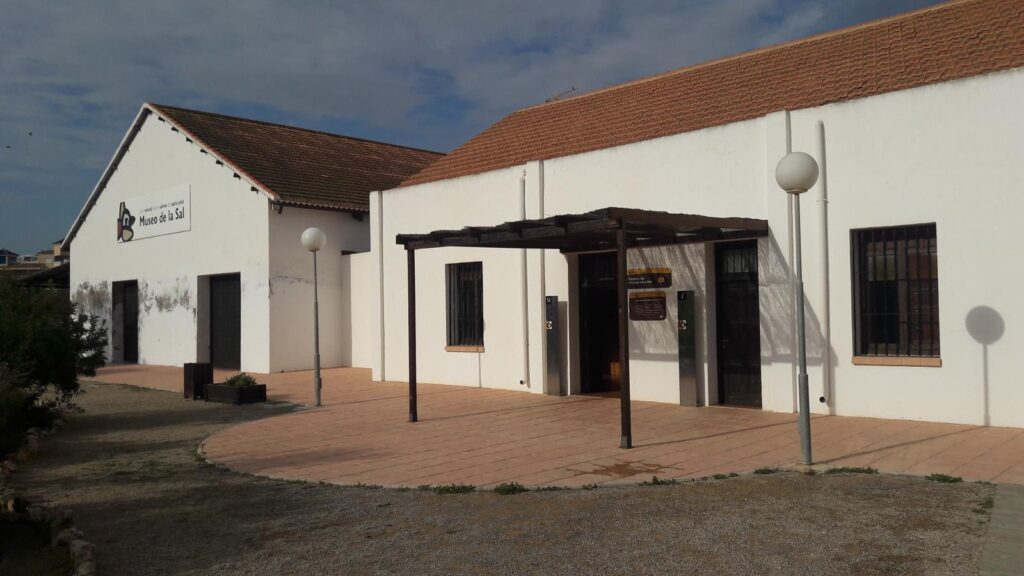
The Museo de la Sal is the best place to begin.
It functions as the interpretation centre for the Salinas de Santa Pola Natural Park and explains both the ecological and industrial importance of the area.
The official park guide places the centre in Santa Pola, with pedestrian access from Avenida de Zaragoza and urban parking nearby. (parquesnaturales.gva.es)
For first-time visitors, this is particularly valuable because the Salinas can otherwise look visually simple.
You see water.
Salt ponds.
Birds in the distance.
Possibly large salt piles.
Without context, it is easy to miss why the landscape is important.
The museum helps explain:
- how salt is produced;
- how seawater moves through the ponds;
- why salinity varies between areas;
- the relationship between salt production and bird habitat;
- the natural park’s main ecosystems;
- the history of salt-working around Santa Pola.
That background makes the rest of the visit much more meaningful.
How much time do you need at the museum?
For most visitors, around 30 to 60 minutes should be enough.
This is not necessarily a major museum requiring half a day.
Its value comes from providing context before you go outside.
If you are especially interested in salt production, wetlands or birdlife, allow longer.
The Salt Museum Birdwatching Route
One of the easiest places to observe the wetland is directly associated with the museum.
Birding Comunitat Valenciana describes an accessible circular route of approximately one kilometre around the museum area. The route includes birdwatching facilities and an observation point overlooking the ponds. (birding.comunitatvalenciana.com)
This is an ideal introduction because it does not require serious hiking.
The terrain is easy and the route works well for:
- casual birdwatchers;
- photographers;
- families;
- people with limited time;
- visitors who simply want to understand the wetland.
There are also basic facilities nearby, making this much more comfortable than stopping at an isolated observation area.
What can you expect to see?
That varies completely by season and water conditions.
Possible sightings include:
- flamingos;
- avocets;
- stilts;
- ducks;
- gulls;
- herons;
- other wetland species.
Some birds may be close enough to appreciate with the naked eye.
Others may be hundreds of metres away.
This is why binoculars can transform the experience.
Without them, you may see a group of pale shapes.
With binoculars, you realise you are watching individual flamingos feeding, ducks moving between channels or several species sharing the same pond.
El Pinet
El Pinet offers a different perspective on the natural park.
This area lies toward the southern end of the Salinas, close to the coast and the El Pinet beach area.
The landscape combines:
- salt lagoons;
- dunes;
- Mediterranean vegetation;
- beach;
- open wetland.
That makes it one of the most visually varied parts of the park.
It is especially useful if you want the day to feel like more than a museum visit.
Why El Pinet is worth including
The main attraction is the contrast between wetland and coast.
You can observe the salinas, then continue toward the beach and dunes without needing to travel far.
This works particularly well for:
- photography;
- birdwatching;
- a relaxed walk;
- combining nature with the sea;
- visitors who want a quieter environment than central Santa Pola.
The landscape feels more open here than around the interpretation centre.
Is El Pinet better for flamingos?
Not necessarily.
There is no single location where flamingos are guaranteed to be closer.
Their position depends on:
- water levels;
- food availability;
- disturbance;
- season;
- the current management of the salt ponds.
El Pinet may provide excellent sightings one day and relatively distant birds on another.
That unpredictability is normal.
How much time should you allow?
Around one to two hours is reasonable for a relaxed visit.
Longer if you:
- enjoy birdwatching;
- want to photograph the landscape;
- continue to the beach;
- simply enjoy quiet places.
For a first day trip from Benidorm, you do not need to spend half the day here unless wildlife observation is your main purpose.
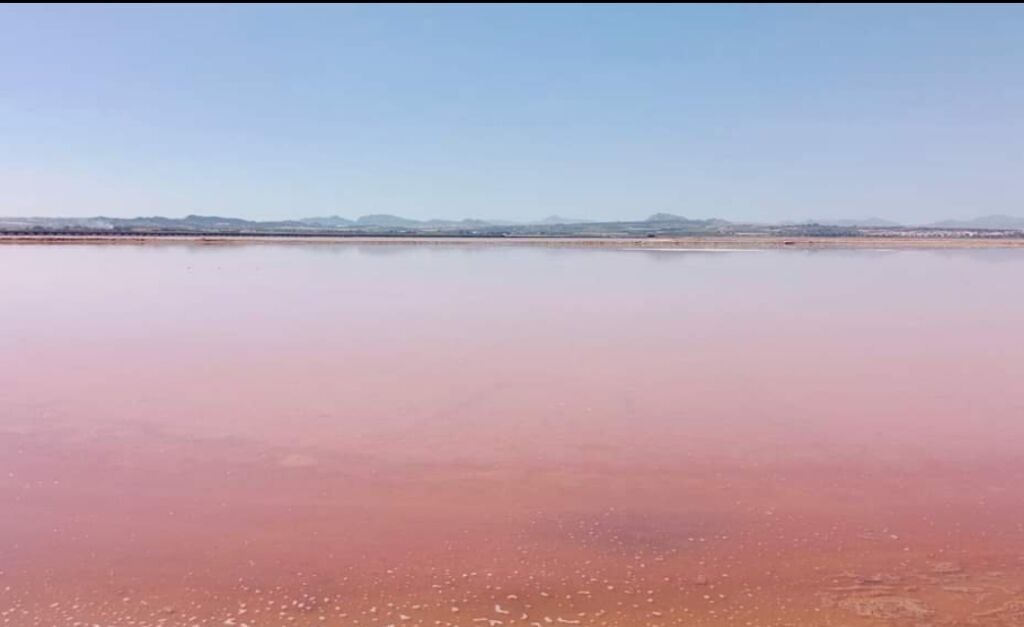
Observation Areas Around the Salt Ponds
One of the most tempting ways to experience the Salinas is simply to drive along the N-332 and look toward the ponds.
You will almost certainly see parts of the landscape from the road.
You may also see flamingos.
But this does not mean you should stop wherever the view looks interesting.
Do not stop on unsafe road sections
The N-332 is a busy road.
Stopping on a narrow shoulder, slowing unexpectedly or trying to photograph birds from the roadside creates unnecessary risk.
It also contributes to disturbance when multiple vehicles begin using informal stopping points.
Only use:
- established parking areas;
- official access points;
- designated observation areas;
- safe roads where parking is clearly permitted.
A photograph is not worth creating a traffic hazard.
Why roadside views can still be useful
Even without stopping, the road provides a good sense of the scale of the Salinas.
The ponds extend across a much larger area than the museum route suggests.
From the car or bus, you may notice:
- extensive water surfaces;
- salt mounds;
- changing pond colours;
- groups of birds;
- industrial salt infrastructure.
Use this as part of the experience rather than trying to convert every visible bird into a photo stop.
Tamarit Tower
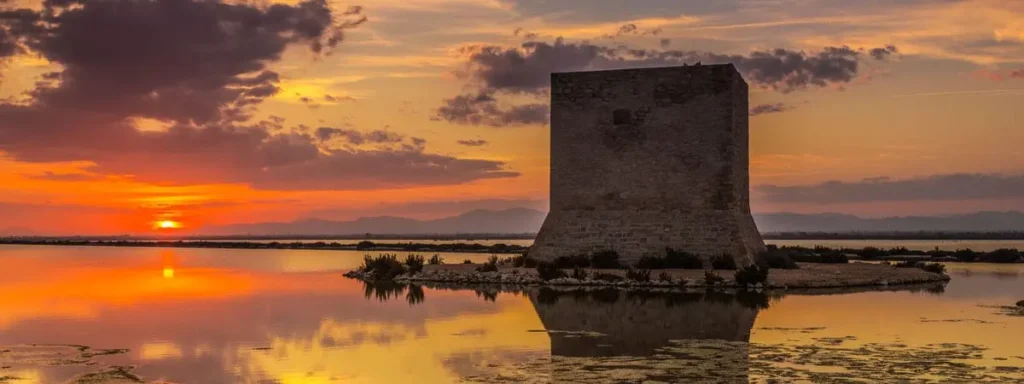
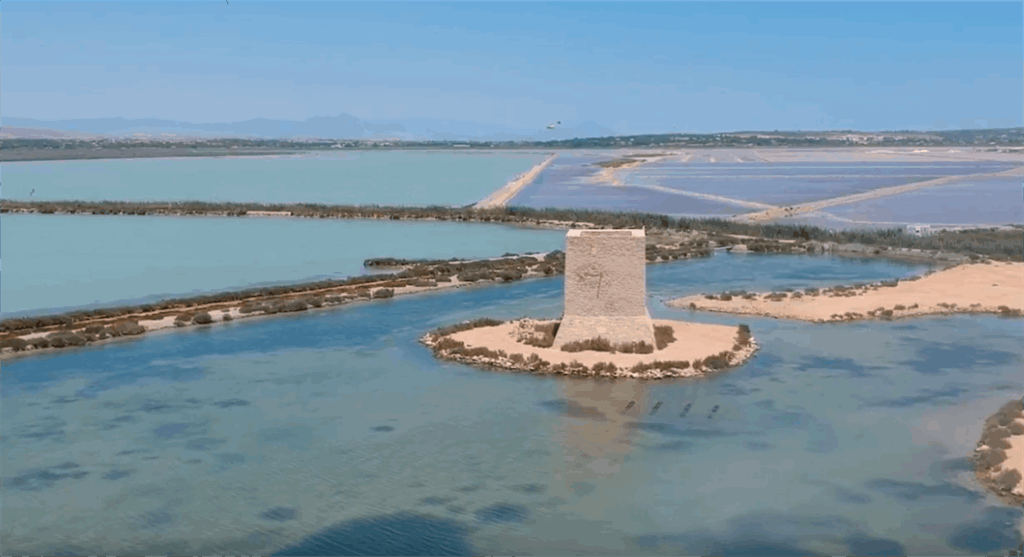
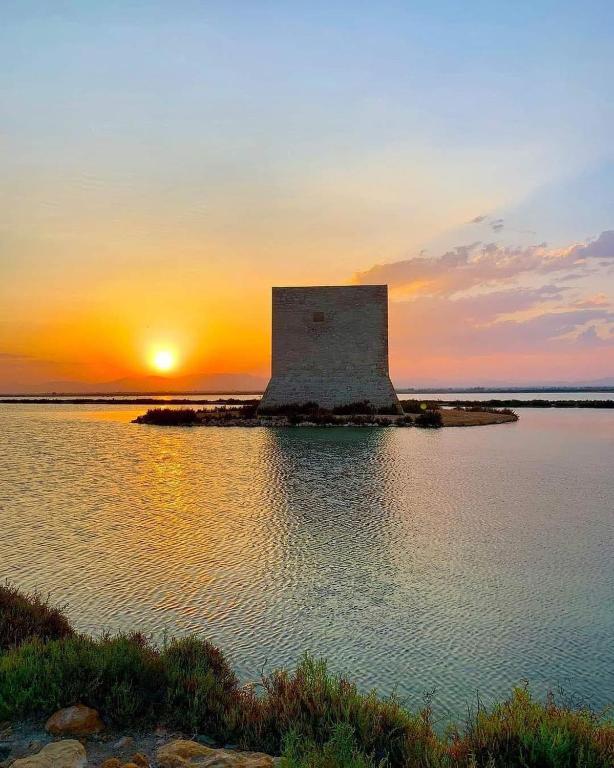
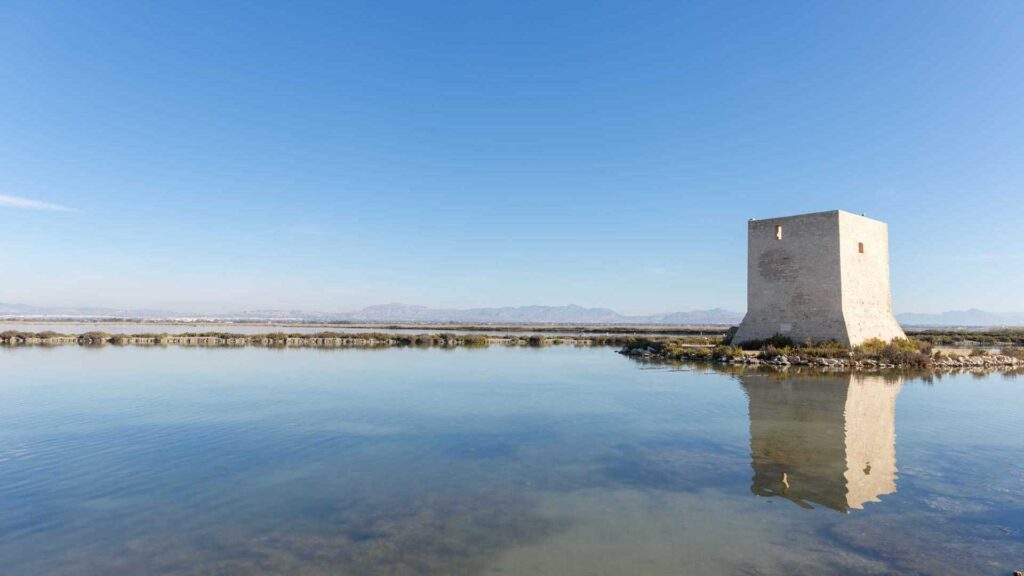
The Torre del Tamarit is one of the most recognisable visual landmarks in the Salinas.
The small historic tower stands beside the salt ponds and appears in many photographs of the natural park, often reflected in shallow water with flamingos or other birds in the background.
Its importance for a visitor is primarily visual and historical.
It provides:
- one of the most distinctive photographic compositions in the park;
- a human landmark inside an otherwise flat wetland;
- a connection with the historic coastal landscape.
Is Tamarit Tower a major attraction?
No.
Do not travel from Benidorm expecting a large monument with extensive interiors or a long historical visit.
Its value comes from the setting.
The tower works best as part of the broader Salinas landscape.
Photography around Tamarit Tower
The area can be especially attractive:
- early in the morning;
- late in the afternoon;
- when water levels create reflections;
- when birds happen to be present nearby.
Again, use safe and permitted observation points.
Do not enter restricted salt-production areas trying to improve the angle.
Should You Try to See Every Part of the Natural Park?
No.
The park is too large and too sensitive for that to be a useful objective.
A much better first visit is:
- understand the landscape at the Salt Museum;
- complete the short birdwatching route;
- visit one additional area such as El Pinet;
- enjoy the broader Salinas from safe observation points.
That gives you several different perspectives without turning the day into hours of driving between similar ponds.
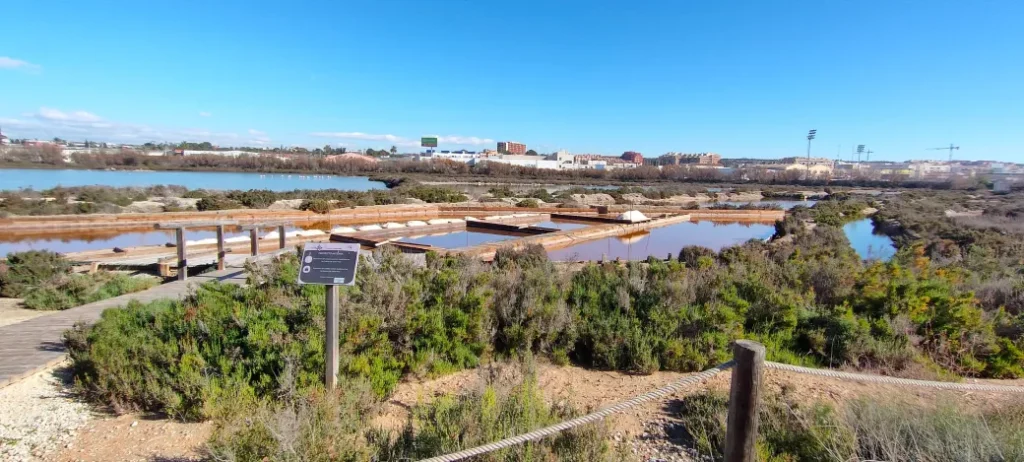
Which Area Is Best for First-Time Visitors?
For most people:
Best starting point: Salt Museum
Because it gives you context and easy birdwatching.
Best second stop: El Pinet
Because it adds a more open landscape and coastal environment.
Best photographic landmark: Tamarit Tower
Because it provides one of the most recognisable views of the Salinas.
Best strategy for serious birdwatchers
Spend longer at official observation points and let wildlife determine the pace of the day.
Do not constantly relocate in search of “better” flamingos.
Birdwatching often improves when you simply stay still.
How Close Can You Get to the Birds?
Usually, not especially close.
That is exactly how it should be.
The Salinas are habitat first and visitor attraction second.
Flamingos and other birds should not need to move because someone wants a photograph.
Remain:
- on official paths;
- behind observation structures;
- outside restricted areas;
- quiet around feeding and resting birds.
A pair of binoculars or a telephoto lens is the appropriate way to reduce apparent distance.
Walking toward the birds is not.
Are Binoculars Worth Bringing?
Absolutely.
For this particular experience, binoculars may be the single most useful optional item.
Even an inexpensive compact pair can make a major difference.
Without binoculars:
“There are some birds over there.”
With binoculars:
“Those are flamingos, stilts and ducks feeding in different parts of the pond.”
That changes the quality of the visit considerably.
If you already own binoculars, bring them.
If you are genuinely interested in birdwatching and expect to explore more Costa Blanca wetlands later, this is also the kind of destination where buying a basic pair can start to make sense.
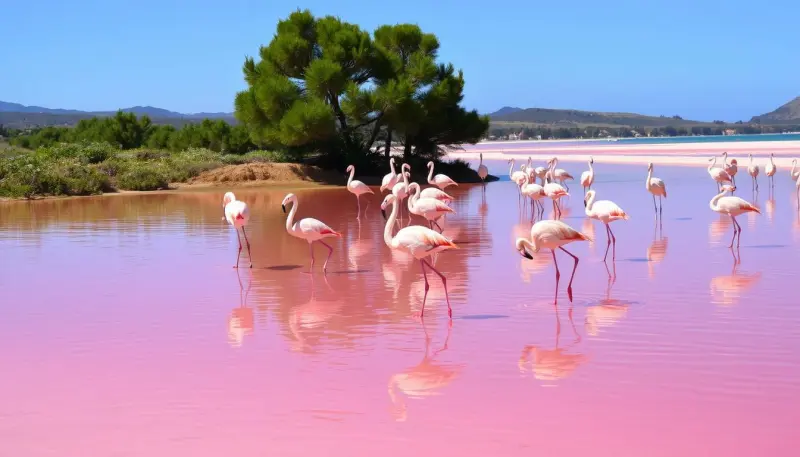
How Should You Structure the Visit?
For most first-time visitors, I would recommend:
First: Salt Museum and Interpretation Centre
Learn what you are looking at.
Second: Museum Birdwatching Route
Use the observation facilities and see what species are present.
Third: El Pinet or Another Official Observation Area
Experience a broader and quieter part of the wetland.
Fourth: Continue into Santa Pola
Finish the nature-focused part of the day and move toward lunch, the port or another activity.
This gives the visit a logical progression:
understand → observe → explore → relax.
It is much more satisfying than driving randomly around the edge of the Salinas hoping to find flamingos close to the road.
Flamingos and Birdwatching
Flamingos are the species most visitors hope to see at the Santa Pola Salt Lakes.
That expectation is understandable.
The common flamingo is one of the park’s resident species, and large groups can sometimes be visible across the shallow ponds. Birding Comunitat Valenciana lists the species among the year-round residents of the natural park.
However, the number of flamingos you actually see — and how close they appear — varies considerably.
Can You See Flamingos All Year?
Yes, in the sense that common flamingos are resident in the natural park.
No, in the sense that there is no guarantee of a spectacular close view on every visit.
Birds move between ponds according to:
- water depth;
- salinity;
- food availability;
- disturbance;
- season;
- management of the salt works.
A group that was easy to photograph one week may be much farther away the next.
This is why it is better to think:
“I am visiting an important wetland where flamingos live.”
rather than:
“I am visiting a place where I am guaranteed a close-up flamingo experience.”
That distinction will protect you from one of the most common sources of disappointment.
What Is the Best Time of Year for Birdwatching?
Official birding information recommends spring, autumn and winter as the strongest general seasons for visiting the Salinas.
Each season offers something different.
Spring
Spring is particularly interesting because breeding and migratory activity increases.
Species recorded during the warmer breeding season include terns, purple herons, collared pratincoles and spoonbills, alongside resident flamingos and other wetland birds.
This is also an attractive period for photography because temperatures are usually more comfortable than in midsummer.
Summer
Summer still offers birdlife, but heat becomes the main disadvantage.
Some breeding species remain present, and flamingos may still be visible.
However, long periods outdoors in exposed wetlands can become uncomfortable during the middle of the day.
Early morning is the sensible choice.
Autumn
Autumn combines migration with improving temperatures.
This can provide excellent birding conditions, particularly for visitors who are not specialists but simply want to see a varied wetland landscape.
Winter
Winter is one of the most interesting seasons.
A large number of additional species use the park during this period, including cormorants, marsh harriers, ospreys, teal, shoveler, waders and other waterbirds.
For long-stay residents in Benidorm, this makes Santa Pola particularly useful because it remains a worthwhile excursion outside the normal beach season.
What Other Birds Can You See?
Flamingos may attract the attention, but they are only part of the experience.
Resident species listed for the park include:
- black-necked grebe;
- common shelduck;
- red-crested pochard;
- white-headed duck;
- marbled duck;
- grey heron;
- little egret;
- glossy ibis;
- pied avocet;
- black-winged stilt;
- Kentish plover;
- Audouin’s gull.
Seasonal migration adds many more possibilities.
You do not need to identify all of them.
For beginners, a more enjoyable approach is to learn to recognise a handful of obvious groups:
- flamingos;
- herons;
- ducks;
- stilts;
- avocets;
- gulls;
- terns.
Once you begin noticing differences in shape, colour and feeding behaviour, the wetland becomes much more interesting.
Do You Need Binoculars?
You do not need binoculars to visit.
But you will almost certainly enjoy the Salinas more if you bring them.
Birds often remain at considerable distance.
Even a basic compact pair can help you see:
- individual flamingos;
- feeding behaviour;
- different duck species;
- waders along the shallow edges;
- birds too distant to identify with the naked eye.
For this guide, binoculars are more useful than hiking equipment.
If you already own a pair, this is exactly the kind of excursion where they deserve a place in your bag.
What About Photography?
Wildlife photography requires realistic expectations.
A smartphone can produce excellent photographs of:
- reflections;
- salt ponds;
- Tamarit Tower;
- skies;
- landscapes;
- groups of distant flamingos.
For detailed photographs of individual birds, a telephoto lens is much more useful.
The important principle is simple:
use focal length to get closer, not your feet.
Do not leave paths, cross boundaries or approach resting birds because you want a better photograph.
Best Time of Day
Early morning is usually the strongest all-round choice.
Advantages include:
- softer light;
- cooler temperatures;
- less heat shimmer over the water;
- potentially more bird activity;
- fewer visitors.
Late afternoon can also produce attractive light and reflections.
The middle of the day is generally the least appealing time, particularly in summer, because:
- temperatures rise;
- light becomes harsh;
- heat haze reduces long-distance visibility;
- walking feels less comfortable.
The park’s visitor facilities are currently listed as open Monday to Sunday from 09:00 to 14:00, including the visitor centre, observation facilities and Salt Museum area.
That naturally makes a morning visit the easiest option for first-time visitors.
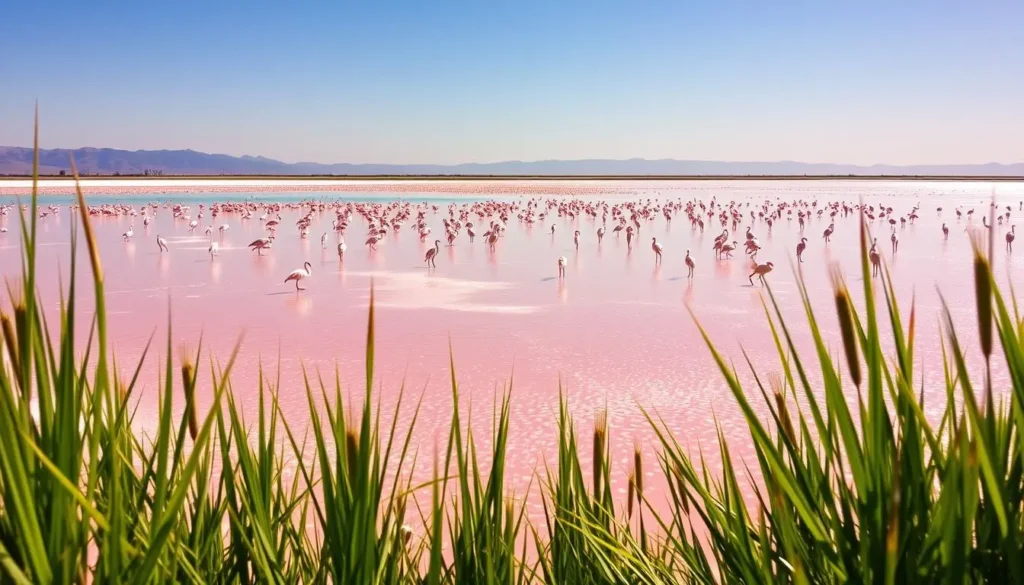
How to Get There from Benidorm
Santa Pola lies considerably farther south than destinations such as Altea, Calpe or Serra Gelada.
For that reason, transport matters more.
A car provides the greatest flexibility, particularly if you want to combine the visitor centre with El Pinet, Tamarit and Santa Pola itself.
Public transport remains possible, but it works best when the day is planned around Santa Pola town and the Salt Museum rather than multiple wetland locations.
By Car
For most visitors, driving is the simplest option.
The usual route from Benidorm heads south through the Alicante area before continuing toward Santa Pola.
Depending on traffic and your exact starting point, you should think in terms of roughly one hour to one hour and fifteen minutes each way, with additional time possible around Alicante during busy periods.
The main advantage is not simply speed.
It is flexibility.
With a car, you can realistically combine:
- Salt Museum;
- birdwatching route;
- Tamarit area;
- El Pinet;
- Santa Pola town;
- lunch or beach.
You can also adapt the itinerary immediately if one observation area is quiet.
Where Should You Drive First?
For a first visit, set the Salt Museum / Natural Park Visitor Centre as your initial destination rather than simply entering “Salinas de Santa Pola” into the navigation system.
The official visitor centre is located at:
Av. Zaragoza, 45, Santa Pola
and the park information currently lists visitor facilities, parking, an observatory and interpretive routes there.
Starting here gives the day structure.
Afterwards, you can decide whether to continue toward another wetland area.
By Public Transport
Public transport is possible, but the journey is less direct than driving.
A practical approach is generally:
- travel from Benidorm to Alicante;
- change to a Santa Pola bus.
Vectalia currently operates regular services between Alicante Bus Station and Santa Pola. Its Santa Pola–Alicante corridor includes direct services as well as routes serving Gran Alacant, Arenales del Sol and El Altet.
The current timetable shows frequent departures throughout the day in both directions, making a day trip realistic when connections from Benidorm align well.
However, the total journey is substantially longer than driving because you need to account for:
- Benidorm to Alicante;
- transfer time;
- Alicante to Santa Pola;
- movement within Santa Pola;
- return connections.
For this reason, public transport is best suited to a full-day visit, not a quick morning excursion.
Can You Reach the Salt Museum Without a Car?
Yes.
The Salt Museum is on the urban edge of Santa Pola rather than deep inside an inaccessible natural area.
Once in Santa Pola, local buses can help with movement around town, and the current urban network includes services toward the Tamarit area.
This makes the museum and its associated birdwatching route reasonably practical for visitors without a car.
Can You Visit El Pinet Easily Without a Car?
This is where the limitations become more noticeable.
El Pinet is not as convenient to integrate into a car-free itinerary.
Public transport may get you relatively close depending on the service and season, but the journey becomes less straightforward and requires more timetable planning.
For a first car-free visit, I would prioritise:
- Salt Museum;
- birdwatching route;
- Santa Pola town;
- Tamarit if local transport fits.
Save El Pinet for a day when you have a car, taxi or deliberately planned transport.
Do You Need a Car?
Strictly speaking, no.
Practically, it depends on what you want from the day.
You do not need a car if your objective is:
- visit the Salt Museum;
- complete the short birdwatching route;
- spend time in Santa Pola;
- have lunch;
- enjoy a relaxed nature-focused day.
A car becomes much more useful if you want:
- several observation locations;
- El Pinet;
- photography at different points;
- maximum flexibility;
- an early start;
- the ability to adapt according to bird activity.
Is a Taxi Worth Considering?
Potentially, but mainly for shorter local transfers.
Taking a taxi all the way from Benidorm would be expensive compared with driving or public transport.
However, a taxi within the Santa Pola area can be useful if:
- you arrived by bus;
- you want to reach a less convenient observation area;
- several people share the fare;
- you want to avoid spending a large part of the day coordinating local buses.
For a group of two to four people, combining intercity public transport with one local taxi can sometimes offer a good compromise.
Which Transport Option Is Best?
For most first-time visitors:
Car: best overall.
Public transport: perfectly viable for Salt Museum + Santa Pola town.
Public transport + local taxi: useful compromise if you want one additional wetland area.
The Salinas are not inaccessible without a vehicle.
But unlike Serra Gelada, where public transport can actually simplify a linear hiking route, here a car genuinely expands the experience.
Planning Your Visit
The Santa Pola Salt Lakes are easy to underestimate because the terrain is flat and there is no major physical challenge.
In practice, the quality of the visit depends much more on timing than on fitness.
Light, temperature, bird activity and access to the interpretation facilities all change the experience considerably.
How Much Time Do You Need?
For a first visit, allow around two to three hours for the Salinas themselves.
That is enough to:
- visit the Salt Museum;
- complete the short birdwatching route;
- spend time at an observation point;
- move to one additional area if you have a car.
Serious birdwatchers can easily spend much longer.
A half-day works well when your only objective is the natural park.
For someone travelling all the way from Benidorm, however, a full Santa Pola day usually makes more sense.
Best Time of Day
Morning is the strongest default choice.
The visitor facilities are currently listed as operating from 09:00 to 14:00, so an early arrival allows you to use the museum and observation infrastructure before moving elsewhere. (birding.comunitatvalenciana.com)
Morning also provides:
- cooler temperatures;
- softer light;
- less heat shimmer;
- more comfortable walking;
- better conditions for photography.
Late afternoon can also be excellent for landscape photography, particularly around reflections and Tamarit Tower.
The middle of the day is usually the least attractive period in summer.
Best Time of Year
Santa Pola is a year-round destination, but the experience changes with the seasons.
Spring
One of the best all-round periods.
Migration and breeding activity increase bird diversity, while temperatures are generally comfortable.
This is an excellent season for combining birdwatching with walking and photography.
Summer
Summer remains viable, but timing becomes critical.
Visit early.
The wetlands offer very little continuous shade, and direct sun reflected from water and pale salt surfaces can make the heat feel particularly strong.
A good summer strategy is:
- Salinas early in the morning;
- lunch or indoor cultural visit at midday;
- beach or seafront later in the afternoon.
Autumn
Another strong period, particularly because of migration and milder weather.
This is likely to be one of the best times for long-stay residents who want a nature excursion after the main summer season.
Winter
Winter can be excellent for birdwatching.
Additional wintering species use the wetlands, temperatures are comfortable for standing at observation points and the light can be very attractive on clear days.
For anyone staying on the Costa Blanca outside summer, Santa Pola becomes particularly valuable.
What Weather Should You Avoid?
Heavy rain naturally reduces the appeal of an exposed wetland.
Strong wind is another factor.
Wind can make binoculars harder to hold steady, reduce comfort at observation points and make wildlife photography frustrating.
Extreme heat is the most important problem in summer.
This is not a physically dangerous mountain route, but several hours standing or walking around open salt ponds in very high temperatures can still result in dehydration and heat stress.
What Should You Bring?
The Salinas require very little specialist equipment.
Binoculars
The most useful item after water.
Even a basic pair dramatically improves wildlife observation.
Comfortable Shoes
Normal trainers or walking shoes are sufficient for most official routes.
There is no need for hiking boots unless you plan a longer walk elsewhere.
Water
Carry enough for several hours, particularly in warm weather.
Because Santa Pola is nearby, resupply is easy once you leave the natural park.
Sun Protection
Bring:
- sunscreen;
- sunglasses;
- hat.
Do not assume the wetland provides shade.
Camera
Optional but worthwhile.
A telephoto lens is particularly useful for birds.
A phone remains perfectly adequate for landscape photography.
A Light Layer
Useful in winter or on windy mornings.
Flat coastal wetlands can feel much cooler when exposed to wind than the temperature forecast suggests.
Should You Bring Your Laptop?
For the Salinas themselves, no.
There is no useful reason to carry a laptop around the wetland.
It adds weight, heat sensitivity and responsibility while doing nothing to improve the experience.
Santa Pola town is different.
A digital nomad could visit the Salinas in the morning, have lunch and work from a suitable café later in the day.
If that is genuinely your plan, bringing a laptop may be reasonable.
Otherwise, leave it in Benidorm.
What Else Can You Do in Santa Pola?
The Salt Lakes work best as the nature-focused part of a broader Santa Pola day.
The town gives you several easy options once you finish birdwatching.
Santa Pola Port
The port is the most natural place to continue.
Santa Pola has a strong fishing identity, and the harbour area creates a completely different atmosphere from the wetlands.
After several quiet hours observing birds, moving toward the port adds:
- activity;
- boats;
- restaurants;
- sea views;
- a stronger sense of the town itself.
For most first-time visitors, this is the easiest next stop.
Castle-Fortress
The Castillo-Fortaleza sits in central Santa Pola and is one of the town’s main historic landmarks.
The municipal tourism service currently lists access to the Castle-Fortress and Museo del Mar as free.
The castle is particularly convenient because it does not require a major detour from the town centre.
There is one current detail worth knowing.
Restoration work has been affecting the clock-tower area during 2026. The main entrance reopened in July with a temporary protective structure while restoration preparations continued.
That does not make the castle unsuitable to visit, but the appearance of part of the building may be affected while works continue.
Museo del Mar
The Museo del Mar is located within the Castle-Fortress complex.
Its maritime and archaeological focus provides useful context for Santa Pola beyond the salt industry.
Current municipal tourism information lists entry as free.
This can be an especially good addition during the hottest part of a summer day.
Beaches
Santa Pola has several beaches, making it easy to finish the day beside the sea.
You do not need to choose the “best beach in Santa Pola” for this guide.
The objective is simply to add a relaxed coastal activity after the Salinas.
Levante Beach works well for convenience because it is close to central Santa Pola.
Gran Playa is another practical option.
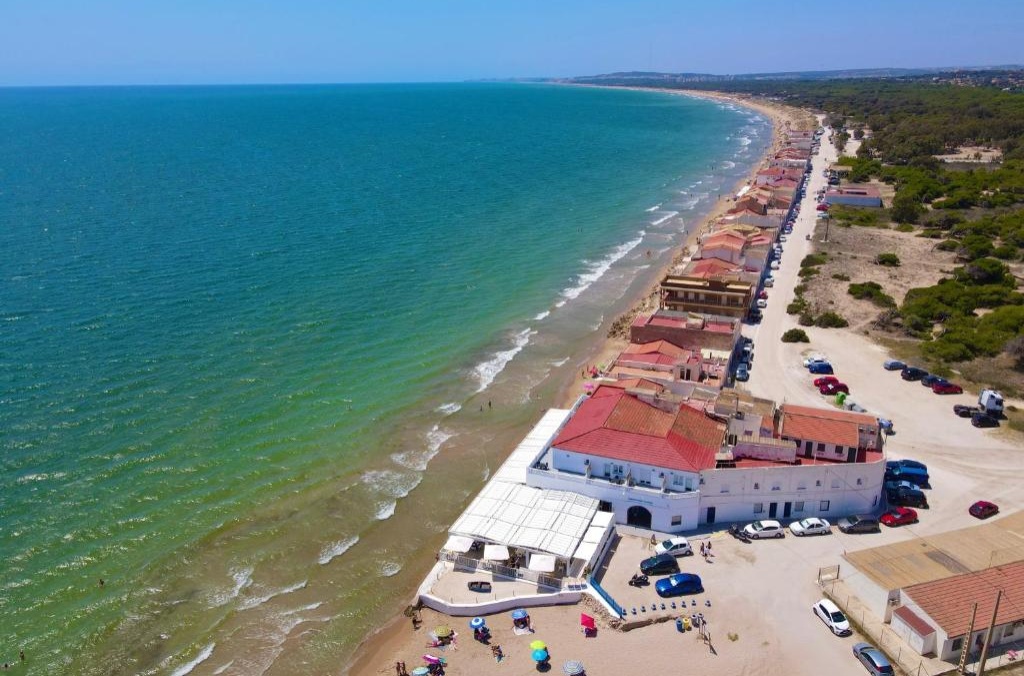
Tamarit Beach connects especially well with the salt-landscape theme and regained Blue Flag status in 2026.
Municipal beach information confirms that lifeguard coverage and other services vary by beach and season, so summer visitors should check current service periods rather than assuming year-round supervision. (santapola.es)
Coastal Walk
If you still want to walk after the Salinas, the seafront is a better choice than adding another long wetland route.
A simple port-and-beach walk lets you experience the Mediterranean side of Santa Pola without turning the day into another demanding itinerary.
Should You Add Tabarca?
Not on the same first visit.
Yes, boats to Tabarca leave from Santa Pola.
But Tabarca deserves its own day — and in this project it already has its own full guide.
Combining:
- Salinas;
- museum;
- ferry;
- Tabarca;
- return to Santa Pola;
- journey back to Benidorm
would turn two good experiences into one rushed schedule.
If you are staying on the Costa Blanca for several weeks, there is no reason to do that.
Food and Realistic Budget
Santa Pola works naturally as a lunch destination after the Salt Lakes.
The town’s fishing tradition makes seafood and rice the most obvious choices, but you can keep the day inexpensive if food is not a major priority.
Where to Eat
The port and central area are the most convenient places.
They allow you to finish birdwatching, park or arrive by bus and then continue the day on foot.
You will find:
- fish;
- seafood;
- rice dishes;
- tapas;
- Mediterranean menus;
- casual cafés.
For a first visit, convenience matters more than searching for a remote restaurant.
What to Eat
Fresh fish and seafood make sense in a fishing town.
Rice dishes are another natural option.
As elsewhere on the Costa Blanca, check:
- whether rice is priced per person;
- minimum number of diners;
- whether seafood is priced by weight;
- supplements not obvious from the first menu page.
Do not choose only according to the sea view.
Salt as Part of the Local Identity
Salt is not merely something you see in the landscape.
It remains central to Santa Pola’s identity.
The town’s tourism promotion in 2026 has explicitly used salt and local heritage as a central cultural theme, connecting the Salinas with other historic sites around Santa Pola.
That makes the Salt Museum more relevant than it may initially appear.
It connects the wetland with the town rather than presenting the Salinas as a separate nature attraction.
Low-Cost Day
A budget visit could include:
- public transport;
- free Salt Museum;
- free birdwatching route;
- food brought from home or simple lunch;
- free walk around Santa Pola;
- free beach.
Allow approximately:
€15–€30 per person
Transport will be the largest variable.
Standard Day by Car
A typical day might include:
- shared fuel;
- possible parking;
- Salt Museum;
- lunch;
- coffee;
- beach or town visit.
A reasonable planning range is:
€25–€50 per person
The cost falls when several people share a vehicle.
Comfortable Day
Add:
- taxi or more expensive transport;
- substantial seafood or rice lunch;
- several drinks;
- extra cafés or snacks.
Allow approximately:
€45–€80+ per person
These are broad planning estimates rather than guaranteed prices.
Example Budget
| Expense | Budget Day | Comfortable Day |
|---|---|---|
| Salt Museum | Free | Free |
| Birdwatching route | Free | Free |
| Castle / Museo del Mar | Free | Free |
| Transport | €8–€20 | €20–€40+ |
| Lunch | €8–€15 | €20–€35+ |
| Coffee / drinks | €2–€5 | €6–€12 |
| Beach / walking | Free | Free |
| Approximate total | €15–€40 | €45–€80+ |
Current municipal tourism information lists the Salt Museum, Museo del Mar and Castle-Fortress access as free, which helps make Santa Pola a particularly strong-value day trip.
Is Santa Pola Good Value?
Yes.
Especially for long-stay residents.
The main experience costs nothing.
You can spend several hours in a protected natural environment, visit cultural sites and finish by the sea without purchasing a major attraction ticket.
The day only becomes expensive if you choose expensive transport or a substantial seafood meal.
For digital nomads and residents managing a monthly leisure budget, the Santa Pola Salt Lakes are one of the more economical full-day experiences in this series.
Common Mistakes
The Santa Pola Salt Lakes are easy to visit, but they are also easy to misunderstand.
Most disappointing visits come from unrealistic expectations or poor planning rather than from the wetland itself.
Expecting Guaranteed Flamingos
Flamingos are resident in the park, but that does not mean they will always be close, numerous or easy to photograph.
Their position changes according to water levels, food availability and disturbance.
A successful visit should not depend on seeing a particular number of birds.
Thinking You Can Walk Everywhere
The Salinas are a protected natural park and an active salt-production landscape.
Not every pond, track or embankment is open to visitors.
Stay on:
- official paths;
- designated routes;
- observation areas;
- clearly permitted access points.
Do not interpret an unmarked track as an invitation to explore.
Stopping Unsafely Along the N-332
The road gives impressive views across parts of the wetland, which makes informal stopping very tempting.
Do not pull over on narrow shoulders or slow unpredictably because you see flamingos.
Use established parking and observation areas.
Arriving at Midday in Summer
This is one of the easiest ways to make the Salinas feel unpleasant.
The landscape is exposed, flat and reflective.
Visit early, then move into Santa Pola for lunch or indoor activities during the hottest part of the day.
Forgetting Binoculars
This does not ruin the visit, but it can reduce it significantly.
Birds that appear as distant shapes with the naked eye become much more interesting through binoculars.
If you own a pair, bring them.
Trying to Get Closer to Wildlife
The correct response to a distant bird is better optics, not walking toward it.
Do not:
- cross barriers;
- leave observation routes;
- approach feeding birds;
- use drones irresponsibly;
- create noise to make birds move.
The wetland exists for wildlife first.
Treating the Salt Ponds Like Recreational Lagoons
These are not swimming areas.
They form part of a protected ecosystem and active salt operation.
Use Santa Pola’s beaches if you want to swim.
Trying to See Every Corner of the Park
The Salinas cover a large area.
A first visit is better when you focus on a few representative locations rather than spending hours driving between ponds.
Combining Santa Pola Salt Lakes and Tabarca in One Rushed Day
Technically possible does not mean enjoyable.
The Salinas deserve a calm morning.
Tabarca deserves its own full excursion.
Trying to compress both into one day creates unnecessary timetable pressure and reduces the quality of both experiences.
Suggested One-Day Itinerary from Benidorm
A good Santa Pola day should begin with the wetland and become progressively more relaxed.
08:00–09:15: Travel from Benidorm
Leave early enough to arrive around the opening time of the visitor facilities.
By car, allow extra margin for traffic around Alicante.
Public transport users should plan connections in advance.
09:15–10:00: Salt Museum and Interpretation Centre
Start by understanding the landscape.
Learn about:
- salt production;
- pond management;
- birdlife;
- the history of the Salinas.
This context improves everything that follows.
10:00–11:00: Birdwatching Route
Complete the short route around the museum area.
Move slowly.
Use binoculars.
Spend time at the observation point rather than treating it as a walking exercise.
11:00–12:30: El Pinet or Another Observation Area
If you have a car, continue toward a second wetland location.
El Pinet provides a good contrast because it combines salt lagoons, dunes and coast.
Car-free visitors can instead remain longer around the museum area or move toward Tamarit using local transport where practical.
12:30–13:00: Move into Santa Pola
Finish the main nature-focused part of the day before the hottest hours.
13:00–14:30: Lunch
Choose the port or central area.
Seafood, fish or rice are natural options.
Do not schedule lunch so tightly that you have to abandon a good birdwatching moment.
14:30–16:00: Castle-Fortress and Museo del Mar
This works particularly well in summer because part of the afternoon can be spent away from the strongest sun.
Alternatively, skip museums and relax over coffee if you prefer a slower day.
16:00–17:30: Beach, Port or Seafront Walk
Choose according to energy and weather.
A swim or short coastal walk provides a completely different ending to the wetland experience.
17:30–19:00: Return to Benidorm
Drivers can remain flexible.
Public transport users should allow enough time to reach the correct stop without rushing.
Half-Day Alternative
If you only want the Salinas:
- travel early;
- visit the Salt Museum;
- complete the birdwatching route;
- visit one additional observation area;
- have lunch;
- return to Benidorm.
This works particularly well by car.
For public transport users, the full-day version generally makes better use of the longer journey.
Is It Worth Visiting for Digital Nomads?
Yes, especially for digital nomads who value quiet, nature and variety more than conventional attractions.
The Salt Lakes provide something that many remote workers need but do not always prioritise:
a slow environment with very little pressure to do anything.
You can spend an hour watching birds without achieving a measurable objective.
That is a useful contrast to a work routine built around:
- notifications;
- deadlines;
- analytics;
- calls;
- constant screen interaction.
Can You Work There?
Not meaningfully.
The wetland itself is not a remote-work destination.
There are no suitable workspaces, power facilities or reasons to sit with a laptop beside an observation pond.
The purpose of the Salinas is to observe and disconnect.
Could You Work in Santa Pola Afterwards?
Yes.
Santa Pola is a normal coastal town with cafés and other urban spaces.
A realistic remote-work version could be:
- Salinas early morning;
- lunch;
- short work session in Santa Pola;
- beach or seafront;
- return to Benidorm.
This makes the destination more flexible than an isolated mountain excursion.
Should You Bring Your Laptop?
Only if you genuinely intend to work afterwards.
Do not carry it around the wetland simply because you might use it.
If you have the full day free, leave it behind.
Who Will Enjoy It Most?
The Salinas are particularly suited to:
Birdwatchers
Obvious, but important.
Both beginners and experienced observers can find the park rewarding.
Photographers
Especially those interested in:
- wildlife;
- reflections;
- minimalist landscapes;
- sunrise or late-afternoon light;
- Tamarit Tower.
Slow Travellers
This is not a destination that rewards rushing.
People who enjoy simply observing a place will get more from it.
Long-Stay Residents
The Salinas offer variety after weeks of coastal resort life.
They are particularly useful in autumn and winter when beach-focused excursions become less appealing.
Nature Lovers Who Do Not Want a Hike
You can experience a major natural area without climbing mountains or completing a long trail.
Digital Nomads Needing a Mental Break
The flat, quiet landscape provides a strong contrast with screens and urban routine.
Who Might Be Disappointed?
Visitors Expecting a Flamingo Attraction
If you expect birds to stand close to a viewing platform on command, this is not the right place.
People Looking for Physical Adventure
There is very little hiking challenge.
Choose Serra Gelada or Peñón de Ifach instead.
Visitors Who Need Constant Entertainment
Wetland observation involves patience.
There may be periods where very little seems to happen.
People Without Interest in Wildlife or Landscapes
If birds, salt production and open environments do not interest you, the Salinas may feel visually repetitive.
Visitors Expecting a Single Major Attraction
There is no equivalent of a summit, castle or waterfall acting as a dramatic endpoint.
The experience is the landscape itself.
BenidormNomads Verdict
The Santa Pola Salt Lakes are one of the quieter and more specialised experiences in this series.
They are unlikely to be everyone’s favourite day trip.
But for the right visitor, they offer something genuinely difficult to find in Benidorm itself.
Birdlife: 9.5/10
This is the main strength.
The diversity of resident, breeding, migratory and wintering birds makes the park one of the best wildlife experiences on this part of the Costa Blanca.
Scenery: 8/10
The landscape is attractive but subtle.
Its strength lies in reflections, open horizons, salt ponds and changing light rather than dramatic terrain.
Photography: 9/10
Excellent for wildlife and minimalist landscape photography.
A telephoto lens increases the possibilities considerably.
Accessibility from Benidorm: 7/10
Driving is straightforward but relatively long compared with northern Costa Blanca destinations.
Public transport is possible but requires more planning and usually a change in Alicante.
Value for Money: 9.5/10
The core experience is free.
The Salt Museum and several complementary cultural attractions in Santa Pola are also currently free.
Transport and food are the main costs.
Walking Experience: 6.5/10
There are easy routes and pleasant observation walks, but this is not primarily a hiking destination.
Uniqueness: 9/10
The combination of active salt production, protected wetland and large bird populations creates a landscape unlike most other excursions from Benidorm.
Remote Work Compatibility: 5/10
The natural park itself is unsuitable for work.
Santa Pola town makes it possible to add a work session later, which raises the practical score.
Relaxation: 9.5/10
One of the strongest categories.
When the wetland is quiet, the open landscape and slow rhythm make it an excellent place to decompress.
Overall Atmosphere: 8.5/10
The Salinas feel calm, open and surprisingly removed from the busy Costa Blanca despite being close to roads and coastal development.
Overall Rating: 8.6/10
This is not the most dramatic experience in the series, but it is one of the most distinctive.
Its value increases considerably for birdwatchers, photographers and long-stay residents looking for variety.
Are the Santa Pola Salt Lakes Worth the Trip from Benidorm?
Yes — if you understand what kind of day you are choosing.
Go if you want:
- birdwatching;
- flamingos without unrealistic expectations;
- photography;
- quiet landscapes;
- a break from resort environments;
- an inexpensive nature-focused day;
- something different from another beach or mountain.
You may prefer another destination if you want:
- hiking;
- dramatic scenery;
- guaranteed wildlife encounters;
- a major attraction with a clear beginning and end.
For a first visit, the strongest plan is simple.
Start at the Salt Museum.
Spend real time observing the birds.
Visit one additional wetland area.
Then move into Santa Pola for lunch and a relaxed afternoon by the sea.
Do not chase flamingos from one pond to another.
Do not try to “complete” the natural park.
The Salinas work best when you slow down enough to notice what is already there.
For digital nomads and long-stay residents in Benidorm, that slower pace may be exactly what makes the journey worthwhile.