

Canelobre Caves from Benidorm: Are Alicante’s Giant Caves Worth the Trip?
There are plenty of day trips from Benidorm that revolve around beaches, viewpoints, mountain walks or historic towns. The Canelobre Caves offer something completely different.
Hidden high in the mountains above Busot, around 700 metres above sea level on the northern side of the Cabeçó d’Or, the caves are one of the most unusual natural attractions in Alicante province. You arrive in a dry, rocky Mediterranean landscape, follow the road up into the mountains and then disappear through a man-made tunnel into an enormous underground chamber that feels almost completely disconnected from the world outside.
That contrast is a large part of the appeal.
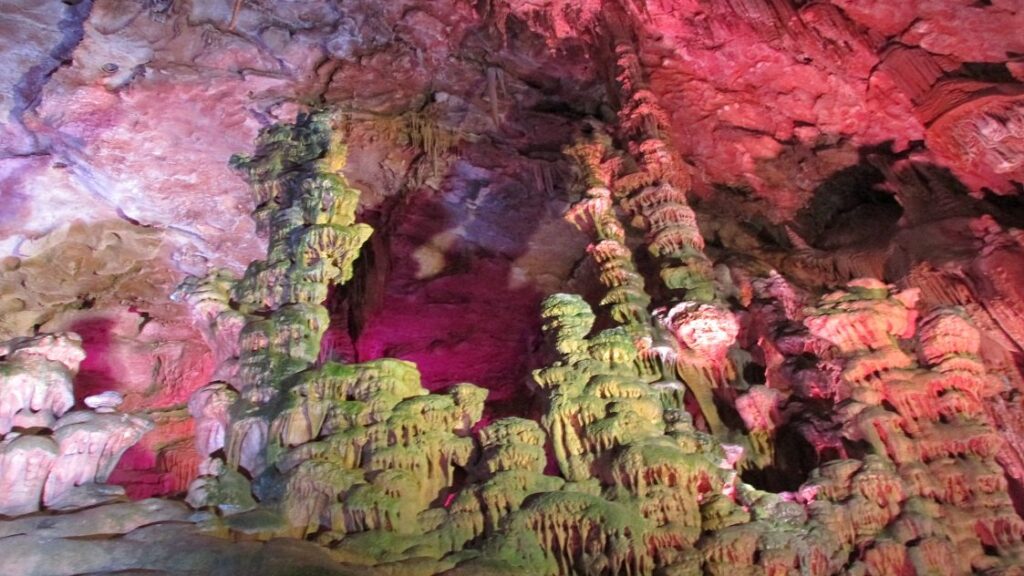
The visit is not especially long and the cave system open to the public is not enormous in the sense of involving kilometres of underground walking. What makes Canelobre memorable is scale. The main chamber contains a space of more than 80,000 square metres, with a vault reaching around 70 metres high. Inside, water and limestone have created stalactites, stalagmites, columns and other formations over immense periods of time.
The result is closer to entering a natural cathedral than exploring a narrow cave passage.
For someone staying in Benidorm for several weeks or months, this makes Canelobre particularly interesting. It provides a genuine change of environment without requiring a difficult hike or a full day of sightseeing. You can spend part of the day underground, part of it exploring Busot or the surrounding landscape, and return to the coast having experienced something that feels very different from the usual Costa Blanca routine.
The important thing is to understand what the visit actually offers before you go.
Canelobre is impressive, but it is not an enormous underground adventure where you spend three hours moving through multiple chambers. Nor is it a place where you freely wander at your own pace. The experience is structured around guided visits, and much of its impact comes from entering one extraordinary chamber, understanding its geology and history, and taking in its scale.
That means the question is not simply whether the cave is beautiful.
The more useful question is:
Is the experience substantial enough to justify travelling from Benidorm?
For most people who enjoy natural landscapes, geology or unusual places, the answer is yes — particularly if the visit is combined intelligently with Busot or another nearby stop.

What Are the Canelobre Caves?
The Cuevas del Canelobre are a karst cave system formed inside Jurassic limestone in the Cabeçó d’Or mountain range. The rock itself dates back roughly 145 million years, while the cave has been slowly shaped by water filtering through fractures in the limestone and dissolving the rock over enormous periods of time.
This process created the formations visitors see today.
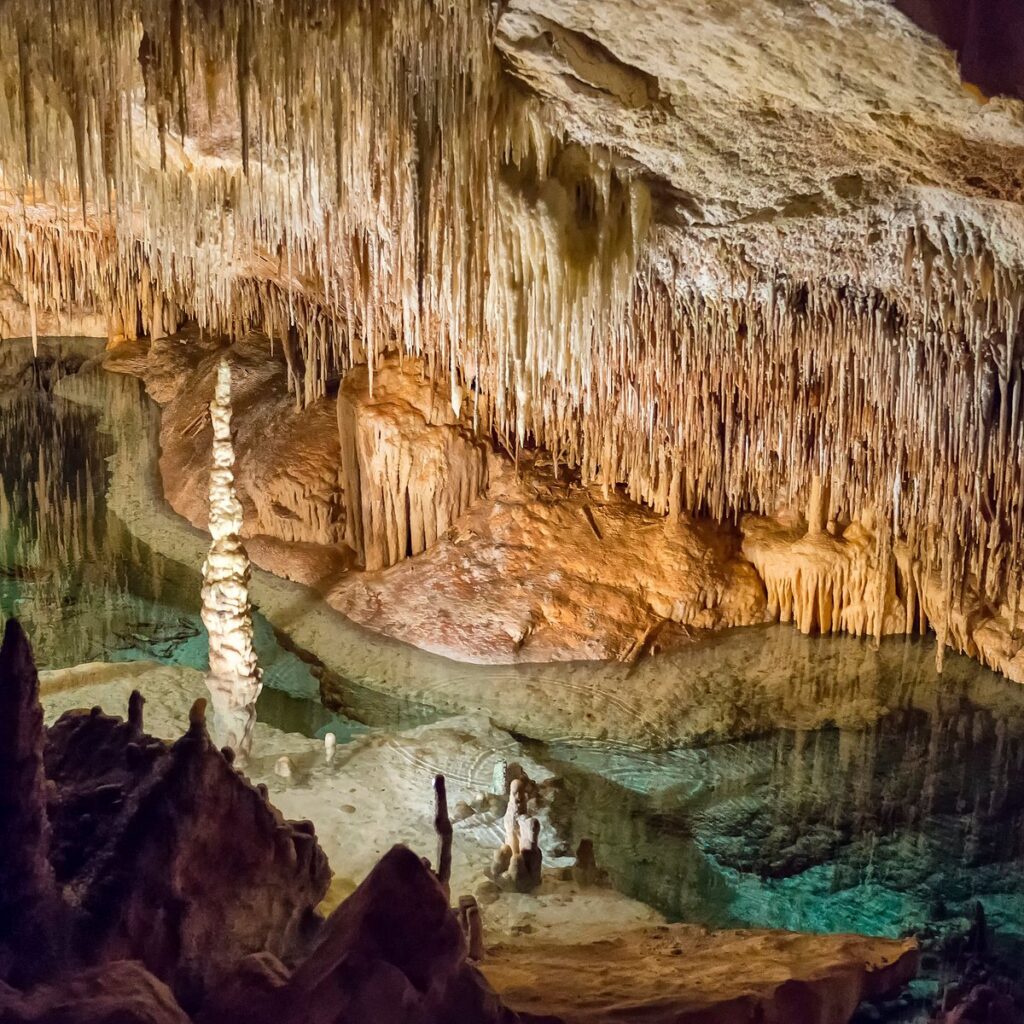
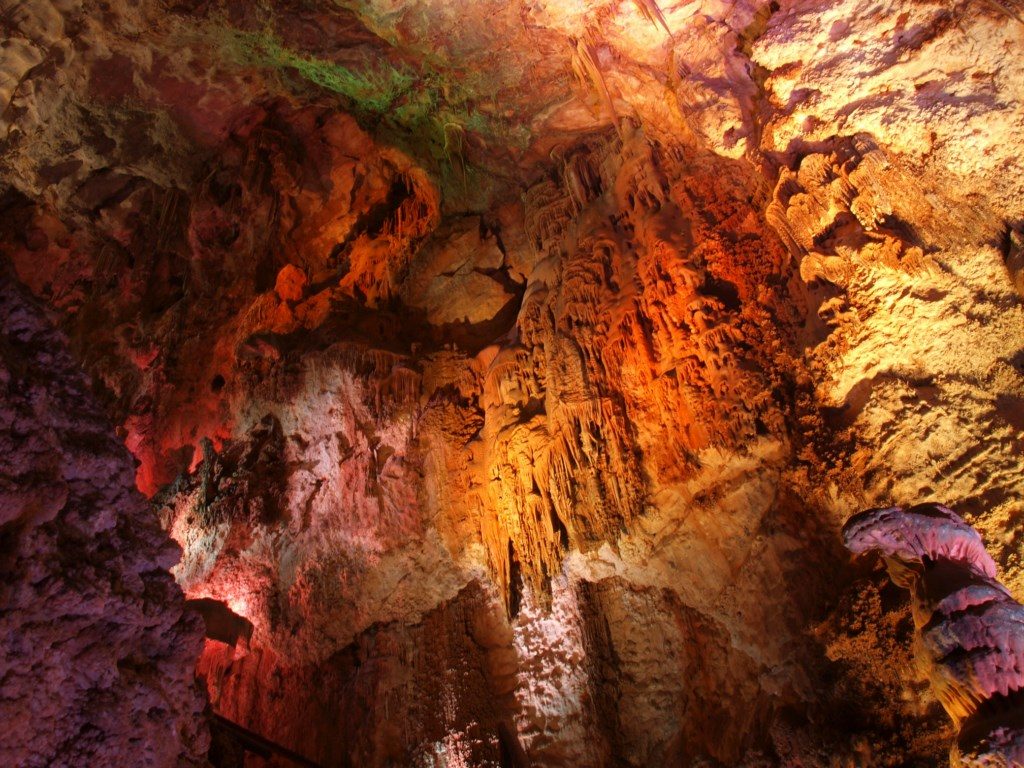
Stalactites grew downward from the ceiling as mineral-rich water deposited calcium carbonate. Stalagmites formed on the floor below. In places where the two eventually met, they created columns. Elsewhere, the water produced more irregular shapes, curtains and structures that people have interpreted as familiar objects or figures.
The name Canelobre itself comes from one of the cave’s most famous formations, a large stalagmite whose shape resembles a traditional candelabrum.
But while individual formations are interesting, the chamber itself is what usually leaves the strongest impression.
A Cave That Feels Like a Cathedral
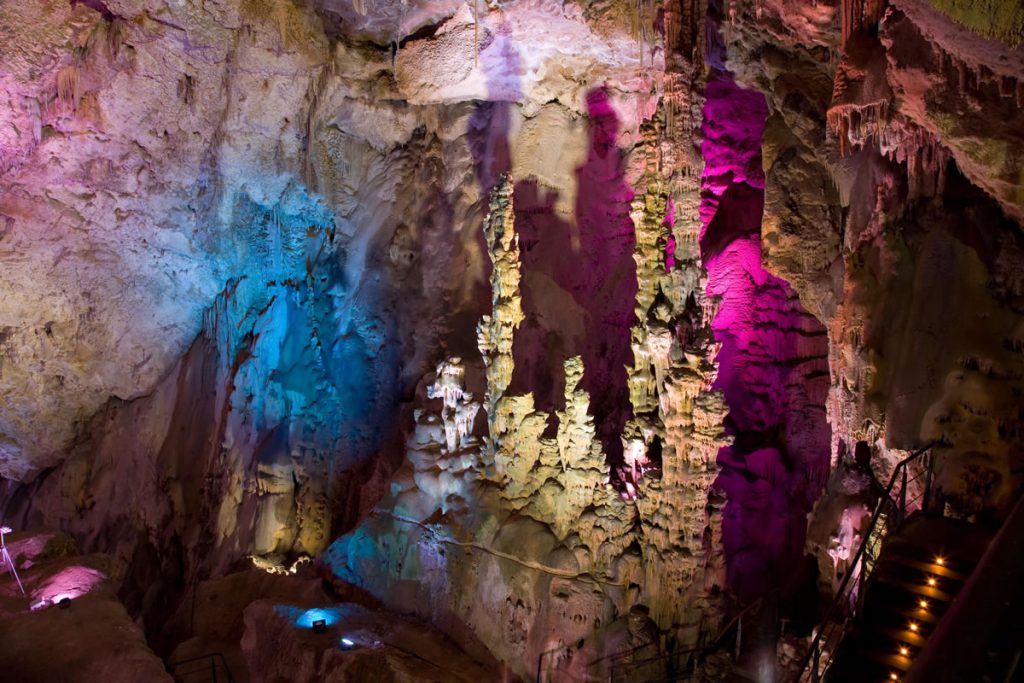
The main vault reaches approximately 70 metres in height, making it one of the highest cave vaults open to visitors in Spain. The dimensions change your perception almost immediately after entering. Instead of feeling confined underground, you find yourself in a huge vertical space where the ceiling rises far above you and artificial lighting reveals formations at different levels.
This cathedral-like scale is why photographs of Canelobre can be deceptive.
Pictures usually show impressive stalactites and illuminated rock, but they do not always communicate how much empty space surrounds them. Standing at the lower part of the chamber and looking upward gives a much better sense of why the cave has become one of Busot’s main attractions.
The acoustics also contribute to that feeling. The chamber has been used for musical performances because sound resonates strongly inside the cavern, adding another layer to the experience.
The Formations Inside
Several formations have been given names according to the shapes people see in them.
One of the best known is La Sagrada Familia, a group of formations dominated by a column more than 25 metres high. Another is El Canelobre, the stalagmite that gives the cave its name and is estimated to be more than 100,000 years old.
Like many show caves, some of the fun comes from deciding whether you can actually see the shapes described by the guide.
You may immediately recognise a figure.
You may see something completely different.
Or you may simply prefer to appreciate the formations as geology rather than trying to turn every section of rock into an object.
Either approach works.
What matters is remembering how slowly these structures develop. What appears to be a decorative feature has been created drop by drop over thousands or tens of thousands of years.
That scale of time gives the cave much of its fascination.
How Were the Caves Discovered?
Local tourism information traditionally attributes the discovery of the caves to the Arabs around the 10th century, although little is known with certainty about their early history. The cave did not open to the general public until well into the 20th century.
The most dramatic human intervention came much later, during the Spanish Civil War.
The Republican army used the cave as a workshop connected with aircraft repair. During this period, the current entrance tunnel was excavated and several platforms were created inside the cavern.
This history is easy to overlook when you visit.
The tunnel now feels like a convenient tourist entrance, but it is actually a relatively recent addition to a geological space that had existed for millions of years before anyone began modifying it.
That contrast between ancient geology and modern history makes the cave more interesting than its formations alone.
Entering Through the Mountain
The entrance used today is a tunnel approximately 45 metres long.
This creates one of the best moments of the visit.
Outside, you are surrounded by bright Mediterranean light, dry mountains and, on clear days, broad views across the Alicante landscape.
Then you enter the tunnel.
The light changes.
The temperature drops.
The sound changes.
And when the tunnel finally opens into the main chamber, the scale of the cave becomes visible.
That transition is much more effective than simply walking through a conventional doorway into an attraction.
It feels like entering the mountain.
A Natural Space, but Not an Untouched One
It is worth being clear that Canelobre is a developed show cave.
There are:
- stairs;
- platforms;
- artificial lighting;
- guided routes;
- safety infrastructure;
- a man-made entrance tunnel.
You are not entering a completely wild underground environment.
That is not a disadvantage.
The infrastructure makes it possible for ordinary visitors to appreciate a space that would otherwise require specialist equipment and experience.
But anyone expecting raw caving or an adventurous underground expedition should adjust expectations.
Canelobre is about seeing an extraordinary geological chamber comfortably and safely, not about crawling through tunnels with a helmet.
Why Visit the Canelobre Caves from Benidorm?
The strongest argument for visiting from Benidorm is variety.
Benidorm already gives you beaches, coastal walks, nightlife, restaurants and dramatic sea views. Nearby destinations such as Serra Gelada and Peñón de Ifach add mountains and hiking.
Canelobre adds something none of those places can provide.
It takes you underground.
And because the caves sit in the mountains above Busot, the journey also exposes you to a completely different side of Alicante province.
A Genuine Change of Environment
One of the benefits of staying somewhere for weeks rather than days is that you can start exploring places that would never make the itinerary of a weekend tourist.
Canelobre fits that category very well.
The cave may not be the first thing someone associates with the Costa Blanca, but that is precisely why it works so well for long-stay residents.
You leave a densely built coastal city, travel into increasingly rural terrain and end up high on the side of a mountain.
Then you spend part of the morning inside a cave where the temperature remains around 18°C throughout the year.
In summer, that contrast can be particularly striking.
Walking out of 35°C heat and into a cavern at roughly 18°C feels like entering another season.
In winter, the difference is smaller but the interior temperature remains relatively stable, making the caves a reliable year-round attraction.
You Do Not Need to Be Interested in Geology
Someone who already understands karst landscapes will obviously find plenty to appreciate.
But you do not need to know the difference between a stalactite and a stalagmite before arriving.
The attraction works primarily because of its visual scale.
You see enormous vertical spaces, illuminated rock formations and geological structures that clearly could not have been created on a human timescale.
That alone is enough to make the visit worthwhile for many people.
The guided format also means the geology is explained rather than simply presented.
It Works When You Want Something Interesting but Not Exhausting
Canelobre is particularly useful for days when you want to leave Benidorm but do not want a demanding physical activity.
Compared with hiking Peñón de Ifach or crossing Serra Gelada, the physical effort is modest.
There are stairs and changes in level inside the cave, so it is not completely effortless, but you do not need hiking fitness.
This makes it a good option:
- after several active days;
- during hot weather;
- when travelling with someone who does not want a serious hike;
- when you want a half-day experience rather than an expedition.
The trade-off is that the cave visit itself is relatively short.
You should not expect it to occupy six hours.
That is why the quality of the overall day depends on what you combine with it.
The Setting Adds More Than You Might Expect
If the caves were located beside a motorway in Alicante, the experience would still be interesting.
But the location adds significantly to the visit.
Busot sits around seven kilometres inland from the coast, at the foot of the Cabeçó d’Or, while the cave entrance is much higher on the mountain. The surrounding landscape feels far removed from the apartment towers and beaches of Benidorm.
The approach road, mountain views and sense of elevation all help create anticipation before you even enter the cave.
This also means you should not treat the journey purely as dead travel time.
Part of the appeal is watching the Costa Blanca landscape change as you move inland.
It Can Be More Than a Cave Visit
The key to making Canelobre worth the journey from Benidorm is not to think of it as an isolated attraction.
Busot itself can be explored afterwards, and the ticket currently includes access to the town’s Ethnic Music Museum. The surrounding Cabeçó d’Or area also opens up possibilities for walking and hiking, although combining a serious mountain route with a cave visit requires more planning than simply adding a stroll through the village.
This flexibility means Canelobre can become:
- a relaxed half-day excursion;
- a cave-and-Busot cultural day;
- a cave visit followed by lunch and coastal time;
- part of a more active mountain day.
That is much more useful for someone based in Benidorm than judging the caves only by how many minutes the guided tour lasts.
Who Is Likely to Enjoy It?
Canelobre has quite broad appeal.
It works particularly well for people interested in:
- unusual natural places;
- geology;
- photography;
- history;
- mountain landscapes;
- short excursions;
- activities that do not depend heavily on weather.
It can also work well for visitors who are tired of doing another beach day but do not necessarily want to spend six hours hiking.
Who May Find It Underwhelming?
The biggest risk is expecting an enormous cave network.
The chamber is enormous.
The actual visitor experience is comparatively compact.
If your mental image is of spending hours exploring tunnel after tunnel, Canelobre may feel shorter than expected.
Similarly, someone travelling a long distance solely to “tick off” the cave, completing the guided visit and immediately driving back to Benidorm, may question whether the journey was worthwhile.
That is why this guide will treat the caves as the centrepiece of the day, not necessarily the entire day.
Combined with Busot, the mountain landscape or another nearby stop, the experience becomes much more convincing.
And that is probably the best way for a Benidorm-based visitor to approach Canelobre: not as a giant tourist complex, but as a striking underground experience that opens the door to exploring a less familiar part of the Costa Blanca.

What Is the Cave Visit Actually Like?
The Canelobre Caves are not the kind of attraction where you wander freely for hours. The visit is organised, relatively compact and focused on the main chamber, but that does not mean it feels rushed or insignificant.
The experience starts before you even see the cave itself.
After climbing into the mountains above Busot, you arrive at a setting that already feels removed from the coast. The air is often cooler, the views open up across the surrounding landscape and the entrance sits directly in the side of the mountain.
From there, visitors enter through the tunnel created during the Spanish Civil War.
The transition is immediate. Bright Mediterranean light gives way to artificial illumination, the temperature drops and the acoustics change. For a few moments, you are moving through a fairly ordinary-looking tunnel.
Then the space opens.
That first view into the main chamber is probably the strongest moment of the entire visit.
The Main Chamber
The scale is difficult to appreciate from photographs.
The chamber is not simply wide. It rises dramatically above you, with the highest part of the vault reaching around 70 metres. Lighting picks out stalactites, columns and irregular limestone surfaces at different heights, while the darker sections of the cave make it difficult to judge exactly where the rock ends.
That combination of height, darkness and artificial lighting gives Canelobre its cathedral-like atmosphere.
You are not moving through narrow passages where the walls constantly press in around you. Instead, the cave feels unexpectedly open.
For visitors who are slightly uncomfortable in confined spaces, that distinction can matter. Although you are obviously underground, the main chamber itself does not usually create the same claustrophobic sensation as a narrow cave system.
The entrance tunnel is more enclosed, but once inside the chamber the sense of vertical space becomes dominant.
How the Guided Visit Works
Visits are organised in groups rather than as unrestricted self-guided entry.
The current system uses scheduled passes, generally spaced at intervals of around 40 minutes, although exact operating arrangements can change with season, visitor numbers or special events.
A guide accompanies the group through the accessible part of the cave and explains its geology, formations and history.
The guided format is useful here.
Without explanation, many visitors would probably walk through, admire the scale, photograph a few formations and leave without understanding much about what they had seen.
The commentary provides context about how the cave formed, how slowly stalactites and stalagmites grow and how the space was altered during the Spanish Civil War.
It also draws attention to formations you might otherwise overlook.
The disadvantage is that you cannot simply remain inside indefinitely.
If you are the type of photographer who wants twenty minutes to set up one composition, or someone who prefers exploring attractions entirely at your own pace, the structured format may feel slightly restrictive.
For most visitors, however, the guided visit is a sensible balance.
How Long Does the Visit Take?
The underground portion is relatively short compared with some large cave complexes.
A typical visit takes roughly 40 to 45 minutes, although the exact duration can vary.
That is enough time to understand the main chamber and appreciate its most important formations, but it is also one of the reasons you should avoid imagining Canelobre as a full-day attraction by itself.
You may spend considerably more time on the overall visit once you include:
- parking;
- waiting for your scheduled entry;
- enjoying the viewpoints outside;
- using the visitor facilities;
- travelling between the caves and Busot.
But the cave tour itself is compact.
This is not necessarily a weakness.
Forty minutes underground can feel substantial when the surroundings are visually intense, and the experience does not need to be stretched artificially.
The mistake is simply travelling from Benidorm expecting several hours of underground exploration.
The Route Inside
The accessible route involves changes in level and a significant number of steps.
You enter near the upper part of the chamber and move through different viewing positions that allow you to appreciate the cave from changing perspectives.
This matters because Canelobre is a very vertical space.
From one level, you may be looking across the chamber.
From another, you are looking upward toward formations and the enormous ceiling.
At lower points, the scale of the space becomes even more obvious.
The stairs are part of what makes those different viewpoints possible.
They also mean the caves are not completely effortless for every visitor.
How Physically Difficult Is It?
For an average visitor, the cave is not physically demanding.
You do not need hiking fitness, specialist footwear or technical ability.
However, anyone with:
- significant mobility limitations;
- knee problems;
- difficulty with stairs;
- balance issues
should check current accessibility conditions before visiting.
The main challenge is repeated stair use rather than distance.
For most people, normal comfortable shoes are enough.
Flip-flops or unstable footwear are a poor choice, particularly because cave surfaces can feel humid and steps require attention.
The interior temperature also makes heavy hiking clothing unnecessary.
Is the Cave Slippery?
Caves are naturally humid environments, and parts of the floor or stairs can sometimes feel damp.
The tourist route is prepared for visitors, but you should still walk carefully rather than treating the stairs like an ordinary indoor staircase.
Good grip is more useful than fashionable footwear.
This is especially relevant for anyone visiting directly after a beach day and arriving in sandals.
The Temperature Inside
One of the most pleasant aspects of Canelobre is its relatively stable underground temperature.
The interior remains at around 17–18°C throughout much of the year.
That creates very different experiences depending on when you visit.
In summer, the cave can feel wonderfully cool.
If you arrive after walking from a car park under strong Alicante sun, the temperature change is immediate and refreshing.
In winter, the cave can actually feel relatively mild compared with a cold or windy day outside.
For most visitors, normal clothing is enough.
However, people who feel cold easily may appreciate a light layer, especially if they arrive in summer wearing only shorts and a thin T-shirt.
Does It Feel Cold?
Usually not in the way people imagine when they hear “cave”.
You are not entering an icy underground environment.
The temperature is cool and stable rather than genuinely cold.
The important difference is relative.
If the outside temperature is 34°C, 18°C feels dramatically cooler.
If you are visiting on a mild winter day, the contrast may barely register.
The Most Impressive Formations
The guided visit draws attention to several named formations, but the most useful advice is not to become obsessed with remembering every name.
Part of the experience is simply looking.
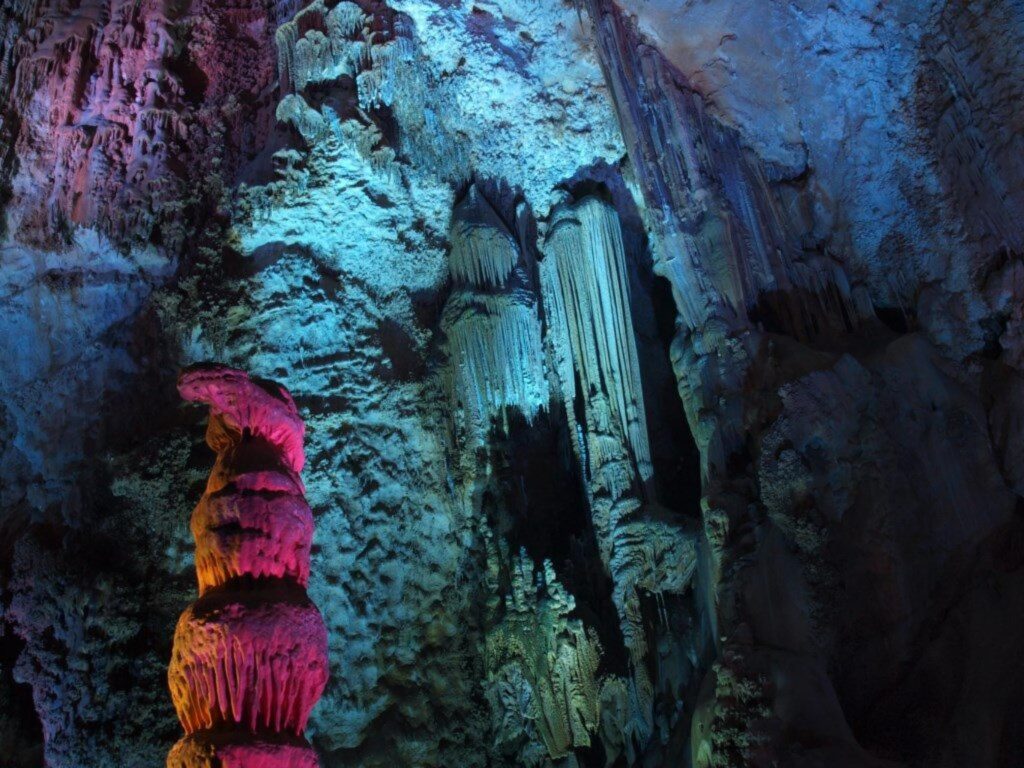
The cave contains a wide range of structures produced by mineral deposits over vast periods of time. Some are thin and delicate. Others are massive columns that appear almost architectural.
The famous formation known as El Canelobre resembles a large candelabrum and gives the caves their name.
Another major feature is the group known as La Sagrada Familia, which includes one of the largest columns inside the cave.
These named formations help visitors orient themselves, but they should not become a checklist.
The cave is most impressive when viewed as a complete environment.
The height of the chamber, the lighting, the shapes in the rock and the sense of geological time work together.
Lighting: Atmospheric but Artificial
The cave is illuminated specifically for visitors.
That lighting helps reveal formations that would otherwise disappear into darkness and creates dramatic contrasts across the chamber.
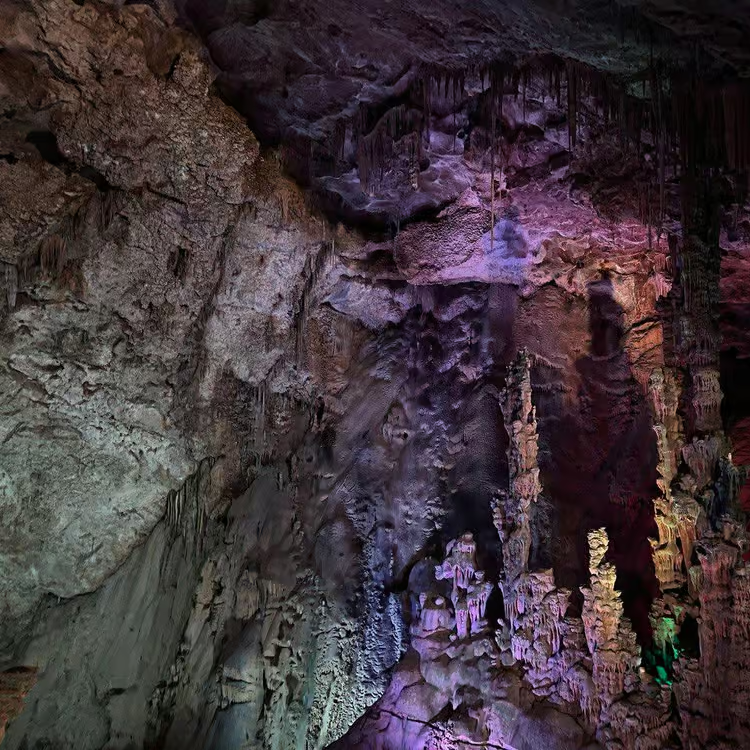
It also means the colours you see are partly influenced by artificial light.
This is worth remembering when looking at photographs online.
Some images may appear intensely coloured or almost theatrical.
The actual experience is darker and more atmospheric.
Your eyes also adjust differently from a camera sensor.
In person, the feeling of scale is usually more impressive than the colour.
Can You Take Photos?
Photography rules can change, particularly if visitor management or conservation requirements are adjusted, so it is worth checking the current instructions when you arrive.
Where photography is permitted, caves create several challenges.
Low light means smartphones may:
- increase noise;
- blur movement;
- over-process shadows;
- struggle with extreme contrast.
Modern phones can still produce good results, especially if you hold them steady and avoid excessive digital zoom.
A dedicated camera performs better, but photography should not dominate the visit.
Because you are moving with a guided group, there is limited time to stop repeatedly.
The best strategy is to take a few photographs and then actually look at the chamber.
Is a Tripod Practical?
Normally, no.
Even if technically allowed, setting up a tripod inside a moving guided group would be inconvenient and potentially disruptive.
Canelobre is better approached as handheld travel photography than as a dedicated architectural photo shoot.
What About Video?
Short clips can communicate the scale of the chamber better than still photographs, particularly when you slowly pan from floor to ceiling.
Again, follow whatever rules are given at the entrance.
Avoid bright lights, flash or anything that interferes with other visitors.
The Acoustics
One of the more unusual characteristics of the cave is its sound.
The large chamber creates strong reverberation, and this has allowed Canelobre to be used for concerts and musical performances.
Even during a normal visit, you notice that voices behave differently inside.
The sound lingers.
That acoustic character reinforces the cathedral comparison and makes the chamber feel larger than it appears in photographs.
If your visit happens to coincide with a special musical event, the experience would obviously be very different from a standard tourist tour.
Does It Feel Crowded?
That depends heavily on timing.
Because visits are organised into groups, you will never have the unrestricted solitude of a wild cave.
During busy weekends, holidays and summer periods, groups can be relatively full.
The main chamber is large enough that the physical space does not necessarily feel cramped, but crowds affect the atmosphere.
A quieter visit allows you to hear the cave, notice details and appreciate the scale without constantly navigating around other people.
If you have flexibility, weekday mornings are generally more appealing than peak weekend periods.
How Much of the Cave Do You Actually See?
This is another area where expectations matter.
The public visit focuses on the accessible main chamber rather than opening an enormous underground network to tourism.
There are other parts of the cave system, but ordinary visitors do not explore them.
What you are seeing is therefore a selected section.
Fortunately, it is the section that contains the extraordinary scale Canelobre is known for.
You leave having seen something impressive, but not necessarily with the feeling of having completed a long underground journey.
That difference is central to deciding whether the caves are worth travelling to.

The Most Impressive Things Inside
Although the chamber contains individual formations worth noticing, the real strengths of Canelobre can be reduced to three experiences: scale, geology and contrast.
The Vertical Scale
This is the feature most likely to stay with you.
Many caves impress because of intricate formations.
Canelobre does that too, but its strongest advantage is space.
Looking upward into a vault around 70 metres high creates a sense of proportion that photographs struggle to reproduce.
People standing at different levels of the visitor route suddenly appear very small.
That visual reference helps you understand just how large the chamber is.
The Geological Formations
Once your eyes adjust to the scale, you begin noticing smaller details.
Some formations descend from the ceiling in long, narrow shapes. Others rise from the floor in thick columns. Mineral deposits create textures across the rock surfaces that look almost melted or folded.
The guide may explain how tiny changes in water flow can alter the direction and shape of these structures.
That is where the geology becomes easier to understand.
Instead of thinking of the cave as static rock, you begin to see it as something that has been changing extremely slowly for thousands of years.
The Human History
The Civil War history adds an unexpected element.
Knowing that the cavern once contained wartime activity changes the way you look at the platforms and entrance tunnel.
The cave is ancient, but the way we experience it today has been shaped by events less than a century old.
That overlap between natural history and human intervention gives Canelobre more depth than a purely decorative cave attraction.
The Moment You Return Outside
One of the best parts of a cave visit is often the exit.
After spending time in a dark environment at a stable temperature, daylight feels unusually bright.
The mountain landscape suddenly seems larger and warmer.
In summer, the temperature difference can be immediate.
This transition back into the Costa Blanca landscape is worth enjoying rather than walking directly to the car.
Spend a few minutes outside.
Look across the mountains.
Let your eyes readjust.
The cave visit may only last around 40 minutes, but the contrast between the world inside and the landscape outside is what makes it feel like a much more distinctive experience.
How to Get There from Benidorm
Getting to the Canelobre Caves is straightforward by car, but noticeably less convenient by public transport.
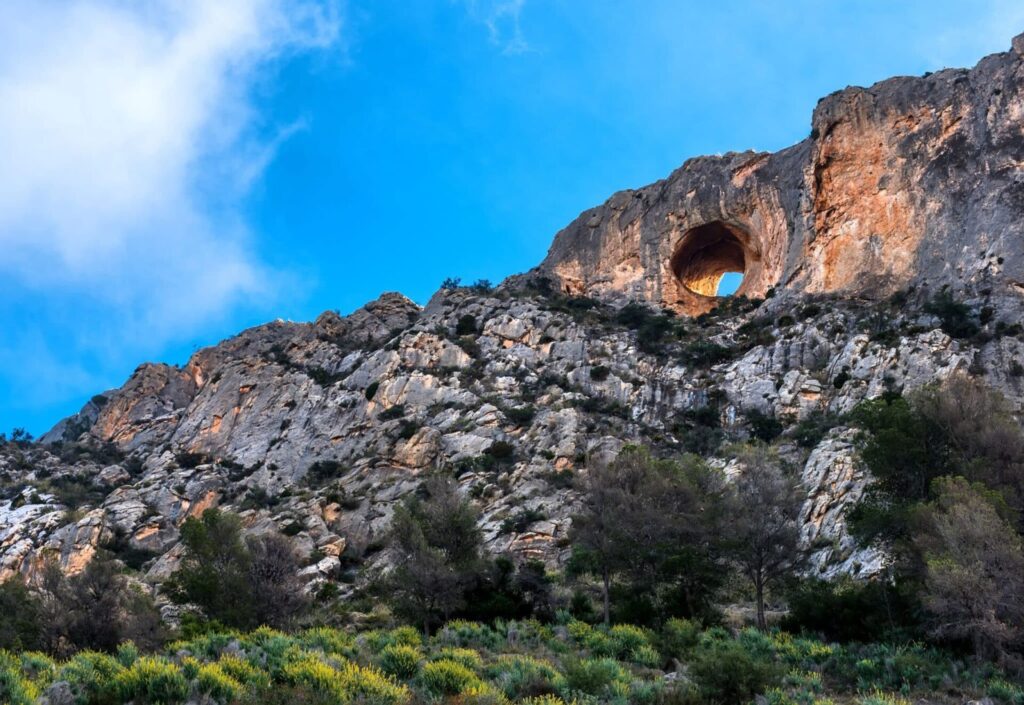
That difference matters because the caves are not located in Busot town itself. They sit higher in the mountains on the road leading into the Cabeçó d’Or area, so reaching Busot is only part of the journey.
For most visitors coming from Benidorm, driving is clearly the easiest option.
By Car
From Benidorm, the journey usually takes around 45 minutes to one hour, depending on traffic and your exact starting point.
The route heads south toward the Alicante area before turning inland toward Busot and the Cabeçó d’Or.
The final section of the journey is the most interesting. As you leave the coast behind, the landscape becomes increasingly mountainous and rural, and the road climbs toward the cave entrance.
That approach is worth enjoying rather than treating purely as transport.
You gradually move from a densely developed coastal corridor into a much quieter interior landscape.
Parking is available near the caves, making this the most practical option if you want to combine the visit with Busot, lunch or a hike.
Is the Road Difficult?
No.
The road is mountainous, but it is paved and designed for normal vehicle access to a major visitor attraction.
Drivers who are comfortable on ordinary mountain roads should have no problem.
The main considerations are the usual ones:
- take bends at a sensible speed;
- expect cyclists on good-weather days;
- avoid assuming that a quiet road is an empty road;
- allow extra time if visibility is poor.
The final approach is also part of what makes the excursion feel worthwhile.
When you arrive, you are clearly somewhere very different from Benidorm.
By Public Transport
Public transport is technically possible, but it requires more patience.
Busot is connected with El Campello by the C-52 bus line, while El Campello itself is connected with the Alicante metropolitan area by TRAM. Official Busot tourism information also notes a connection via Mutxamel using the C-51.
For someone travelling from Benidorm, the most logical public transport chain is generally:
Benidorm → El Campello → Busot
The first part is relatively straightforward because TRAM Line 1 connects Benidorm with El Campello.
The difficulty comes after that.
Reaching Busot village does not automatically solve the problem of reaching the caves.
The Real Problem Without a Car
The Canelobre Caves are several kilometres outside Busot and significantly higher in the mountains.
This is the key detail that generic transport advice often overlooks.
A route planner may show that Busot has public transport and make the destination appear easy to reach.
In reality, the final section between the village and the caves is what makes a car-free visit awkward.
You may need:
- a taxi;
- a pre-arranged local transfer;
- a long walk that is not especially practical as part of a casual sightseeing day.
For that reason, I would not recommend relying on buses alone unless you have checked the exact timetable and solved the final connection in advance.
Is a Taxi Worth Considering?
Yes, especially for the final section.
A sensible car-free strategy could be:
- travel from Benidorm to El Campello;
- continue to Busot by bus;
- use a taxi between Busot and the caves.
This is more realistic than trying to walk the mountain road simply to avoid a taxi fare.
For two or more people, sharing the taxi makes the option more reasonable.
Taking a taxi all the way from Benidorm would obviously be much more expensive and usually makes less financial sense than hiring a car or using public transport for most of the journey.
Do You Really Need a Car?
Not absolutely.
But for this particular excursion, a car makes a major difference.
With one, you can easily combine:
- Canelobre Caves;
- Busot;
- the Ethnic Music Museum;
- lunch;
- nearby viewpoints;
- a walking route;
- another coastal stop on the way back.
Without one, each additional element requires more coordination.
So while the caves are technically accessible to non-drivers, this is one of the experiences in the series where having a vehicle changes the day significantly.

Planning Your Visit
Canelobre is not a place where you should simply arrive whenever you feel like it and assume immediate entry.
The cave operates through scheduled guided visits, and the current ticketing system allows you to check availability and select a specific date and number of visitors before booking.
That makes a little advance planning worthwhile, especially at weekends and during summer.
Tickets and Guided Visits
The general adult ticket currently costs €12 and includes both:
- the guided cave visit;
- admission to the Ethnic Music Museum in Busot.
Reduced prices are available for pensioners, students, young people and some disability categories, while children under five and registered Busot residents can enter free under the current tariff structure.
Guided passes are generally scheduled around every 40 minutes.
That does not necessarily mean every visitor spends exactly 40 minutes underground. It refers primarily to the timetable between entry groups.
The important practical point is that you are booking a time slot rather than purchasing completely flexible admission.
Should You Book in Advance?
Yes, particularly if:
- you are visiting at the weekend;
- you are coming during July or August;
- you are travelling with several people;
- you have built the rest of your day around a specific entry time.
The official ticketing system allows visitors to check availability online, so there is little reason to risk arriving after a long drive and discovering that the next convenient slot is full.
During quieter periods, same-day admission may be easier, but advance booking still makes the day more predictable.
Current Opening Hours
As of 2026, the caves use different seasonal schedules.
September to June
The caves are closed on Mondays.
From Tuesday to Friday, the ticket office operates approximately from 10:30 to 16:50.
On Saturdays, Sundays and public holidays, it stays open until around 17:50.
July and August
During summer, the caves currently open every day, with ticket-office hours from approximately 10:30 to 19:30.
There are also special schedules around Easter and certain holiday dates.
Because these times can change, especially around public holidays, always check the official schedule shortly before travelling.
Best Time of Day
For most visitors from Benidorm, morning is the best choice.
An entry between roughly 10:30 and midday gives you several advantages.
You can:
- drive before the hottest part of the day;
- visit the caves while temperatures outside are rising;
- continue into Busot for lunch;
- use the afternoon for the museum, a walk or another stop.
Morning visits also leave more flexibility if traffic, parking or travel takes longer than expected.
Is Summer a Good Time?
Yes.
In some ways, summer is one of the most enjoyable periods precisely because the cave remains cool inside.
The contrast between strong Mediterranean heat and the stable underground temperature makes the experience particularly pleasant.
However, remember that most of the rest of the day happens outside.
If you plan to walk around Busot or the Cabeçó d’Or afterwards, midday heat can still be intense.
A good summer itinerary is therefore:
cave first, lunch second, outdoor activity later.
What About Winter?
Winter works well too.
The attraction is protected from rain and wind once you are inside, so it is a useful option on days when a coastal hike looks less appealing.
The mountain approach can feel cooler than Benidorm, particularly in wind or poor weather, but the cave itself remains relatively stable.
What Should You Wear?
Normal comfortable clothing is enough for most visitors.
You do not need specialist cave equipment.
A sensible combination would be:
- trainers or walking shoes;
- comfortable trousers or shorts;
- a T-shirt;
- a light layer if you feel cold easily.
The main reason for decent footwear is the stairs and potentially damp surfaces, not rough terrain.
Should You Bring a Jacket?
In summer, a thin layer can be useful if you are sensitive to temperature changes.
For many people, the cool cave will simply feel refreshing.
In winter, you will probably already be wearing enough clothing.
There is no need to arrive with heavy mountain gear simply because you are entering a cave.
How Much Time Should You Allow?
For the caves alone, around one and a half to two hours is a comfortable planning window.
That includes:
- arriving;
- parking;
- waiting for your guided slot;
- completing the visit;
- spending some time enjoying the mountain views afterwards.
The cave itself will occupy only part of that.
If you include Busot and the Ethnic Music Museum, allow at least half a day.
If you also add hiking or another destination, it easily becomes a full-day excursion.
The Ethnic Music Museum
Because the standard cave ticket includes admission to the Museo de Música Étnica, it makes sense to use it rather than treating the museum as an unrelated attraction.
The museum is located in Busot and contains a large collection of musical instruments from different cultures around the world.
Its current opening schedule is broadly designed to complement cave visits, with split morning and afternoon hours outside summer and longer opening hours in July and August.
This gives the day a useful second dimension.
The cave provides geology and dramatic natural scale.
The museum provides something smaller, cultural and completely different.
Cave First or Museum First?
For most visitors, I would choose the cave first.
There are two reasons.
First, the guided cave visit has the more restrictive timetable.
Second, the cave is the main reason you travelled from Benidorm.
Once that is completed, the rest of the day can become more flexible.
The museum works naturally after lunch or as a quieter activity during the hotter part of the afternoon.
Can You Arrive Late for Your Time Slot?
Do not plan on it.
Because entry operates in guided groups, arriving late may mean missing your scheduled pass or having to wait for another available group.
Leave enough margin for:
- traffic;
- parking;
- finding the entrance;
- collecting or validating tickets.
A mountain excursion becomes much less relaxing if the last twenty minutes are spent racing a booking time.
Is the €12 Ticket Good Value?
For the cave alone, some visitors may initially think €12 feels slightly high for a visit lasting less than an hour.
That reaction is understandable.
The value becomes stronger when you consider:
- the unusual scale of the chamber;
- the guided interpretation;
- maintenance of the visitor infrastructure;
- the included Ethnic Music Museum admission.
It is still not a cheap attraction compared with free hiking routes or natural parks.
But this is a different type of experience.
You are paying for controlled access to a fragile underground environment and a guided visit rather than simply entering a landscape.
For most first-time visitors, particularly those combining the caves with Busot, the price feels reasonable.
What Else to Do in Busot
The Canelobre Caves are the main reason most visitors come to Busot, but treating the village as nothing more than a place you drive through would be a mistake.
Busot is small, quiet and very different from Benidorm. It sits at the foot of the Cabeçó d’Or, only around seven kilometres from the coast, yet the atmosphere is distinctly inland. The terrain is drier, the streets are calmer and the mountain dominates the landscape in a way that makes the village feel more connected to rural Alicante than to the beach resorts nearby.
For someone staying in Benidorm, that contrast is part of the value of the day. You are not travelling to Busot because it is packed with monuments. You are going because the cave, the village and the surrounding mountain form a coherent experience together.
The Ethnic Music Museum
The most obvious addition is the Museo de Música Étnica, especially because admission is currently included with the standard Canelobre ticket.
The museum contains a large collection of musical instruments from different cultures and periods around the world. Busot tourism presents it as one of the town’s main cultural attractions, and it works surprisingly well after the caves because the change of subject is so complete: you move from geology and enormous underground spaces to a much smaller museum focused on human culture and sound.
You do not need to be especially interested in ethnomusicology to enjoy it.
For most visitors, the appeal comes from seeing how many different ways people have invented to create music with wood, skins, metal, strings, air and percussion.
It also adds practical value to the cave ticket. If you have already paid for both experiences, it makes little sense to return directly to Benidorm without at least considering the museum.
Walking Around Busot
Busot itself is best approached without a checklist.
This is not a destination where you need to race between ten attractions.
A slower walk through the centre works better.
The village has narrow streets, traditional houses and views toward the surrounding mountains. Its Muslim origins and historic relationship with the old castle give it more depth than its size initially suggests.
You can comfortably spend an hour wandering around, stopping for coffee and simply enjoying the quieter pace.
That may sound modest, but after the structured cave visit it provides exactly the kind of unplanned time that makes a day trip feel less mechanical.
The Busot Treasure Route
Families or visitors who enjoy something more interactive may also notice the Tesoro de Busot, a town-centre treasure-hunt style route promoted by the local tourism office.
It uses a passport available from the Ethnic Music Museum or Canelobre ticket office and turns the village into a small discovery game with different difficulty levels.
For most adult digital nomads this will probably not be the central reason to visit, but it can be a useful option for anyone travelling with children or wanting a more structured way to explore the village.
Can You Combine the Caves with a Hike?
Yes, and this is where the day can become much more ambitious.
The Cabeçó d’Or rises to around 1,200 metres and is one of the most distinctive mountains in the Alicante area. Its limestone ridge, steep walls and relative isolation make it a serious mountain environment rather than a gentle viewpoint walk.
The important point is that there is a big difference between:
visiting Canelobre and adding a short walk
and
visiting Canelobre and hiking the Cabeçó d’Or properly.
Those are two very different days.
The Main Cabeçó d’Or Route
The official Busot tourism route uses the PR-CV 2 and starts from a parking area on the road toward the caves.
The published route is approximately 10.5 kilometres, takes around four hours and is rated as medium difficulty. The route climbs through a rugged limestone landscape and eventually reaches the higher parts of the mountain.
That means it should not be treated as a casual add-on after lunch.
A four-hour mountain route combined with:
- driving from Benidorm;
- a scheduled cave visit;
- lunch;
- Busot;
- the return journey
creates a substantial day.
For fit hikers, it can be excellent.
For everyone else, it may turn a relaxed excursion into something unnecessarily demanding.
What Is the Hike Like?
The Cabeçó d’Or is visually very different from the cave interior.
The route moves through an exposed Mediterranean mountain landscape dominated by limestone, steep slopes and open views.
There is also interesting wildlife potential. Official local information highlights the mountain’s importance for cliff-nesting birds of prey, including Bonelli’s eagle, golden eagle, peregrine falcon and eagle owl.
The landscape has a much wilder feel than the tourist infrastructure around the caves.
That contrast can make the combination especially rewarding:
in the morning, you enter the mountain.
Later, you climb across its surface.
Should You Do the Full Hike on the Same Day?
Only if hiking is one of the main purposes of the day.
If you simply think:
“We have visited the cave, so perhaps we should do a bit of hiking too.”
then the full PR-CV 2 is probably more than you need.
A better relaxed itinerary is to enjoy the cave, spend some time around the mountain setting and then continue into Busot.
If, however, you already enjoy mountain walking and are comfortable with a roughly four-hour route, combining both can create one of the most complete nature days in this series.
In that case, start early and organise the cave booking around the hike rather than trying to squeeze the hike into whatever time remains.
Summer Changes Everything
A route that sounds reasonable in spring can become a very different proposition in August.
The Cabeçó d’Or is exposed, rocky and potentially very hot.
There is limited protection from the sun on large parts of the mountain.
For a full hike in warmer months, you need:
- an early start;
- plenty of water;
- proper footwear;
- sun protection;
- realistic awareness of the temperature.
Do not spend the cool morning underground and then decide at 14:00 in July that it seems like a good moment to climb the mountain.
The caves may be a summer-friendly attraction.
The exposed mountain above them is not automatically a summer-friendly hike.
A Better Option for Casual Walkers
If you want some outdoor movement without committing to the full route, the best strategy is simply to enjoy the cave surroundings and shorter nearby walking opportunities before driving into Busot.
You still get the mountain atmosphere without turning the day into a fitness challenge.
This is particularly useful for couples or groups where one person enjoys hiking more than the others.
The caves are accessible to a broad range of visitors.
The full Cabeçó route is a more specific choice.
Food and Realistic Budget
Busot is small, but you do not need to return to the coast immediately for lunch.
The local food scene reflects its position between inland Alicante and the Mediterranean. Official tourism information describes a mixture of Valencian, Murcian and Manchegan influences, with both mountain dishes and coastal products appearing in local cooking.
That makes lunch in Busot a useful part of the experience rather than merely a practical stop.
What Kind of Food Can You Expect?
Traditional dishes promoted locally include olleta con perdiz, local-style gazpacho with chicken and rabbit, borreta, pericana and suquet de peix.
This mixture tells you quite a lot about Busot itself.
It is close enough to the Mediterranean for fish to be part of the culinary identity, but far enough inland for meat, stews and stronger rural dishes to feel equally natural.
Local sweets also reflect the area’s historic influences, with products such as anise pastries, sweet-potato pastries and almond-based baking appearing in traditional cuisine.
You do not need to seek out a specific “must-eat” dish for the day to work.
The more important point is that lunch here can feel genuinely different from another meal on Benidorm seafront.
Eating Near the Caves or in the Village?
There is currently a snack bar at the cave access area, which is useful for drinks, sandwiches and a quick stop. Busot tourism also lists several restaurants and bars in the village and surrounding area, ranging from traditional home cooking and grilled meats to international options.
For a full-day visit, I would generally choose the village.
It gives you a reason to explore Busot rather than treating the cave complex as an isolated attraction.
If you are doing the Cabeçó hike, however, convenience becomes more important. In that case, eating close to the route or carrying suitable food may make more sense than reorganising the entire day around a restaurant.
How Much Should You Budget?
Canelobre is not an expensive excursion, but unlike Serra Gelada or Santa Pola Salt Lakes, the main attraction is not free.
The current standard adult cave ticket is €12, including the Ethnic Music Museum.
From there, the biggest variable is transport.
If two people share a car, fuel costs should remain modest. Public transport can be cheaper in pure ticket price, but local taxi use may reduce that advantage.
A simple half-day could therefore remain around €20–€30 per person if you keep food inexpensive.
A more complete day with a restaurant lunch, coffee and shared driving costs is more realistically around €35–€55 per person.
If you add taxis, a more substantial meal or other paid activities, the total can rise further.
A Realistic Half-Day Budget
For a straightforward cave visit from Benidorm with shared car costs:
| Expense | Approximate Cost |
|---|---|
| Canelobre Caves + museum | €12 |
| Shared fuel / transport | €5–€10 |
| Coffee or snack | €3–€6 |
| Approximate total | €20–€30 |
A Comfortable Full-Day Budget
For caves, Busot and lunch:
| Expense | Approximate Cost |
|---|---|
| Canelobre Caves + museum | €12 |
| Shared transport | €5–€12 |
| Lunch | €15–€25 |
| Coffee / drinks | €4–€8 |
| Approximate total | €35–€55 |
These figures are planning estimates rather than fixed prices, but they give a useful sense of scale.
Is It Good Value?
Yes, provided you do not judge value only by minutes spent underground.
If you drive from Benidorm, enter the cave, leave after forty minutes and immediately drive home, €12 plus transport may feel less compelling.
If the cave becomes the centrepiece of a half or full day involving:
- the mountain landscape;
- Busot;
- the included museum;
- lunch;
- perhaps some walking,
the value improves considerably.
That is really the recurring theme with Canelobre.
The cave itself is impressive.
But the excursion becomes much better when you allow the surrounding area to become part of the experience.
Common Mistakes
The Canelobre Caves are easy to visit, but there are a few ways to make the experience feel shorter, more expensive or less satisfying than it really is.
The biggest mistake is treating the cave as if it were a complete full-day attraction on its own. The guided visit is impressive, but relatively compact. If you drive from Benidorm, spend forty minutes underground and immediately return, the excursion may feel disproportionate to the travel time.
Canelobre works much better when the cave is the centrepiece of the day rather than the entire day.
Arriving Without Checking the Time Slots
Because visits are organised in guided groups, timing matters.
Do not assume that turning up at any point during opening hours guarantees immediate entry. On busy days, you may have to wait for the next available group or discover that the most convenient slots are already full.
A little planning makes the whole day much more relaxed.
Underestimating the Stairs
The cave is not a difficult physical attraction, but it is not completely flat either.
Visitors with knee problems, reduced mobility or difficulty with stairs should check current access conditions before travelling.
For everyone else, the stairs are manageable, but comfortable footwear makes the visit noticeably easier.
Wearing Beach Footwear
You are still in a cave.
Even though the route is prepared for visitors, surfaces can be damp and steps require attention.
Flip-flops are a poor choice.
Normal trainers or walking shoes are much more sensible.
Expecting Hours of Underground Exploration
This is probably the most important expectation to correct.
Canelobre is not a vast public cave network with kilometres of passages.
The main chamber is enormous, but the visitor route is comparatively short.
The experience is about scale, not distance.
If you understand that before arriving, the visit feels far more satisfying.
Trying to Photograph Everything
The temptation is understandable.
The lighting is dramatic, the chamber is huge and every angle seems potentially interesting.
But guided visits move at a steady pace.
If you spend the entire time looking at your phone or camera screen, you risk missing the thing photographs capture least effectively: the feeling of space.
Take a few images.
Then look up.
Assuming the Cave Will Keep You Cool All Day
The interior is pleasantly cool, especially in summer.
But you will still spend most of the day outside.
Busot and the Cabeçó d’Or can become extremely hot in summer, so the cave should not create a false sense that the entire excursion is heat-proof.
Adding a Serious Hike Without Planning for It
The full Cabeçó d’Or route is not a casual extension of the cave visit.
If you want to hike properly, treat it as one of the main activities of the day.
Bring enough water, appropriate footwear and sufficient time.
Do not decide spontaneously to start a four-hour mountain route in the middle of a hot afternoon.
Skipping Busot Completely
You can certainly visit only the cave.
But if you have travelled from Benidorm, Busot gives the excursion more depth.
Even a short walk, coffee or museum visit changes the day from “drive-cave-drive” into something much more complete.
Suggested Half-Day and Full-Day Itineraries
Canelobre is flexible enough to work as either a short excursion or a full day.
The best version depends on how much time you have and whether you want culture, food or hiking alongside the cave.
Half-Day: Caves and Busot
A half-day is ideal if you want something interesting without dedicating the entire day to sightseeing.
Leave Benidorm in the morning and aim for a cave slot around 10:30 or 11:00.
That gives you enough margin for the drive without needing an extremely early start.
After the guided visit, spend a little time outside enjoying the mountain views rather than returning directly to the car.
Then drive down into Busot.
Walk through the village, visit the Ethnic Music Museum if it interests you and stop for coffee or an early lunch.
By early afternoon, you can begin the return journey to Benidorm.
This version gives you the essence of Canelobre without making the day feel over-planned.
Full Day: Caves, Busot and a Relaxed Afternoon
For most long-stay residents, this is probably the most balanced option.
Start with the cave in the morning.
Afterwards, head into Busot for the museum and a slow walk around the village.
Have lunch there rather than rushing back toward the coast.
In the afternoon, you have several options depending on mood and weather.
You could remain in the area for a short walk and viewpoints.
Or you could drive back toward the coast and stop somewhere such as El Campello before returning to Benidorm.
That creates a day with several changes of environment:
mountain road → underground cave → rural village → Mediterranean coast.
The variety makes the journey feel much more worthwhile.
Full Day for Hikers
If the Cabeçó d’Or is one of your main objectives, organise the entire itinerary differently.
Start very early, particularly outside winter.
Complete the hike during the cooler part of the day.
Then schedule the cave visit for later, when the cool underground environment will feel particularly welcome.
Alternatively, visit the cave first and complete a shorter walking section afterwards rather than attempting the full route.
The important point is not to overfill the day.
A serious hike plus the cave is already enough.
Is It Worth Visiting for Digital Nomads?
Yes, particularly for people who have been living or working in Benidorm long enough to want something genuinely different from another coastal day.
Canelobre is not a remote-work destination.
There is no reason to carry a laptop into the cave, and the surrounding mountain environment is better used as a break from work rather than an extension of it.
But that is exactly why the excursion works.
Remote work often creates a strange routine where even leisure days remain close to screens, Wi-Fi and familiar urban environments.
Canelobre interrupts that completely.
For forty minutes, you are inside a mountain with no reason to check anything.
Then you emerge into a quiet rural landscape where the pace is completely different from central Benidorm.
Can You Work Afterwards?
Yes, but Busot is not the strongest place to organise a serious remote-work session.
The village has cafés and services, but it is not a coworking destination.
If you genuinely need to work later, El Campello or another coastal town on the return route may offer more practical options.
For most people, though, I would treat Canelobre as a proper day off.
Should You Bring Your Laptop?
Only if you already know you need it later.
Otherwise, leave it in Benidorm.
There is no advantage in carrying expensive electronics around a cave, mountain road and village simply because you might answer emails at some point.
Who Will Enjoy Canelobre Most?
The caves are particularly well suited to people who enjoy natural attractions but do not necessarily want physically demanding activities.
They are also a strong choice for visitors interested in geology, photography, unusual landscapes or places with a clear sense of atmosphere.
Long-stay residents benefit especially because Canelobre adds variety to a Costa Blanca itinerary that may otherwise become heavily focused on beaches and coastal towns.
The excursion also works well for couples or groups with different fitness levels. One person may enjoy mountains and geology while another simply appreciates the guided visit and village atmosphere.
Who Might Be Disappointed?
People expecting a huge underground adventure may find the visit too short.
Anyone who strongly dislikes guided groups may also find the format restrictive.
Visitors who judge attractions almost entirely by the amount of time they occupy could question the €12 ticket.
And if you travel from Benidorm only to enter the cave and return immediately, the overall excursion may feel less substantial than expected.
The solution to most of these issues is the same:
build the day around Canelobre, not only inside it.
BenidormNomads Verdict
Canelobre is not one of the biggest or longest excursions in this series, but it is one of the easiest ways to experience a completely different side of Alicante province.
Visual Impact: 9/10
The main chamber is genuinely impressive.
Its vertical scale is the strongest feature and difficult to communicate through photographs alone.
Geological Interest: 9/10
The formations, Jurassic limestone and scale of the cavern make this a strong geological attraction even for visitors without specialist knowledge.
Accessibility from Benidorm: 8/10
By car, access is straightforward and reasonably quick.
Without a car, the final section between Busot and the caves makes the journey considerably less convenient.
Value for Money: 8/10
The ticket is not cheap compared with free natural attractions, but the guided cave visit and included museum provide reasonable value.
The score rises if you use the full ticket rather than skipping Busot entirely.
Photography: 8.5/10
The cave is visually dramatic, but low light and the guided format limit how much time photographers can spend composing shots.
The mountain setting adds additional opportunities outside.
Walking Experience: 7/10
The standard cave visit involves stairs but very little serious walking.
The score changes completely if you add the Cabeçó d’Or.
Uniqueness: 9.5/10
This is one of the clearest strengths.
Few experiences near Benidorm offer anything comparable to entering a cavern of this scale inside a mountain.
Remote Work Compatibility: 4/10
The attraction itself is unsuitable for work.
That is not really a weakness, but it makes Canelobre less flexible than urban day trips where a work session can easily be added.
Relaxation: 8/10
The cave is structured and guided, but the surrounding landscape and Busot provide a calm contrast to Benidorm.
Overall Atmosphere: 9/10
The combination of mountain approach, tunnel entrance, enormous underground chamber and quiet rural surroundings gives the excursion a strong sense of place.
Overall Rating: 8.8/10
Canelobre performs especially well on uniqueness and visual impact.
It is less convincing if judged only by duration, which is why combining it with Busot or the surrounding landscape is so important.

Are the Canelobre Caves Worth the Trip from Benidorm?
Yes.
But the answer comes with one important condition.
Do not travel there expecting a three-hour underground expedition.
The actual cave visit is relatively short.
What makes Canelobre worth the journey is the quality of those forty or so minutes underground and the way the attraction fits into a broader day in the mountains above Alicante.
The chamber is genuinely impressive.
The transition through the tunnel works.
The temperature change is memorable in summer.
The geological formations are interesting without requiring specialist knowledge.
And the scale of the main vault gives the cave something that photographs do not properly reproduce.
For someone spending only a weekend in Benidorm, Canelobre may compete with more obvious Costa Blanca highlights.
For someone staying several weeks or months, the equation changes completely.
You already have time for beaches.
You already have time for Altea, Calpe and the usual coastal experiences.
Canelobre gives you something different.
The best approach is to book a morning cave visit, take your time afterwards, continue into Busot and let the excursion develop into a slower inland day.
Add the Ethnic Music Museum if it interests you.
Have lunch in the village.
Walk a little in the mountain surroundings if the weather is suitable.
Or, if you are a serious hiker, turn the Cabeçó d’Or into the second major attraction of the day.
What you should not do is measure Canelobre purely in minutes underground.
Some places justify a visit because they offer a long list of things to do.
Others justify it because they give you one experience you cannot reproduce elsewhere.
The Canelobre Caves belong much more to the second category.
And from Benidorm, that makes them a very worthwhile change of scenery.