
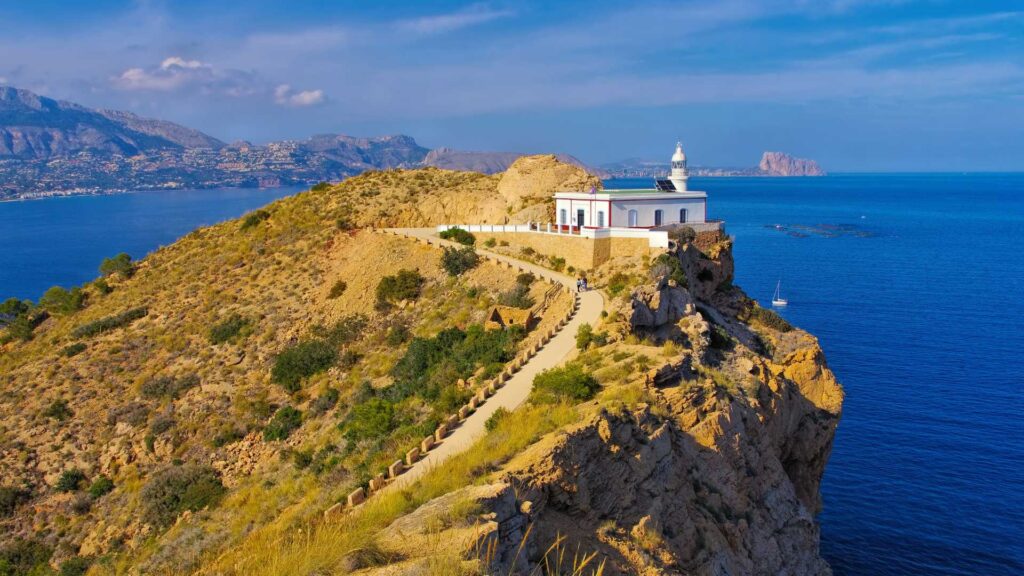
Living in Benidorm gives you an unusual advantage that is easy to underestimate: one of the Costa Blanca’s most distinctive natural parks begins almost at the edge of the city.
Serra Gelada — often referred to in English-language material as Sierra Helada — forms the dramatic mountain backdrop behind the eastern side of Benidorm and continues north toward l’Albir and Altea. From the beaches and high-rise streets, it can look like little more than a steep green ridge separating the towns along the coast.
Once you start exploring it, the experience is very different.
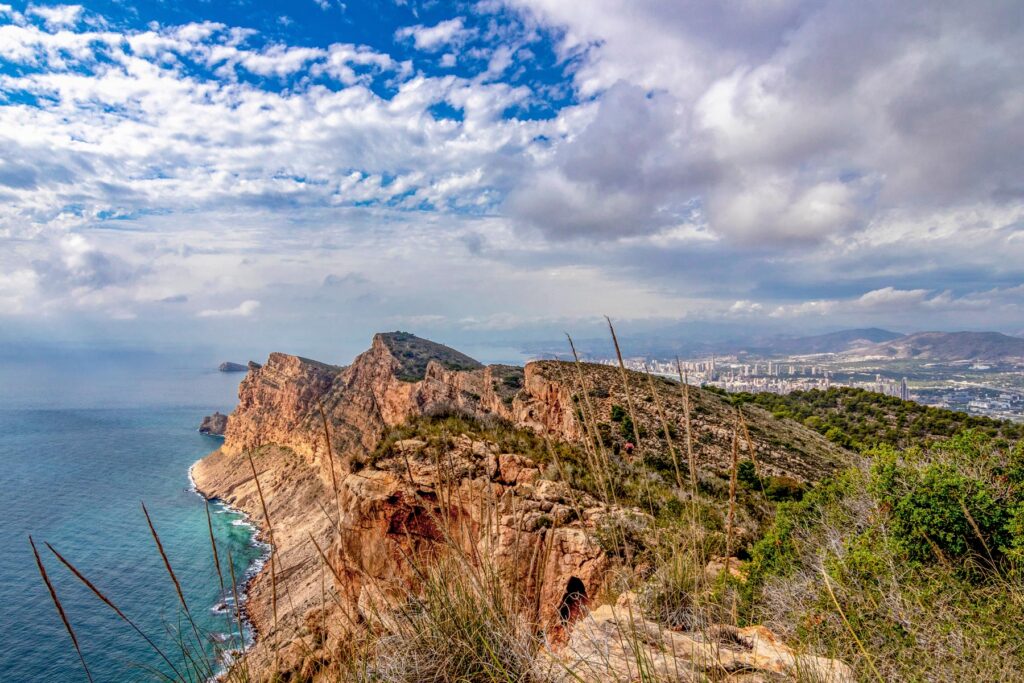
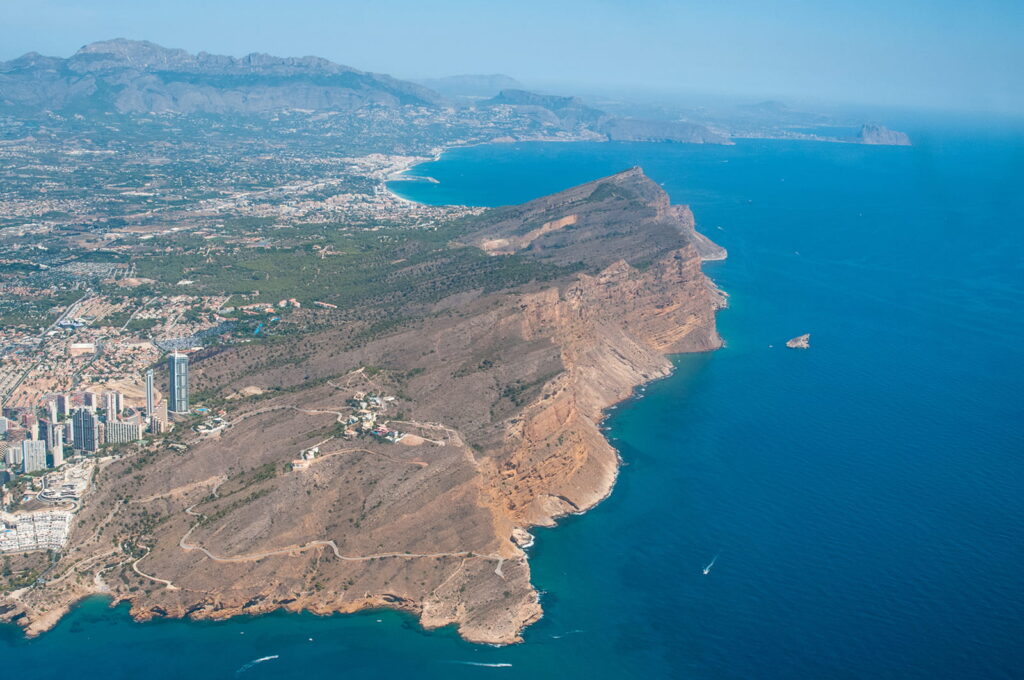
Serra Gelada contains high coastal cliffs, exposed ridges, Mediterranean vegetation, secluded coves and some of the best elevated views over Benidorm and the Bay of Altea. It is also unusual because the protected area includes both terrestrial and marine environments, making the relationship between mountain and sea a defining feature of the park.
For digital nomads, remote workers and long-stay residents in Benidorm, Serra Gelada is particularly valuable because you do not need to organise a complicated excursion to experience it.
Depending on the route you choose, you can spend a couple of hours walking to a viewpoint, enjoy an easy coastal route to a lighthouse, or dedicate most of a day to a demanding traverse across the entire ridge.
That flexibility is also where some confusion begins.
A visitor who walks to the Faro de l’Albir may describe Serra Gelada as an easy and accessible excursion. Someone who completes the full ridge traverse may describe it as a tough hike involving repeated climbs, steep descents and very little shade.
Both descriptions are correct.
They are simply talking about completely different experiences.
The most useful question is therefore not:
“Is Serra Gelada worth visiting?”
For anyone spending significant time in Benidorm, the answer is almost certainly yes.
The better question is:
“Which Serra Gelada route is right for me?”
This guide will help you answer that before you set out.
What Is Serra Gelada Natural Park?
Serra Gelada Natural Park stretches along the coast between the municipalities of Benidorm, l’Alfàs del Pi and Altea.
Unlike many inland protected areas, its identity is inseparable from the Mediterranean. The mountain ridge rises abruptly above the sea, creating long sections of steep coastline and providing elevated views in both directions.
The park’s official walking network on land is surprisingly simple. The Generalitat Valenciana identifies two principal official terrestrial itineraries: the Red Route, leading to the Faro de l’Albir, and the Yellow Route, which traverses Serra Gelada.
However, for someone based in Benidorm, there is a third practical way to experience the area: walking toward La Cruz de Benidorm, the large cross and viewpoint above the eastern side of the city. Visit Benidorm promotes this as a separate Serra Gelada route, with approximately 5 kilometres return, a maximum elevation gain of 237 metres and a medium difficulty rating.
These three possibilities create very different days.
You can approach Serra Gelada as:
- an accessible coastal walk;
- a short but steep viewpoint hike;
- a substantial mountain traverse.
That is one reason the park works so well for long-stay residents. You do not need to experience everything in a single visit.
In fact, Serra Gelada is better understood as somewhere you return to several times.
One morning you might walk to La Cruz before starting work. Another day you could visit the lighthouse from l’Albir with friends or relatives who are not regular hikers. Later, when temperatures are cooler and you have an entire day available, you could attempt the full ridge traverse.
Each visit reveals a different side of the same landscape.
Why Visit Serra Gelada When You Are Staying in Benidorm?
The strongest reason is proximity.
Many worthwhile Costa Blanca experiences require a car, public transport planning or at least half a day simply because of the journey involved.
Serra Gelada is different.
From eastern Benidorm, you can reach its southern side without leaving the city. The La Cruz route can be approached directly from the urban area, while the northern side of the park at l’Albir is close enough for a straightforward bus, taxi, bicycle or car journey.
That means Serra Gelada can function as part of normal life rather than only as a special excursion.
For someone working remotely in Benidorm, this matters.
You might not always have an entire free day available. Sometimes what you need is two or three hours outdoors after spending several days behind a screen. Serra Gelada can provide that without requiring an elaborate plan.
At the same time, the full traverse is substantial enough to feel like a genuine hiking day.
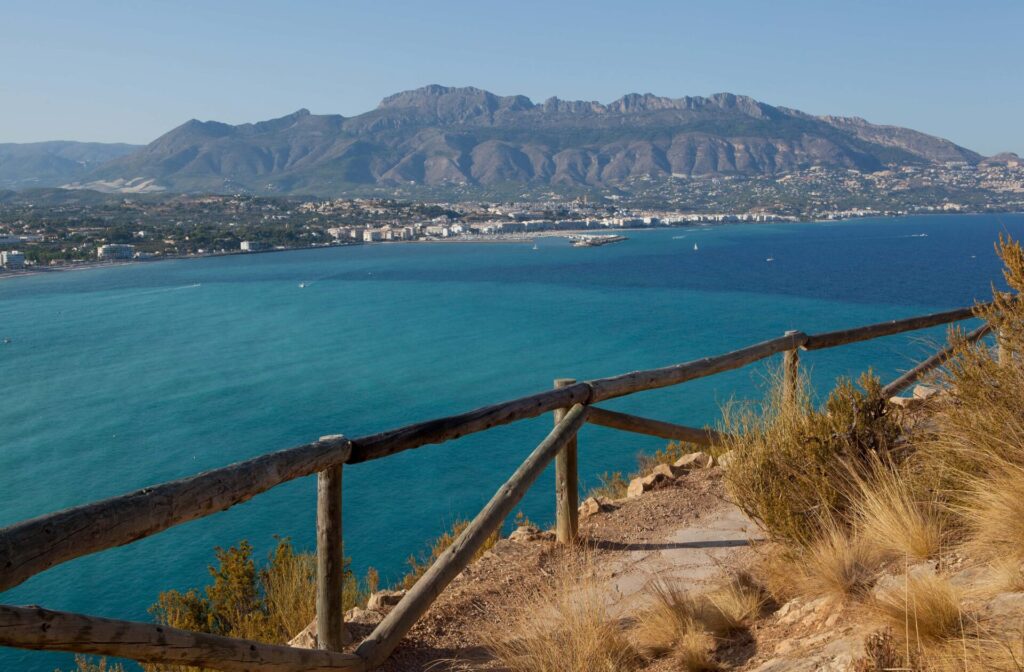
It provides a very different perspective on Benidorm
Benidorm feels completely different when viewed from above.
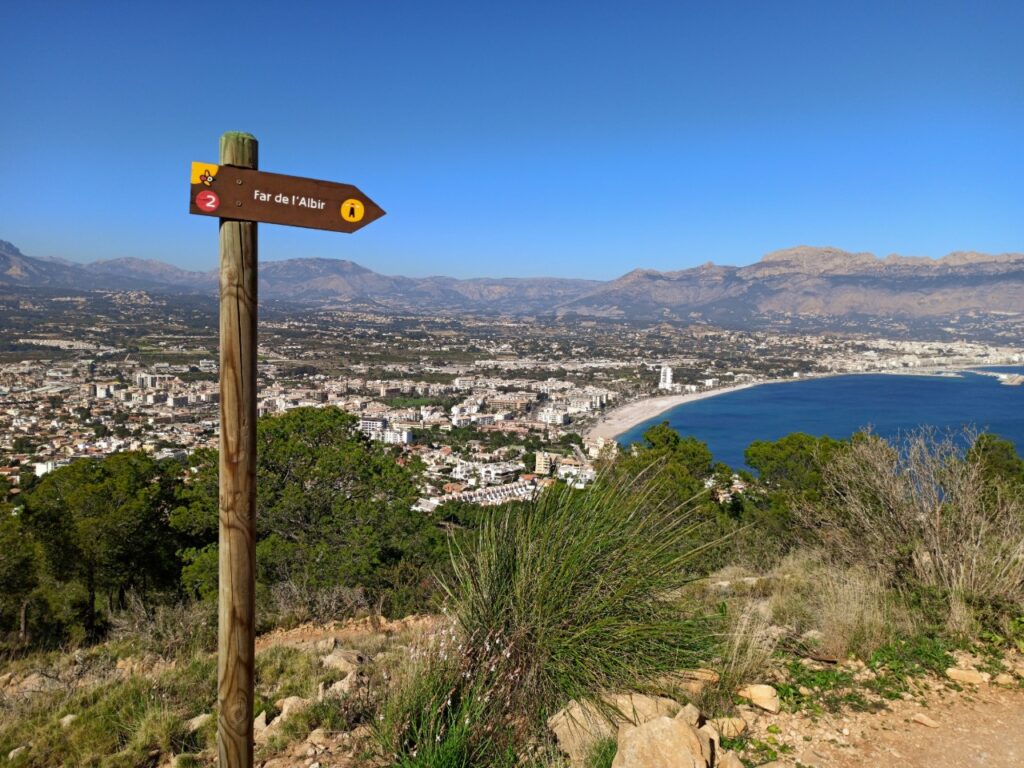
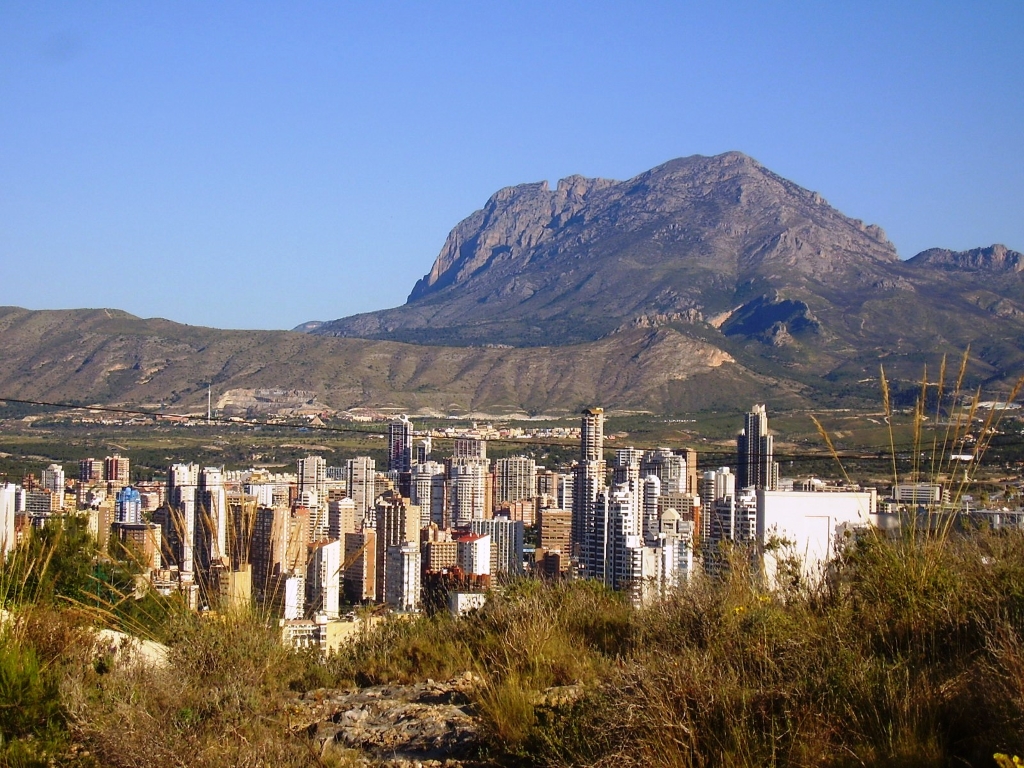
From the Serra Gelada side, the skyline becomes compressed between the mountains and the sea. The familiar towers of Levante and Poniente are transformed into part of a wider landscape that includes Puig Campana, the surrounding mountains and the Mediterranean.
For residents, this perspective can be particularly rewarding because you recognise the streets, beaches and buildings below rather than simply looking at an unfamiliar city.
It gives geographical context to the place where you are living.
It offers exercise without travelling far
Remote work can make physical activity surprisingly easy to postpone.
A ten-minute break becomes another email. A planned afternoon walk disappears because a meeting runs late. Days can pass without going much farther than the supermarket, café or coworking space.
Serra Gelada provides an obvious antidote.
Even the shorter options involve elevation, while the complete traverse is a serious workout involving repeated ascents and descents.
You can choose the level of effort according to the day.
The scenery changes depending on the route
This is not simply a case of doing a shorter or longer version of the same walk.
The lighthouse route emphasises the northern coastline and Bay of Altea.
La Cruz provides one of the classic elevated views over Benidorm.
The full traverse gives you the ridge itself, with prolonged exposure to the mountain landscape and views alternating between the urban coast and open Mediterranean.
That variety makes Serra Gelada unusually reusable as a local experience.
It costs very little
There is no expensive attraction ticket required simply to walk through the natural park.
For someone already living in Benidorm, some Serra Gelada outings can involve almost no cost beyond water, food or local transport.
This makes it particularly attractive to digital nomads or long-stay residents who want regular activities without treating every free day as a tourist spending day.

The Three Main Ways to Experience Serra Gelada
Before planning transport, footwear or timing, decide what you actually want from the visit.
For most readers, the choice can be reduced to three options.
Option 1: Faro de l’Albir — The Easy Choice
The Faro de l’Albir Route is the most accessible introduction to Serra Gelada.
Officially designated as the park’s Red Route, it approaches the lighthouse from the l’Albir side along a comparatively easy route. The Generalitat describes it as one of the park’s most accessible walks and classifies it as low difficulty.
This is the best option when you want:
- coastal scenery without a demanding hike;
- an outing suitable for people with limited hiking experience;
- something you can comfortably combine with l’Albir;
- a relaxed morning rather than a full-day challenge;
- a route where conversation and sightseeing matter more than physical effort.
The route also passes points of historical and geological interest, including the old ochre mines near Cala de la Mina. At the end, the Faro de l’Albir houses an interpretation centre explaining aspects of the park and the history of the lighthouse keepers.
This is the version of Serra Gelada most likely to appeal to people who would normally say:
“I like walking, but I’m not really a hiker.”
It provides attractive scenery without requiring the commitment of the ridge.
Option 2: La Cruz de Benidorm — The Convenient Choice
If you are already staying in Benidorm, La Cruz may be the easiest way to experience Serra Gelada without organising an excursion at all.
The route climbs from the eastern side of Benidorm toward the cross visible above the city.
Visit Benidorm lists the route at approximately 5 kilometres return, with a maximum elevation gain of 237 metres, an estimated duration of around three hours and a medium difficulty classification.
The exact experience depends on where in Benidorm you begin walking. Someone staying around Rincon de Loix may be able to approach the route directly from their accommodation, while a resident farther west may prefer to use local transport for part of the journey.
La Cruz is ideal when you want:
- impressive views over Benidorm;
- a workout without dedicating the entire day;
- an early-morning or late-afternoon walk;
- an activity you can begin almost directly from the city;
- photography around sunrise or softer evening light.
The trade-off is that this does not provide the same sense of immersion as crossing the entire Serra Gelada ridge.
You remain relatively close to Benidorm, and sections of the approach feel connected to the urban environment.
That is not necessarily a disadvantage.
For remote workers, La Cruz may actually be the most useful Serra Gelada experience because it can fit into an ordinary weekday.
Option 3: The Full Serra Gelada Traverse — The Serious Hike
The Yellow Route, or full Serra Gelada traverse, is a completely different proposition.
According to the Generalitat Valenciana, the official itinerary covers approximately 6.4 kilometres one way, requires around 3.5 to 4 hours one way and reaches a maximum elevation difference of 438 metres.
Those numbers do not fully communicate the effort involved.
The route repeatedly gains and loses elevation as it follows the ridge. You are not simply climbing to a summit and then walking gently downhill. The sequence of ascents and descents accumulates fatigue, particularly when combined with direct sun and limited shade.
This is the Serra Gelada experience for people who want:
- a proper hiking day;
- sustained physical effort;
- extensive ridge views;
- a stronger sense of leaving the city behind;
- an activity that requires preparation rather than casual sightseeing.
It also introduces a logistical issue absent from the other two options.
Because the traverse takes you from one side of Serra Gelada toward the other, you need to think about how you will return.
Walking the entire route and then automatically reversing it would turn an already substantial hike into a considerably more demanding day. Most visitors will therefore want to organise public transport, a taxi, a second vehicle or another return strategy.
We will deal with that later in the guide because poor return planning is one of the easiest ways to make this route unnecessarily difficult.

Which Option Makes Most Sense for You?
At this stage, a simple rule works surprisingly well.
Choose Faro de l’Albir if you want scenery and an enjoyable walk without a serious physical challenge.
Choose La Cruz if you are based in Benidorm and want the best combination of convenience, exercise and panoramic views.
Choose the full Serra Gelada traverse if hiking itself is the purpose of the day and you are prepared for repeated climbs, prolonged sun exposure and return-transport planning.
You do not need to choose the hardest route to experience Serra Gelada properly.
In fact, for someone spending several weeks or months in Benidorm, the best strategy is probably to do all three on different days.
The park is close enough that there is no reason to rush it.
Faro de l’Albir: The Easiest Way to Experience Serra Gelada
The Faro de l’Albir route is the best introduction to Serra Gelada for visitors who want scenery, fresh air and a sense of the natural park without committing to a demanding hike.
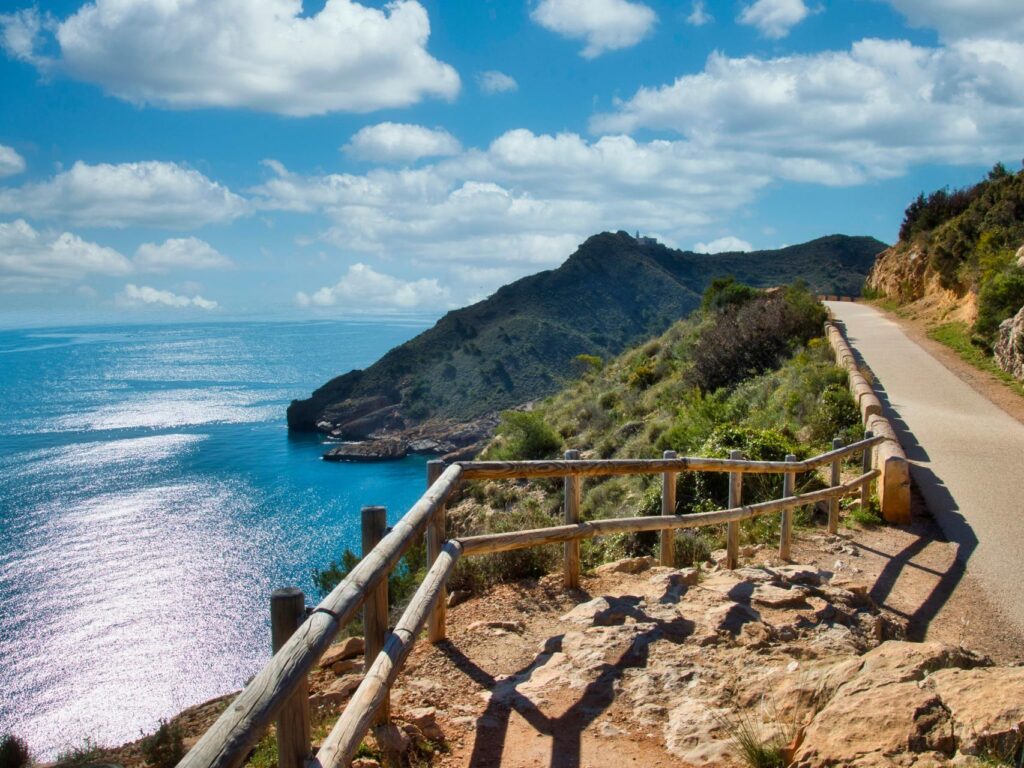
It begins from the l’Albir side of the park and follows a broad, well-surfaced path toward the lighthouse. Compared with the exposed ridge traverse, the route feels controlled, accessible and easy to follow.
The Generalitat classifies the Red Route to the lighthouse as low difficulty, and that is a fair description for most reasonably mobile adults. It still involves some gradient, but the surface and route design make it much less demanding than the other main Serra Gelada options.
This is the route to choose if you are travelling with someone who enjoys walking but does not normally hike, if you want a relaxed half-day from Benidorm or if the full ridge sounds more stressful than enjoyable.
What the walk is actually like
The path gradually moves away from the urban edge of l’Albir and follows the northern side of Serra Gelada.
You are never far from the coast, and the views open toward the Bay of Altea as you progress. The landscape feels increasingly natural despite the fact that the route itself remains relatively comfortable.
One of the advantages of this walk is that you can pay attention to the scenery without constantly watching every footstep. That makes it particularly good for couples, friends and visitors who want to talk while walking rather than concentrate on technical terrain.
The route also gives you a close view of the cliffs and geology of the park without placing you on the exposed upper ridge.
The old ochre mines
One of the most interesting features along this side of Serra Gelada is the area associated with the old ochre mines.
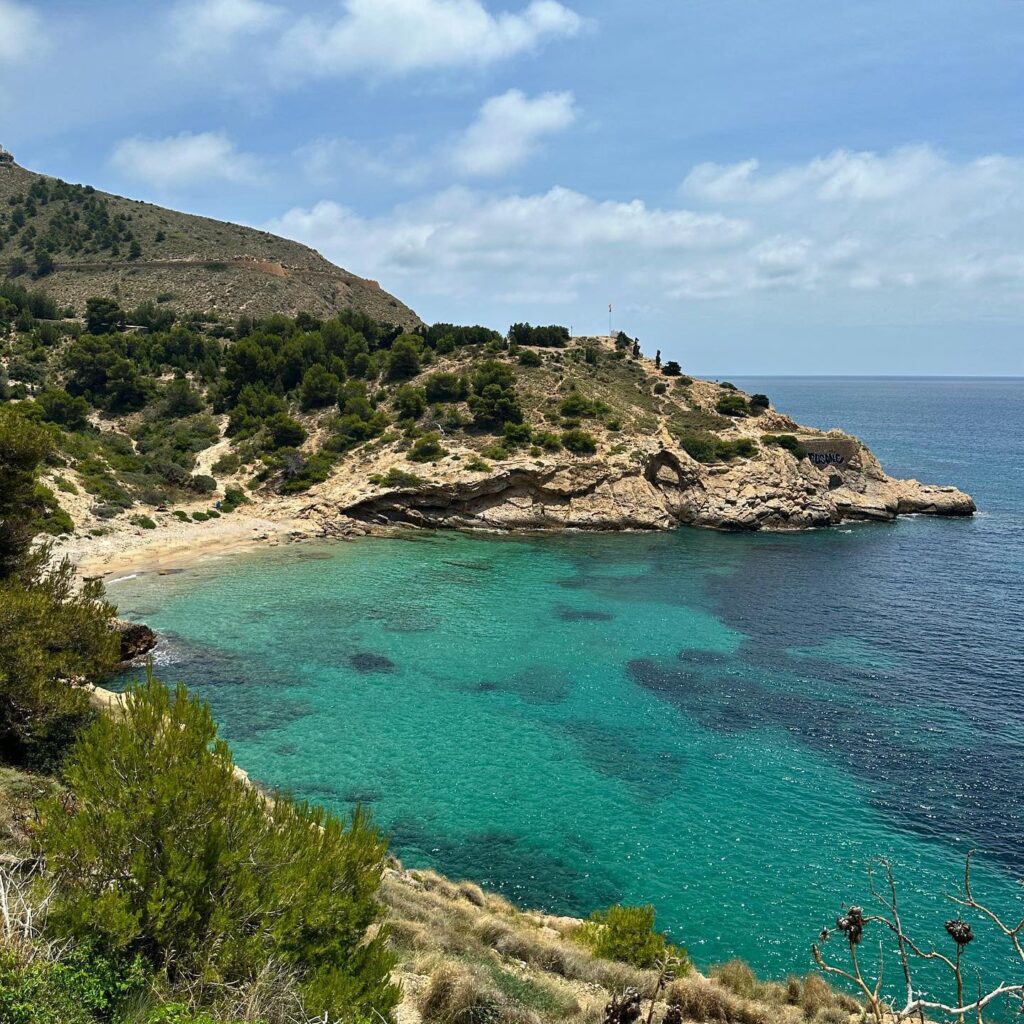
Mining activity once took place in the cliffs around Cala de la Mina, and remnants of this industrial past still form part of the park’s interpretation. The site adds an unexpected historical dimension to a walk that might otherwise be understood purely as a scenic coastal route.
You do not need to turn the excursion into a history lesson, but knowing that people once worked this rugged coastline changes how you look at it.
Reaching Faro de l’Albir
The lighthouse is the natural objective of the route.
Today, the Faro de l’Albir is more than simply a viewpoint. It includes an interpretation centre connected with the natural park and the history of the lighthouse and its keepers.
The final section offers attractive views across the sea and back toward the coast.
Because the route is out-and-back, there is also no transport problem at the end. You simply return along the same path toward l’Albir.
That simplicity is one of the main reasons the Faro route works so well for a casual day off.
How long should you allow?
For most visitors, this is best treated as a relaxed two- to three-hour outing rather than a route to complete as quickly as possible.
That allows time for:
- walking at a comfortable pace;
- stopping at viewpoints;
- visiting the lighthouse area;
- taking photographs;
- looking at the ochre-mine remains;
- short rest stops.
If you move quickly, you may need less time. But rushing removes much of the appeal.
Who should choose this route?
The Faro de l’Albir route is particularly suitable for:
- visitors with limited hiking experience;
- couples or groups with mixed fitness levels;
- older visitors who are comfortable walking but want to avoid rough mountain terrain;
- digital nomads looking for a low-stress half-day away from work;
- photographers who want coastal views without carrying equipment over a difficult ridge;
- people who want to combine Serra Gelada with lunch or time in l’Albir.
It is also the most sensible choice on a day when you want to be outdoors but do not feel energetic enough for a serious hike.
Who may find it too easy?
Experienced hikers looking for a physically demanding route may find the lighthouse walk underwhelming.
The scenery is worthwhile, but the route itself does not provide the challenge of the ridge traverse.
If your main goal is exercise rather than sightseeing, La Cruz or the full traverse will probably be a better match.
La Cruz de Benidorm: The Best Short Workout from the City
La Cruz is one of the most useful outdoor activities available to people actually living in Benidorm.
It requires less organisation than most day trips because the route begins from the eastern side of the city. Depending on where you live or stay, you may be able to walk directly from your accommodation.
Visit Benidorm describes the route as approximately 5 kilometres return, with around 237 metres of maximum elevation difference and an estimated duration of three hours.
The official rating of medium difficulty reflects the sustained uphill effort more than technical terrain.
The climb from Benidorm
From the Rincon de Loix side of the city, the route gradually leaves the dense urban area behind and climbs toward the viewpoint.
The first impression can be deceptive because roads and houses remain visible for part of the ascent. This is not a remote mountain trail from the first step.
What changes is the perspective.
As you gain height, the city begins to spread out below. Levante Beach, the old town, Poniente and the surrounding mountains gradually appear as parts of a much larger landscape.
The climb becomes a workout surprisingly quickly.
Even people who walk regularly around Benidorm may feel the difference once the gradient becomes sustained.
Why La Cruz works so well for remote workers
The main advantage is efficiency.
You can turn La Cruz into:
- an early-morning workout;
- an extended lunch-break walk;
- an afternoon escape after finishing work;
- a sunset outing;
- a weekend activity without organising transport.
That gives it a different value from the lighthouse or ridge traverse.
It is not necessarily the most spectacular Serra Gelada experience, but it may be the one you actually repeat most often.
For a long-stay resident, repeatability matters.
A place you can visit five times during a season may become more useful than a famous attraction you see once.
The viewpoint
The main reward is the view over Benidorm.
The city skyline appears especially dramatic from this side because the high-rise buildings, beaches and surrounding mountains can all be seen together.
On clear days, visibility extends far beyond the immediate urban area.
Sunrise and the late afternoon can provide particularly attractive light, although sunset timing and darkness need to be considered carefully if walking back.
Is the route technically difficult?
Generally, no.
The main challenge is the uphill effort rather than scrambling, exposure or difficult foot placement.
That makes La Cruz suitable for people who want cardiovascular exercise without the rougher terrain of the full Serra Gelada traverse.
However, heat changes the experience considerably.
A steep urban-edge climb under strong summer sun can become exhausting, even when the route looks simple on a map.
Who should choose La Cruz?
La Cruz is ideal for:
- active residents in Benidorm;
- remote workers who want exercise close to home;
- photographers looking for elevated views of the city;
- visitors with only a few hours available;
- people who do not want to organise transport;
- walkers who want more effort than the lighthouse route but less commitment than the traverse.
Who may be disappointed?
Anyone expecting complete wilderness may find the early sections too urban.
Likewise, experienced mountain hikers may see it as a workout and viewpoint rather than a major hiking achievement.
That is perfectly reasonable. La Cruz is valuable because of its location and convenience, not because it pretends to be a remote mountain expedition.

The Full Serra Gelada Traverse: A Proper Hiking Day
The Yellow Route across Serra Gelada is the option that should be treated as a serious hike.
The official itinerary covers approximately 6.4 kilometres one way, takes around 3.5 to 4 hours and reaches a maximum elevation difference of 438 metres.
Those figures can still underestimate the effort because the route repeatedly gains and loses height.
This is not a simple point-to-point walk along a flat ridge.
Why the traverse feels harder than expected
Many hikers look at the total distance and assume that 6.4 kilometres should be easy.
The problem is the profile.
Serra Gelada rises and falls repeatedly, meaning that altitude gained can be lost and then regained again. This constant rhythm makes the route more tiring than a single steady ascent followed by one descent.
The exposed coastal setting adds another factor.
There is limited shade over much of the ridge, so the physical effort can increase dramatically in warm conditions.
A moderate hike on a cool winter morning can become an unpleasant endurance exercise in midsummer.
Starting from the Benidorm side
Beginning from Benidorm allows you to climb away from the city and move progressively north across the ridge.
This direction can be attractive for residents because you can start relatively close to home and finish near l’Albir.
The major planning issue is the return.
Once you reach the northern end, you still need to get back to Benidorm.
That may involve:
- a local bus;
- taxi;
- arranged pickup;
- a second vehicle;
- another pre-planned transport connection.
Do not begin the route assuming you will “work it out later.”
After several hours of hiking, discovering that the next practical bus is much later than expected is frustrating.
Starting from the l’Albir side
The route can also be approached from the northern side.
This may be preferable when transport connections make l’Albir easier to reach early in the morning, or when you want to finish in Benidorm close to accommodation, food and familiar transport.
For some residents, finishing in Benidorm feels psychologically easier because the destination is home rather than another town.
The correct direction depends more on logistics than on a single universally superior route.
The ridge experience
The traverse provides the strongest sense of Serra Gelada as a mountain rather than an urban-edge park.
Once established on the ridge, the views alternate between the Mediterranean, Benidorm, l’Albir, Altea and the surrounding mountains.
The landscape feels exposed and open.
There are sections where you become much more aware of the steep coastline below, although this is primarily a hiking route rather than a technical climbing route.
The repeated ascents can be deceptive. A visible high point may appear to be the last major climb, only for the route to descend again and reveal another rise ahead.
That psychological element is part of the challenge.
How physically demanding is it?
For an active person who hikes regularly, the traverse should be manageable in suitable weather.
For someone whose main exercise is walking around town, it may feel considerably harder.
The route demands:
- cardiovascular fitness;
- leg strength;
- enough water;
- heat management;
- pacing;
- several hours of concentration.
You should be comfortable being outdoors for most of a morning or afternoon without relying on cafés, shade or frequent facilities.
Is there much shade?
No.
Lack of shade is one of the most important practical issues on the full traverse.
Trees do not continuously protect the ridge, and the Mediterranean sun can be intense even outside peak summer.
This means the best hiking season is not necessarily the same as the best beach season.
For the traverse, cooler months are often preferable.
Who should choose the full traverse?
The ridge is best suited to:
- regular hikers;
- active digital nomads wanting a serious workout;
- people comfortable with several hours outdoors;
- visitors seeking the most complete Serra Gelada experience;
- photographers prepared to carry equipment responsibly;
- anyone who values the journey itself rather than simply reaching a viewpoint.
Who should avoid it?
Choose another option if:
- you rarely hike;
- you are uncomfortable with prolonged sun exposure;
- you have significant knee or mobility problems;
- you are starting late;
- you have insufficient water;
- strong heat is forecast;
- you have not planned the return journey;
- you need to be back in Benidorm at a precise time.
The existence of the easier lighthouse route and La Cruz means there is little reason to force yourself onto the traverse.
Which Serra Gelada Route Is Hardest?
The hierarchy is straightforward.
Faro de l’Albir is the easiest.
It is primarily a scenic walk with a well-defined route and modest physical demands.
La Cruz sits in the middle.
It is more physically demanding because of the climb, but the route is shorter and easier to fit into an ordinary day.
The full Serra Gelada traverse is clearly the hardest.
It involves the longest period of sustained effort, repeated elevation changes, greater exposure and the additional complication of point-to-point transport.
A simple comparison looks like this:
| Route | Difficulty | Typical Commitment | Best For |
|---|---|---|---|
| Faro de l’Albir | Easy | 2–3 hours | Relaxed walking and scenery |
| La Cruz | Moderate | 2–3 hours | Exercise and Benidorm views |
| Full traverse | Moderate to demanding | Half to full day | Serious hiking |
The important point is that difficulty does not determine quality.
The lighthouse route can be the best Serra Gelada experience for one reader, while the traverse may be the obvious choice for another.
The right route is the one that matches your fitness, available time and reason for going.
How to Get to Serra Gelada from Benidorm
One of Serra Gelada’s biggest advantages is that you do not need a car to enjoy it.
In fact, depending on the route you choose, driving may offer very little advantage.
The important point is that Serra Gelada has more than one practical access area, and the correct transport plan depends entirely on which version of the park you want to experience.
For most visitors based in Benidorm:
- La Cruz can usually be approached directly from Benidorm.
- Faro de l’Albir requires travelling to the l’Albir side.
- The full traverse requires planning both the starting point and the return from the opposite end.
That last point is particularly important because the official Yellow Route is linear rather than circular.
Getting to La Cruz from Benidorm
La Cruz is the easiest option logistically.
The southern access lies above Rincon de Loix, on the eastern side of Benidorm. Depending on where you are staying, you may be able to begin walking directly from your accommodation.
If you are based around Levante Beach or Rincon de Loix, this is often the most sensible approach.
Visitors staying around the old town, Poniente or farther west can use a local bus or taxi to shorten the urban part of the journey before beginning the climb.
Once you reach the upper streets, the route continues toward La Cruz on an asphalted access road. Motor-vehicle access is restricted on the final approach, so you should expect to complete this section on foot. Official Benidorm route information identifies La Cruz as one of the access points to the Serra Gelada trail network.
This makes La Cruz particularly attractive for people living in Benidorm because there is no need to organise a conventional day trip.
You can leave your accommodation, complete the walk and return home without changing towns.
Getting to Faro de l’Albir
The Faro de l’Albir route begins from the northern side of Serra Gelada.
The official Red Route starts from the lighthouse parking area in l’Albir and follows the paved track toward the Faro de l’Albir. Benidorm’s municipal environmental information currently lists the route as approximately 5 kilometres return, with a duration of around 1.5 to 2 hours and a maximum elevation difference of 112 metres.
From Benidorm, you have several practical options.
By local bus
The most useful public transport connection is the local Avanza/Llorente Bus network.
As of 2026, Line 010 links Benidorm with Rincon de Loix, l’Albir, Playa del Albir, Altea port and Altea.
There is also a Line 050 connecting Benidorm with l’Albir and l’Alfàs del Pi.
This makes l’Albir one of the easier Costa Blanca destinations to reach from Benidorm without a car.
However, do not assume that the bus leaves you directly at the natural park entrance.
Check the current stop location and allow time to walk from the bus stop to the Faro de l’Albir parking and trailhead.
Because local routes and timetables can change, use the official Avanza/Llorente journey information shortly before travelling rather than relying on an old timetable saved from another website.
By taxi
A taxi from Benidorm to the l’Albir trailhead is one of the simplest options when several people are travelling together.
It may also be worthwhile if:
- you want to start early;
- you are carrying photography equipment;
- mobility within l’Albir is an issue;
- bus times do not fit your plan;
- you want to begin the full Serra Gelada traverse from the northern side.
For a group, the difference in cost compared with several bus tickets may be less significant than expected.
By car
Driving to the l’Albir side is straightforward, and there is an established parking area near the beginning of the lighthouse route.
The Generalitat identifies vehicular access via Calle Estrella Polar in l’Albir, with the Faro de l’Albir parking area also lying close to the beginning of the Yellow Route across Serra Gelada.
Parking can naturally become busier at weekends, in holiday periods and during good walking weather.
If you are attempting the full traverse, remember that parking your car at one end creates another problem: you eventually need to return to it.
For the simple lighthouse route, this is not an issue because you return along the same path.

Do You Need a Car for Serra Gelada?
No.
Serra Gelada is actually one of the strongest entries in this series for people living in Benidorm without a vehicle.
La Cruz can be reached from the city itself.
L’Albir has regular local bus connections from Benidorm.
And because the full traverse ends close to an urban area at either end, you can organise the hike around public transport rather than needing a remote trailhead pickup.
A car is useful when:
- several people are travelling together;
- you want an especially early start;
- you are visiting the lighthouse only;
- you want maximum flexibility;
- you plan to combine Serra Gelada with other destinations.
It becomes less useful for the full linear traverse unless you have a second driver, two vehicles or a clear plan to recover the car afterwards.
For solo travellers, the local bus network may actually be more convenient.
How to Organise the Full Traverse Without a Car
The easiest principle is to treat the route as a one-way hike between two urban areas.
You can:
- travel from Benidorm to l’Albir by bus or taxi;
- begin the Yellow Route from the northern side;
- cross Serra Gelada;
- descend toward La Cruz and Benidorm;
- finish close to your accommodation or local city transport.
For many readers, this is probably the most elegant arrangement.
It removes the need to find transport at the end of a tiring hike.
The opposite direction is equally possible:
- begin from Benidorm;
- cross the ridge toward l’Albir;
- finish near the northern trailhead;
- walk into l’Albir;
- return to Benidorm by local bus or taxi.
This version has the advantage of starting directly from the city, but you need to pay more attention to the return timetable.
Neither direction is inherently correct.
Choose according to:
- where you are staying;
- the weather;
- sunrise and sunset;
- bus schedules;
- whether you prefer to finish close to home.
How Difficult Is Serra Gelada Really?
The answer depends completely on the route.
This is why generic descriptions of Serra Gelada can be misleading.
The same natural park contains an easy paved walk and a demanding ridge traverse.
Faro de l’Albir Difficulty
The Faro route is the easiest option.
Benidorm’s official environmental information describes it as a low-difficulty route of approximately 5 kilometres return, taking roughly 1.5 to 2 hours and gaining a maximum of around 112 metres. The paved surface also allows access for bicycles and people with reduced mobility.
For most reasonably mobile adults, the physical effort should be modest.
The main challenges are:
- heat;
- sun exposure;
- distance for people unused to walking;
- occasional gradients;
- choosing whether to explore some of the optional side paths.
It should not be confused with the ridge hike.
La Cruz Difficulty
La Cruz is more physically demanding because of the sustained climb.
The route does not generally require technical hiking skills, but the gradient can make it a strong cardiovascular workout.
Its difficulty also varies according to where you begin.
Someone starting close to Rincon de Loix has a different day from someone walking all the way from central Benidorm.
Heat can transform this route.
In cool conditions, the climb may feel pleasantly demanding. Under strong summer sun, the same asphalted slope can become exhausting.
The lack of technical terrain should never be interpreted as lack of physical effort.

Full Traverse Difficulty
The official Yellow Route is classified by Benidorm’s environmental information as medium-high difficulty, covering approximately 6.5 kilometres one way in around 3.5 to 4 hours with a maximum elevation difference of 438 metres.
The route climbs first toward the high point around the telecommunications installations and then continues through repeated ascents and descents before eventually reaching La Cruz and the Benidorm side.
The cumulative effort is what catches people out.
You may descend significantly, believe the hardest work is finished and then face another climb.
The route requires:
- reasonable cardiovascular fitness;
- strong enough legs for repeated gradients;
- secure footwear;
- enough water;
- tolerance of exposed coastal terrain;
- several hours of sustained activity.
This is a real hiking route, not simply a longer version of the lighthouse walk.
What About Vertigo?
The Faro de l’Albir route should not cause major problems for most people uncomfortable with heights because the main paved route is broad and comparatively controlled.
La Cruz also provides elevated views without requiring the same ridge exposure as the complete traverse.
The Yellow Route is different.
There are sections where the coastal cliffs and steep slopes become much more apparent.
Someone with mild discomfort around heights may still manage well by staying focused on the path.
A person with strong vertigo may find parts of the traverse unpleasant enough that the easier routes provide a much better experience.
There is no value in completing the hardest route simply to prove that you can.
Best Time to Visit Serra Gelada
Serra Gelada is accessible throughout much of the year, but the best season depends partly on the route.
For the full traverse, cooler weather is a major advantage.
Spring
Spring is one of the best periods overall.
Temperatures are generally suitable for hiking, daylight is generous and the landscape tends to feel more alive than during the driest part of summer.
The main disadvantage is popularity during Easter, weekends and public holidays.
For the full traverse, a dry weekday morning in spring can provide close to ideal conditions.
Summer
Summer requires much more caution.
The ridge has substantial exposure to direct sun, and shade is limited.
More importantly, access to Serra Gelada can be temporarily closed during periods of extreme wildfire risk or severe heat.
This is not merely theoretical. Benidorm authorities ordered complete closures of Serra Gelada access on multiple occasions during July 2026 because the Generalitat had declared maximum wildfire pre-emergency levels.
Therefore, summer visitors should always check official local and Generalitat alerts before setting out.
For La Cruz or the lighthouse route, an early-morning outing may still be enjoyable in summer when access is permitted.
For the full traverse, a forecast of extreme heat should be treated as a reason to choose another day.
Autumn
Autumn is another excellent period.
Temperatures often become much more comfortable after summer, while daylight remains sufficient for long walks.
Rain is the main variable.
Heavy autumn storms occur on the Costa Blanca, and a long ridge route should be reconsidered if unstable conditions are expected.
Clear autumn mornings can be among the best times of the year to complete the traverse.
Winter
Winter is particularly suitable for active hikers.
Cooler temperatures make the repeated climbs much more manageable, and visibility can be excellent on clear days.
You need to account for:
- shorter daylight;
- stronger wind;
- cooler exposed sections;
- rapidly changing conditions.
Begin early enough that finishing before darkness is never in doubt.
What Should You Bring?
Again, the answer depends on the route.
The lighthouse walk requires relatively little equipment.
The full traverse deserves proper hiking preparation.
For Faro de l’Albir
A simple setup is usually enough:
- comfortable walking shoes;
- water;
- sunscreen;
- hat;
- sunglasses;
- phone;
- light snack.
Trail shoes are useful but not essential for the main paved route.
If you plan to explore unpaved side paths, better footwear becomes more important.
For La Cruz
Bring:
- secure trainers or walking shoes;
- water;
- sun protection;
- phone;
- a light layer outside summer.
Because the route is close to Benidorm, people sometimes underestimate it and start walking with no water.
That is particularly unwise during warm weather.
For the Full Traverse
Preparation should be more serious.
Bring:
- hiking or trail shoes with reliable grip;
- plenty of water;
- food or substantial snacks;
- sunscreen;
- hat;
- sunglasses;
- charged phone;
- downloaded or accessible route information;
- light windproof or warm layer outside summer;
- small backpack;
- return transport information.
Trekking poles can be useful for people accustomed to using them, particularly during repeated descents.
Do not rely on finding water or refreshments along the ridge.
Once you commit to the traverse, you should be self-sufficient until you reach the urban area at the other end.

How Much Water Should You Carry?
There is no single correct quantity because temperature, body size and pace vary.
For the lighthouse route or La Cruz in mild conditions, a normal walking supply may be sufficient.
For the full traverse, err on the side of carrying more rather than less.
A litre per person may be reasonable in cool conditions for some hikers, but warmer days can require considerably more.
The problem with Serra Gelada is that the sea breeze and views can make conditions feel pleasant while direct sun is steadily increasing dehydration.
Drink before you become very thirsty.
Should You Carry a Laptop?
For the full traverse, definitely not.
It adds unnecessary weight, heat sensitivity and financial risk while providing no useful benefit on the ridge.
La Cruz is also better treated as a screen-free activity.
The lighthouse route is slightly different.
Because l’Albir contains cafés and other urban facilities, a remote worker could theoretically combine the walk with a work session before or afterwards.
Even then, carrying a laptop all the way to the lighthouse simply because you intend to use it later is not ideal.
If possible, separate the two activities.
Serra Gelada is more valuable as somewhere to step away from work than as another backdrop for it.
Safety and Responsible Hiking in Serra Gelada
Serra Gelada feels unusually accessible because it sits immediately beside Benidorm, l’Albir and Altea.
That accessibility can create the wrong impression.
The lighthouse route may be easy, and La Cruz may begin almost within the city, but the natural park still contains exposed terrain, steep slopes, strong sun and areas where conditions can change quickly.
The full traverse in particular should be treated as a mountain hike rather than an extension of a walk around Benidorm.
Check Official Alerts Before You Leave
This is especially important during summer.
Access to Serra Gelada can be restricted or completely prohibited when the Generalitat Valenciana declares extreme wildfire risk or other dangerous conditions.
This has happened repeatedly during the summer of 2026. Benidorm City Council closed pedestrian and vehicle access to Serra Gelada during periods of maximum wildfire pre-emergency, including restrictions affecting La Cruz and the rest of the natural park.
A clear sky and apparently normal weather in Benidorm therefore do not necessarily mean that access is permitted.
Before leaving, check:
- Generalitat Valenciana emergency information;
- Serra Gelada Natural Park notices;
- Benidorm City Council information when using the southern side;
- current weather alerts.
Do not ignore a closure because other walkers appear to be entering the park.
Temporary restrictions exist for a reason and may apply to pedestrians as well as vehicles.
Avoid the Full Traverse in Extreme Heat
The ridge is exposed and provides limited protection from direct sunlight.
During periods of high temperatures, the problem is not simply feeling uncomfortable. Heat reduces physical performance, accelerates dehydration and makes decision-making less reliable.
Benidorm authorities explicitly advised avoiding walking on trails during recent extreme-heat and wildfire-risk episodes and recommended avoiding direct sun during the strongest part of the day.
If you wake up on the planned hiking day and conditions look substantially hotter than expected, choose another version of Serra Gelada.
The Faro de l’Albir walk early in the morning may still be appropriate when access remains open.
The full ridge traverse is much less forgiving.
Respect the Cliffs
Serra Gelada contains some dramatic coastal drops.
They are one of the reasons the scenery is so impressive, but they should never become photography platforms.
Stay on established paths and do not move toward cliff edges simply because a photograph looks better without vegetation or other hikers in the frame.
Wind can also be much more noticeable on exposed ground than it was in Benidorm.
A strong gust matters when someone is standing near a steep drop, holding a phone at arm’s length or concentrating on a camera rather than their footing.
Keep Your Phone Away While Moving on Rough Terrain
Stop before checking messages, maps or photographs.
This is particularly important on the Yellow Route, where attention needs to remain on the trail.
Remote workers sometimes feel compelled to remain available even during time off. Serra Gelada is not the place to answer Slack messages while walking along exposed ground.
If something genuinely requires your attention, stop somewhere secure.
Stay on the Marked Route
Shortcuts can damage vegetation and expose walkers to unstable or much steeper terrain.
A path that looks like an easier descent from above may become impassable farther down.
Follow official routes rather than improvised tracks created by repeated foot traffic.
The fact that several people have walked somewhere does not make it part of the intended trail.
Tell Someone Your Plan for the Full Traverse
For the Faro route or La Cruz, this may not be necessary for most visitors because you remain comparatively close to urban areas.
For the full crossing, it is sensible.
Tell someone:
- where you are starting;
- which direction you are walking;
- roughly when you expect to finish;
- how you intend to return.
This is particularly useful when hiking alone.
Leave No Trace
Everything you carry into Serra Gelada should leave with you.
Do not leave:
- food packaging;
- tissues;
- bottles;
- cigarette ends;
- fruit peel;
- broken equipment.
Do not collect plants or disturb wildlife.
Serra Gelada is a protected natural park, not simply an undeveloped piece of land beside Benidorm.
Common Mistakes When Visiting Serra Gelada
Most disappointing Serra Gelada experiences begin before the walk itself.
The problem is usually not that the park is too difficult. It is that the visitor chose the wrong route or planned it badly.
Assuming All Serra Gelada Routes Are Similar
This is probably the biggest mistake.
Someone reads that the lighthouse walk is easy and assumes Serra Gelada is generally easy.
Another person reads an account of the demanding ridge traverse and decides the park is unsuitable for them altogether.
Neither conclusion is correct.
The three main experiences are sufficiently different that they should almost be treated as separate excursions.
Choosing the Hardest Route Because It Sounds More Complete
The full traverse is not automatically the “real” Serra Gelada.
If you want a pleasant coastal morning, the lighthouse may be a better experience.
If you want exercise without losing an entire day, La Cruz may make more sense.
Completing the longest route provides satisfaction only when hiking itself is what you wanted to do.
Starting the Traverse Too Late
A late start creates several problems at once:
- higher temperatures;
- more accumulated fatigue;
- less daylight;
- greater pressure to maintain pace;
- potential problems with return transport.
For a substantial hike, begin with enough time that slowing down does not create a problem.
Forgetting About the Return Journey
This mistake is specific to the full traverse.
You reach the opposite side of Serra Gelada after several hours of hiking and only then start checking buses.
That is backwards.
Know how you intend to return before beginning the route.
If starting in l’Albir and finishing in Benidorm, the logistics are especially simple for someone staying in Benidorm because you can effectively hike home.
If walking in the opposite direction, check the current bus connection before leaving.
Underestimating the Repeated Climbs
The ridge does not provide one continuous ascent followed by an easy descent.
Repeated changes in elevation gradually consume energy.
Do not use all your strength reaching the first high point because more climbing follows.
A steady pace is much more effective than alternating between fast climbs and long exhausted stops.
Carrying Too Little Water
The proximity of towns creates an illusion of easy access to services.
Once on the ridge, those cafés and supermarkets below are irrelevant.
Carry what you need for the complete route.
Do not rely on finding a water source halfway across.
Expecting Shade
The Mediterranean landscape looks green from Benidorm, but that does not mean the ridge is shaded.
There are long exposed sections.
Sun protection should be considered basic hiking equipment rather than something needed only in July and August.
Doing the Full Traverse in Beach Clothes
Serra Gelada and the Mediterranean are visually inseparable, but the ridge is not a beach activity.
Flip-flops, loose sandals and smooth casual shoes are inappropriate for a serious crossing.
Save them for after the hike.
Planning an Important Meeting Immediately Afterwards
This is a particularly relevant mistake for digital nomads.
A route scheduled to finish at 14:00 does not guarantee that you will be showered, fed, connected and mentally ready for an important video meeting at 15:00.
Hikes take longer than expected.
Transport is delayed.
People become tired.
If you need to protect a work commitment, choose La Cruz or the lighthouse on another day rather than forcing the full traverse into a narrow time window.
Combining Serra Gelada with Other Places
One of the strengths of the park is how naturally it connects with the towns around it.
The best combination depends on which route you choose.
Faro de l’Albir + l’Albir
This is probably the easiest combination.
Complete the lighthouse walk in the morning and return to l’Albir for lunch, coffee or time by the sea.
Because the walk is not especially exhausting, you should still have enough energy to explore the seafront afterwards.
This combination works particularly well for:
- couples;
- visitors with mixed fitness levels;
- people without a car;
- digital nomads wanting a relaxed half-day;
- anyone who wants walking and lunch rather than a serious hike.
It can also be expanded into a longer afternoon if you enjoy l’Albir.
Faro de l’Albir + Altea
Altea is another logical addition because it lies immediately north of l’Albir.
This works best when the lighthouse is your only significant physical activity.
After the walk, you could continue toward Altea for lunch or spend part of the afternoon exploring the old town and seafront.
Do not try to combine the full Serra Gelada traverse, a long Altea visit and an evening schedule unless you have deliberately planned a very full day.
The lighthouse route gives you much more flexibility.
La Cruz + Benidorm
La Cruz naturally belongs with Benidorm because you are already there.
After descending, the easiest continuation is:
- Levante Beach;
- Rincon de Loix;
- a meal or coffee;
- returning home.
There is little need to turn La Cruz into a conventional tourist day trip.
For someone living in Benidorm, its greatest strength is precisely that it fits into normal life.

La Cruz + Cala Tio Ximo
Cala Tio Ximo sits at the foot of Serra Gelada on the Benidorm side and provides a small rocky-and-sandy cove environment rather than another large urban beach. Visit Benidorm highlights it as a snorkelling location beneath Sierra Helada.
This can create an excellent combination in suitable weather:
- walk to La Cruz early;
- descend;
- continue toward Cala Tio Ximo;
- swim or snorkel;
- return to Benidorm.
Visit Benidorm also describes a dedicated Serra Gelada coves route linking this side of the park, so the coastline below La Cruz offers more walking possibilities for anyone who still has energy.
However, after a hot climb, do not assume that entering the sea immediately is always the best idea. Rehydrate and cool down gradually first.
The Full Traverse + l’Albir or Benidorm
After the full traverse, keep additional plans simple.
If you finish in Benidorm, food and rest are probably enough.
If you finish in l’Albir, walking to the seafront for a meal or drink makes sense before taking transport back.
Do not feel that you need to “make the most of the journey” by adding several hours of sightseeing.
You have already spent most of the day experiencing Serra Gelada.
Food and Drink
There are no restaurants or cafés conveniently distributed along the ridge, so the full traverse requires self-sufficiency.
The easier routes are very different because urban facilities lie close to both ends.
After Faro de l’Albir
L’Albir is the most natural place to eat.
You will find cafés, bars and restaurants around the town and seafront, allowing the outing to move naturally from walking to lunch.
For this route, there is little reason to carry a substantial meal unless you specifically want a picnic.
A snack and water during the walk are normally more convenient.
After La Cruz
Benidorm provides effectively unlimited food options once you descend.
That makes La Cruz particularly convenient.
You can decide where to eat after seeing how long the walk takes instead of tying yourself to a restaurant booking.
This flexibility is useful if you are walking before or after work.
During the Full Traverse
Carry enough food to maintain energy.
You do not need an elaborate lunch, but suitable options include:
- sandwiches;
- fruit;
- nuts;
- energy bars;
- simple snacks that tolerate heat.
Avoid heavy foods that become unpleasant after several hours in a backpack.
Take all packaging with you.
Once you finish, you can have a proper meal in Benidorm or l’Albir.
How Much Does a Serra Gelada Day Cost?
Serra Gelada is potentially one of the cheapest experiences in the entire Costa Blanca Experiences series.
There is normally no admission cost for simply walking the official terrestrial routes.
If you are based in Benidorm, La Cruz can effectively cost nothing.
The lighthouse and full traverse mainly introduce transport and food costs.
The following figures are planning estimates rather than live quoted prices.
La Cruz on Foot
If you begin from your accommodation:
€0–€10 per person
Possible costs:
- water or snack;
- coffee afterwards;
- optional local bus.
If you prepare everything at home, the walk itself can genuinely be free.
Faro de l’Albir by Bus
Allow approximately:
€5–€20 per person
This could include:
- local return bus;
- water or coffee;
- small snack.
Add a restaurant lunch and a more comfortable day may cost:
€20–€40 per person
The exact public transport fare should be checked before travelling rather than relying on a fixed figure because fares and ticket conditions can change.
Faro de l’Albir by Taxi
A taxi increases the budget considerably but can make sense for a small group.
Depending on the journey and number of passengers, a comfortable outing with shared taxi transport and lunch might fall broadly around:
€30–€60+ per person
Treat this only as a planning range, not a quoted taxi fare.
Full Traverse Using Public Transport
This can remain very inexpensive.
A practical day might involve:
- one local bus journey;
- food carried from home;
- water;
- walking back into Benidorm.
Budget approximately:
€5–€20 per person
If you eat in a restaurant afterwards:
€20–€40 per person
For the amount of scenery and physical activity involved, that represents excellent value.

Full Traverse with Taxis and Restaurant Lunch
Using taxis for one or both ends and eating a substantial meal could increase the total to:
€40–€70+ per person
Sharing transport reduces the individual cost significantly.
Example Budget Comparison
| Serra Gelada Experience | Low-Cost Approach | More Comfortable Day |
|---|---|---|
| La Cruz | €0–€10 | €15–€30 |
| Faro de l’Albir | €5–€20 | €25–€50+ |
| Full traverse | €5–€20 | €30–€70+ |
These figures should be used to understand the relative cost of each experience, not as guaranteed prices.
Transport fares, taxis and restaurant prices can all change.
Is Serra Gelada Good Value?
Extremely.
Few experiences around Benidorm offer this much flexibility at such a low potential cost.
You can spend almost nothing and still enjoy:
- substantial exercise;
- Mediterranean scenery;
- high coastal viewpoints;
- a protected natural environment;
- photography;
- a genuine break from urban life.
The park also rewards repeat visits.
You can walk La Cruz one week, visit Faro de l’Albir another and save the full traverse for cooler weather.
For someone spending several weeks or months on the Costa Blanca, that repeatability makes Serra Gelada more valuable than many attractions requiring an entrance fee every time you visit.
It is not simply somewhere to tick off once.
It can become part of living in Benidorm.
Suggested Half-Day Itinerary: Faro de l’Albir
This is the best option when you want Serra Gelada to fit comfortably into a relaxed morning or afternoon.
08:30–09:00: Leave Benidorm
Take a local bus, taxi or car toward l’Albir.
If you are travelling in summer, earlier is better. In cooler months, you can be more flexible.
09:00–09:30: Reach the Trailhead
Use this time to organise water, apply sunscreen and make sure you are comfortable before starting.
The lighthouse route is easy compared with the ridge traverse, but there is still no benefit in beginning unprepared.
09:30–11:30: Walk to Faro de l’Albir and Back
Walk at a relaxed pace.
Stop at viewpoints, explore the historical points of interest and spend some time around the lighthouse rather than treating it as a turnaround marker.
The purpose of this version is scenery and enjoyment, not exercise statistics.
11:30–13:00: Explore l’Albir or Have Lunch
Once back in town, choose between:
- lunch;
- coffee;
- the seafront;
- a short beach stop.
This is also the easiest Serra Gelada option to combine with Altea later in the day.
13:00 onwards: Return to Benidorm or Continue to Altea
If you want a half-day outing, return to Benidorm.
If you still have energy, continue toward Altea and turn the excursion into a more complete Costa Blanca day.
Suggested Half-Day Itinerary: La Cruz
La Cruz works differently because you may not need any transport at all.
08:00–08:30: Start from Benidorm
Begin from your accommodation or shorten the urban section using local transport if you are staying farther away.
For summer, an early start is strongly preferable.
08:30–10:00: Climb to La Cruz
Take your time on the ascent.
The climb is the main workout, so maintain a steady pace rather than trying to reach the viewpoint quickly.
10:00–10:30: Enjoy the View
Use the viewpoint as a proper break.
Look over Benidorm, the surrounding mountains and the coastline rather than immediately turning back.
10:30–11:30: Descend
The return should feel considerably easier physically, but continue paying attention to heat and hydration.
11:30 onwards: Return Home, Have Brunch or Continue to the Coast
This is what makes La Cruz so useful for people living in Benidorm.
You can complete a proper outdoor activity and still have most of the day available.
A longer version could continue toward Cala Tio Ximo for a swim or coastal walk.
Suggested Full-Day Itinerary: Serra Gelada Traverse
For someone staying in Benidorm, one of the most practical versions is to begin from the l’Albir side and finish back in Benidorm.
That way, the final destination is effectively home.
07:30–08:00: Leave Benidorm for l’Albir
Take an early local bus or taxi.
Carry everything you need for several hours outdoors before leaving Benidorm.
Do not plan to buy water once you have begun the ridge.
08:00–08:30: Reach the Northern Trailhead
Use the final few minutes to:
- check weather conditions;
- apply sunscreen;
- organise food and water;
- confirm the route;
- make sure everyone feels fit enough to continue.
If the heat or wind already feels excessive, change the plan rather than forcing the traverse.
08:30–12:30: Cross Serra Gelada
Expect repeated climbs and descents rather than a smooth ridge walk.
Keep the pace sustainable from the beginning.
Take short breaks for water and food, but avoid long stops in exposed sun unless necessary.
Photographs are part of the experience, but stop somewhere secure before using your phone or camera.
12:30–13:30: Descend Toward La Cruz and Benidorm
The exact finishing time will depend on fitness and stops.
Once Benidorm becomes increasingly close, resist the temptation to rush the final section simply because the city is visible.
13:30–14:30: Food and Recovery
A proper meal, plenty of water and some shade should be the priority.
This is not the ideal moment to begin another demanding activity.
14:30 onwards: Keep the Rest of the Day Flexible
Good options include:
- returning home;
- relaxing at Levante Beach;
- having coffee;
- taking a short swim;
- doing absolutely nothing.
After the full traverse, the day is already complete.
Is Serra Gelada Worth Visiting for Digital Nomads?
Yes — and probably more than once.
Serra Gelada is particularly well suited to remote workers because it can fill several different roles depending on how much time and energy you have.
La Cruz works as a local workout.
Faro de l’Albir works as a relaxed half-day escape.
The full traverse works as a complete break from work.
That versatility is unusual.
Many Costa Blanca experiences require planning, transport and an entire free day. Serra Gelada can be incorporated into normal life.
If you are based in Benidorm for several weeks or months, it may become one of the natural places you return to rather than somewhere you simply visit once.
Can You Work from Serra Gelada?
For practical purposes, no.
The natural park is not a remote-work environment.
There are no suitable desks, power outlets or reasons to carry a computer onto the ridge.
Even La Cruz is better approached as exercise rather than a novelty workstation.
The Faro de l’Albir route offers a slightly different possibility because you can return to l’Albir afterwards and work from an appropriate café or other suitable location.
That does not mean you should carry a laptop to the lighthouse if you do not need it.
The stronger approach is to separate the activities.
Walk first.
Work later.
Which Route Is Best for a Workday Break?
La Cruz wins.
It requires minimal logistics and can be completed within a few hours.
Someone with a flexible remote schedule could walk early in the morning and begin work afterwards, or finish work and climb later when conditions are suitable.
The lighthouse route requires more transport and therefore feels more like a half-day excursion.
The full traverse should normally be reserved for a genuine day off.
Which Route Is Best for Completely Disconnecting?
The full traverse.
Several hours of repeated climbing, changing scenery and constant movement make it difficult to remain mentally attached to email or work.
That is a positive feature.
Serra Gelada is one of those places where remote workers benefit more from leaving technology behind than from trying to create another “work from anywhere” moment.

Who Will Enjoy Serra Gelada Most?
Serra Gelada has a wider audience than many hiking destinations because of the variety of routes.
Remote workers who need regular exercise
La Cruz is particularly useful because it can become part of a weekly routine rather than a special expedition.
Regular hikers
The Yellow Route provides the most satisfying physical challenge and the strongest sense of crossing the landscape rather than visiting a single viewpoint.
Casual walkers
Faro de l’Albir allows non-hikers to enjoy Serra Gelada without committing to rough terrain or a long day.
Photographers
The park offers very different visual opportunities:
- Benidorm skyline;
- high coastal cliffs;
- Bay of Altea;
- Mediterranean horizons;
- lighthouse scenery;
- mountain landscapes;
- sunrise and evening light.
Long-stay visitors
The ability to return several times makes Serra Gelada particularly valuable to someone living locally.
You do not need to compress the park into one visit.
Car-free residents
The park is unusually accessible without private transport.
That makes it highly relevant to digital nomads who live in Benidorm without owning or renting a car.
Who Might Be Disappointed?
Despite its flexibility, Serra Gelada will not suit everyone equally.
Visitors looking for total wilderness
Benidorm, l’Albir and Altea are never conceptually far away.
The park offers dramatic nature, but it exists directly beside a developed coastal area.
This is not an isolated mountain range.
Experienced hikers choosing only Faro de l’Albir
The lighthouse walk may feel too easy if you are specifically looking for a challenging hiking day.
Choose the ridge instead.
People expecting the ridge to be an easy coastal stroll
The full traverse is much harder than the phrase “coastal walk” might suggest.
Repeated climbs, sun exposure and distance make it a proper hike.
Visitors who dislike uphill walking
Even La Cruz can feel demanding because of the sustained gradient.
The lighthouse is the better choice.
Anyone who expects shade
The exposed character of Serra Gelada is part of the scenery and part of the difficulty.
A hot day can dramatically change the experience.
People who dislike planning
The easier routes are simple, but the full traverse requires at least some thought about weather, water, timing and return transport.

BenidormNomads Verdict
Serra Gelada is one of the strongest experiences available to anyone staying in Benidorm for more than a short holiday.
Its main advantage is not simply the scenery.
It is the flexibility.
You can choose an easy coastal walk, a convenient city-side climb or a demanding ridge traverse without leaving the same natural park.
That makes Serra Gelada unusually useful for real life on the Costa Blanca.
Scenery: 9/10
The combination of Mediterranean coastline, cliffs, Benidorm skyline and Bay of Altea provides consistently strong views.
The full traverse offers the greatest variety.
Hiking Variety: 10/10
This is where Serra Gelada stands out.
Few nearby destinations offer such different experiences within one protected area.
You can adapt the route to fitness, time and mood.
Accessibility from Benidorm: 10/10
La Cruz can be approached from the city itself, while l’Albir is easily reachable by local transport.
A car is unnecessary for most visitors.
Value for Money: 10/10
The walking experiences themselves are free, and some versions require no transport at all.
For long-stay residents, the possibility of returning repeatedly makes the value even stronger.
Photography: 9/10
The park offers coastal, mountain and urban perspectives.
La Cruz is particularly strong for Benidorm skyline photography, while the full ridge provides broader landscape opportunities.
Fitness Challenge: 9/10
The park gives you control over difficulty.
The full traverse provides a serious workout, while easier alternatives remain available.
Crowd Management: 7.5/10
The lighthouse and La Cruz can become busy at popular times.
The ridge generally feels more dispersed, although weekends and good-weather periods can still attract many walkers.
Starting early improves almost every version of the experience.
Food and Nearby Facilities: 9/10
Benidorm and l’Albir provide plenty of options before or after the walk.
The only important distinction is that the full ridge itself requires you to be self-sufficient.
Remote Work Suitability: 3/10
Serra Gelada is not a place to work from.
That score rises indirectly when considering the lighthouse because l’Albir offers places to work afterwards, but the natural park itself should be treated as an outdoor break.
Work-Life Balance Value: 10/10
For remote workers, this may be the most important rating.
Serra Gelada offers an easy way to build physical activity, outdoor time and genuine separation from work into everyday life in Benidorm.
Overall Atmosphere: 9/10
The park feels Mediterranean, exposed and surprisingly wild considering how close it is to major resort towns.
The contrast between urban Benidorm and the ridge is part of its character.
Overall Rating: 9.3/10
Serra Gelada scores exceptionally well because it is not dependent on one single attraction or route.
It provides several genuinely different experiences, costs very little and can be enjoyed without a car.
For someone actually living in Benidorm, that combination is difficult to beat.

Which Serra Gelada Experience Should You Choose?
If this is your first visit and you are not sure about your fitness, start with Faro de l’Albir.
It gives you coastal scenery, a clear destination and an easy introduction to the natural park without turning the day into a physical challenge.
Choose La Cruz if you are living in Benidorm and want something you can realistically repeat.
It offers perhaps the best ratio of effort to organisation: a strong climb, one of the best views over the city and almost no transport planning.
Choose the full Serra Gelada traverse when hiking itself is the purpose of the day.
It is the route that best reveals the scale and character of the mountain, but it should be attempted with enough water, proper footwear, suitable weather and a clear transport plan.
If you are staying in Benidorm for several months, there is no real need to choose only one.
Do the lighthouse on a relaxed morning.
Walk to La Cruz when you need exercise after several days at the laptop.
Save the traverse for a cool, clear day when you have no reason to rush.
That is probably the best way to experience Serra Gelada: not as another attraction to complete once, but as part of living on the Costa Blanca.