

Cape San Antonio from Benidorm: Lighthouse, Coastal Walks and Mediterranean Views
Some places on the Costa Blanca are worth visiting because of what you can do there. Others are worth visiting because of where they are.
Cape San Antonio, or Cap de Sant Antoni, belongs to the second category.
Standing high above the Mediterranean at the northern end of Xàbia, this impressive headland offers a completely different perspective on one of the Costa Blanca’s most beautiful stretches of coastline. Behind you lies the rugged landscape of Montgó Natural Park. Below you, limestone cliffs drop towards the sea. To the south, Xàbia’s bay stretches towards its beaches and distant headlands.
At the top stands a historic lighthouse, overlooking a coastline that has been important to sailors for generations.
It is an extraordinary setting, but there is something visitors should understand before making the journey from Benidorm: the lighthouse viewpoint itself is a relatively short visit.
You can arrive by car, enjoy the panorama, take photographs and leave without spending much time there.
That would be a perfectly reasonable experience if you happened to be exploring Xàbia already. However, travelling from Benidorm exclusively for a brief viewpoint stop would mean missing much of what makes the area interesting.
The real attraction is the combination of the headland, its protected natural environment, the surrounding walking routes and the opportunity to explore a quieter side of the Costa Blanca.
You can spend an hour admiring the scenery or turn the visit into a relaxed half-day excursion through the landscapes of Montgó Natural Park. With a little more time, you can combine it with the historic centre or port of Xàbia.
This guide focuses on making that choice.
Rather than treating Cape San Antonio as another stop on a coastal sightseeing itinerary, we will explore what makes the headland special, how to experience its natural environment and whether it deserves a dedicated excursion from Benidorm.
What Is Cape San Antonio?
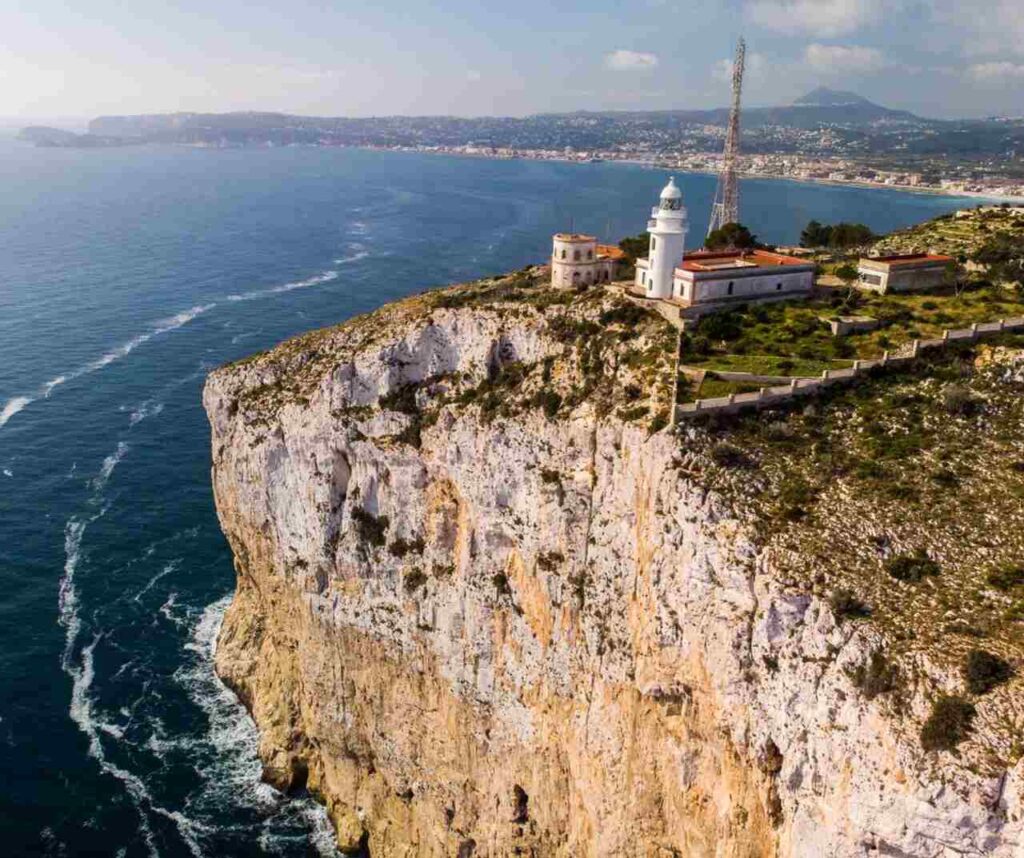
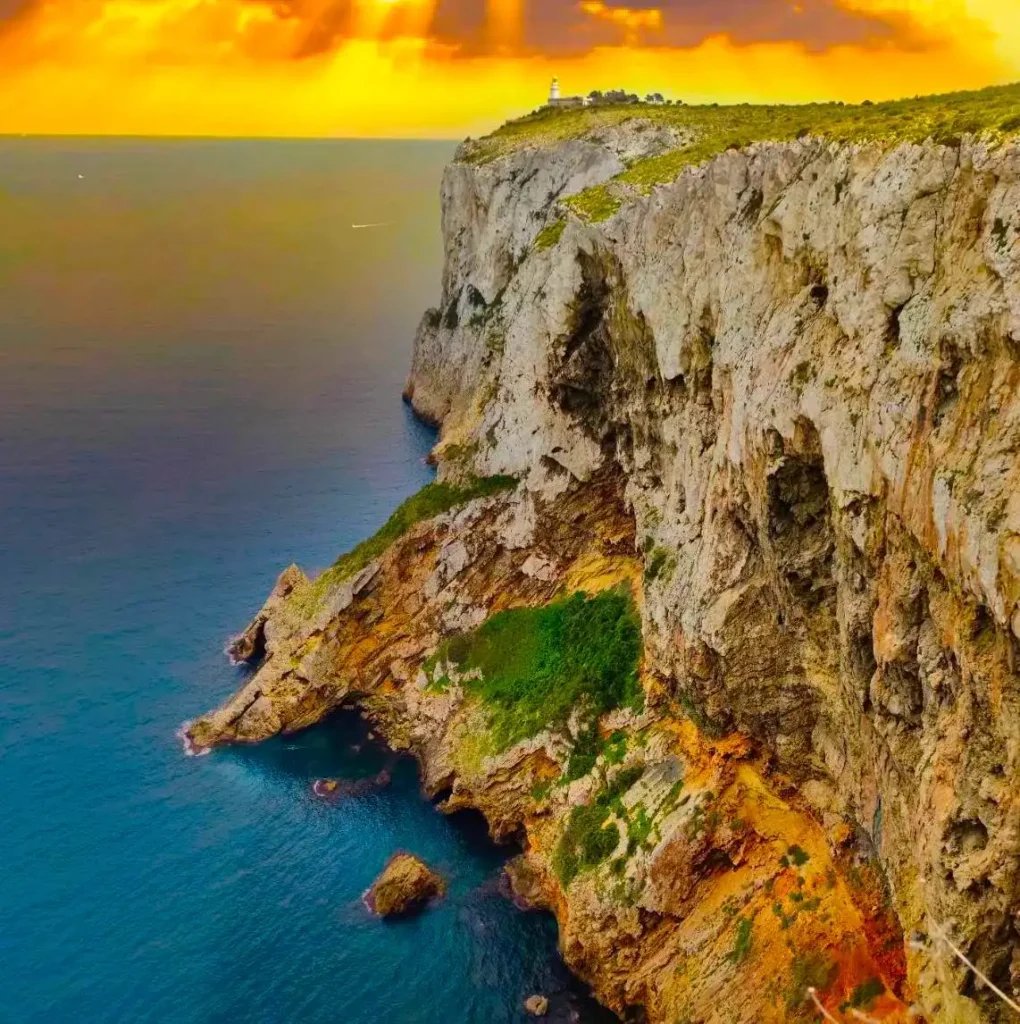
Cape San Antonio is a prominent limestone headland on the northern coast of Xàbia, marking one of the most recognisable geographical features of the northern Costa Blanca.
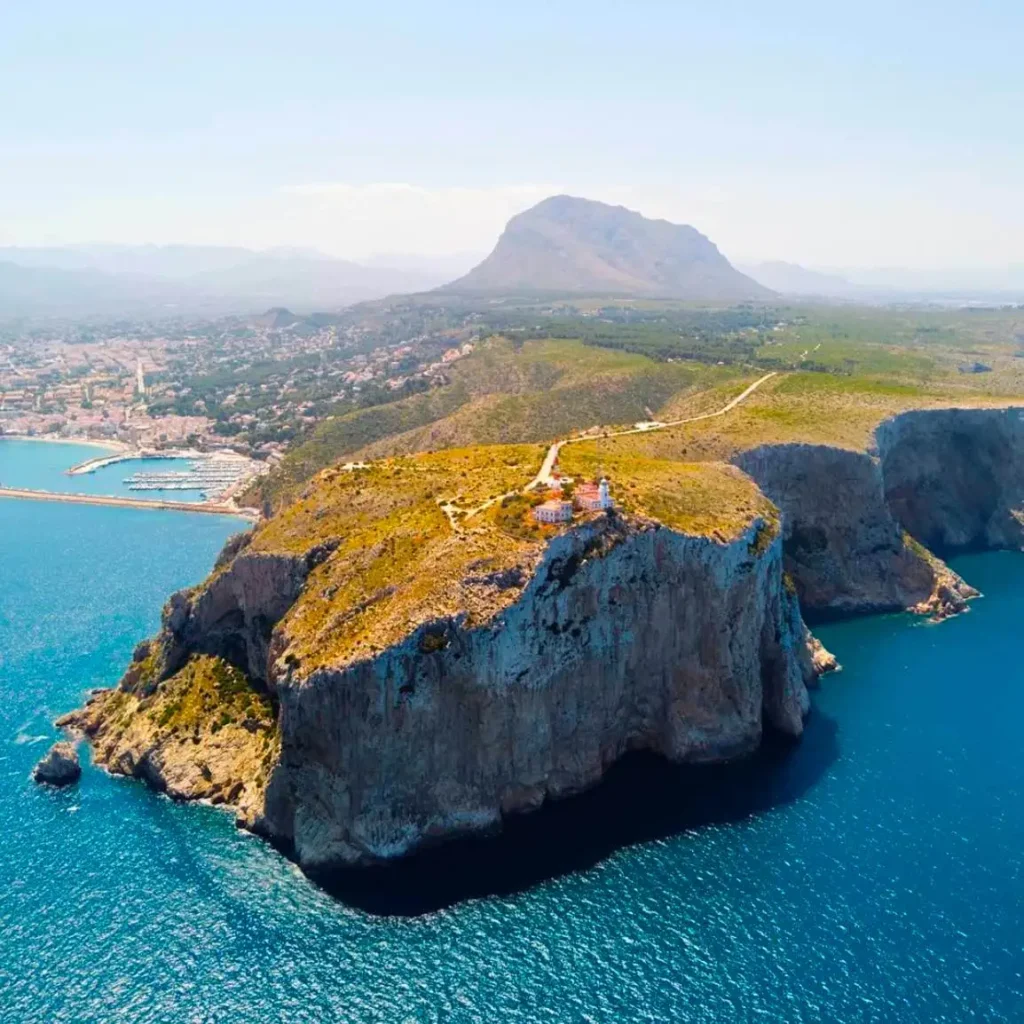
It forms part of Montgó Natural Park, a protected landscape extending between Xàbia and Dénia.
The cape rises approximately 160–175 metres above the Mediterranean, depending on the precise point being measured. Its elevated position creates an almost uninterrupted view across the sea and the surrounding coastline.
But the landscape becomes more interesting when you look beyond the viewpoint.
This is where the eastern end of the Montgó landscape meets the Mediterranean. The result is an environment that combines steep coastal cliffs, low Mediterranean vegetation, exposed limestone and relatively flat terrain farther inland.
It feels quite different from the beaches and urban waterfronts most visitors associate with the Costa Blanca.
Where the Montgó Meets the Mediterranean
One of the defining characteristics of Cape San Antonio is its relationship with Montgó.
The mountain dominates the landscape between Dénia and Xàbia, rising behind the coastal settlements and creating one of the region’s most distinctive silhouettes.
Cape San Antonio forms the mountain’s eastern coastal extension.
Although the headland is considerably lower than Montgó’s summit, it shares much of the same geological character. The rocky terrain, exposed limestone and Mediterranean vegetation create a landscape that feels more mountainous than its modest elevation might suggest.
This relationship also explains why the cape is more than an isolated viewpoint.
You are standing at the edge of a much larger protected environment, with walking routes and natural features extending inland.
Visitors who enjoy exploring landscapes rather than simply photographing them will find plenty of reasons to stay longer.
The Northern Edge of Xàbia
Most visitors experience Xàbia from its beaches, waterfront restaurants or historic centre.
Cape San Antonio reveals the town from another perspective.
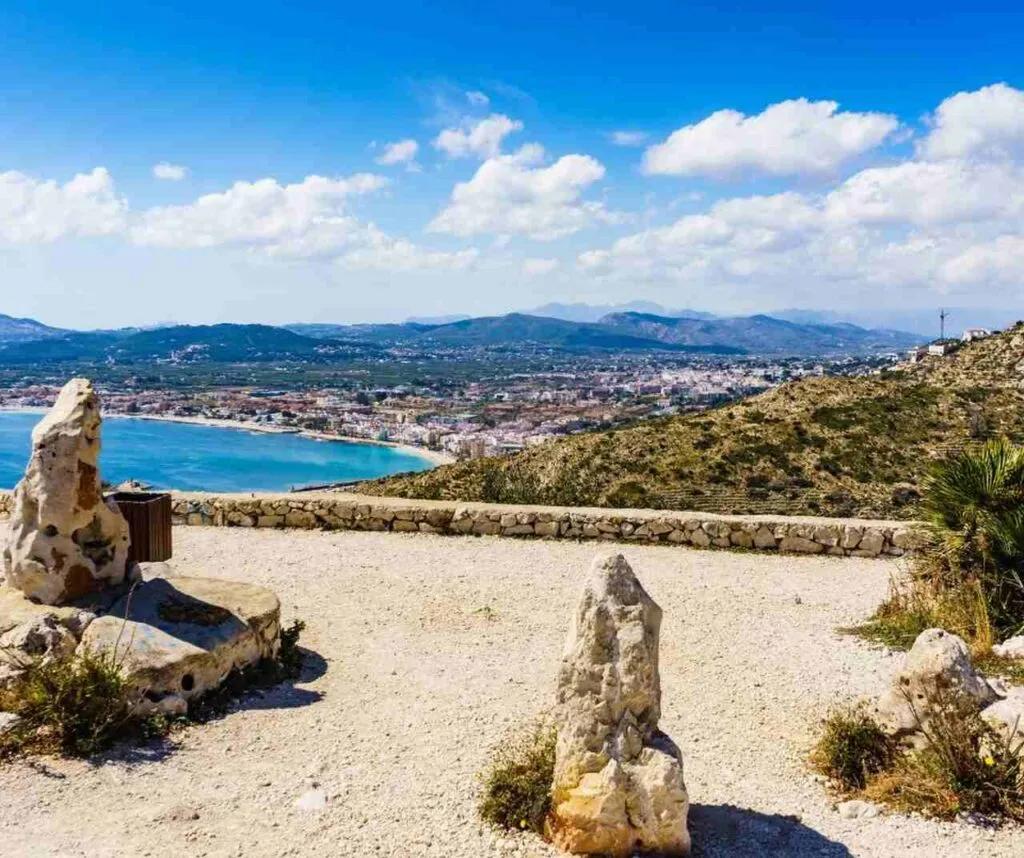
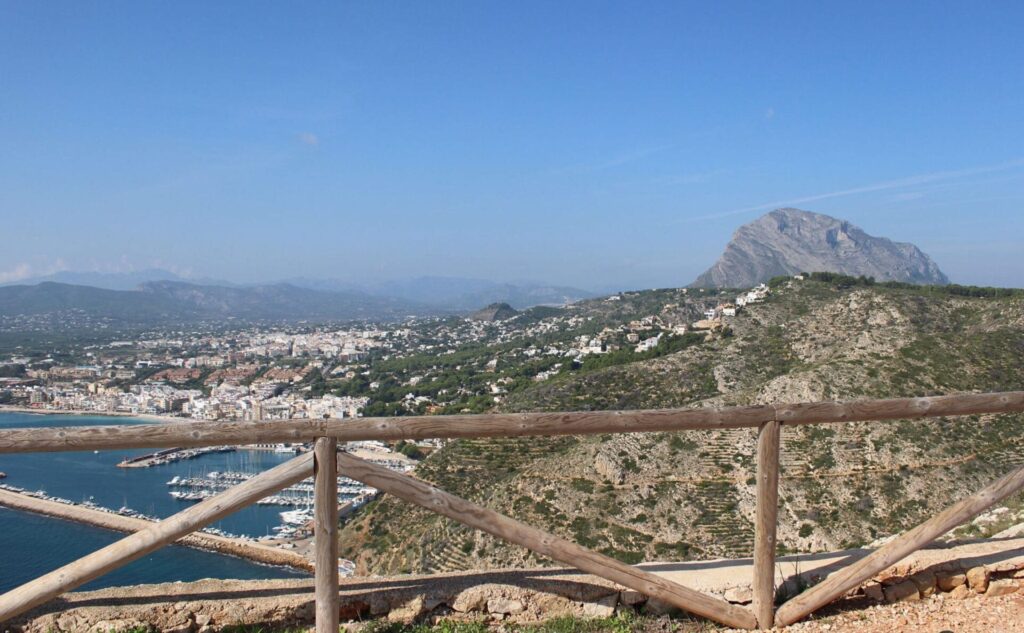
From above, the shape of Xàbia’s bay becomes much easier to understand. You can identify the relationship between the port, the coastline and the surrounding mountains.
Looking south, you see how the coastline gradually changes towards the more rugged headlands associated with Portitxol and Cap de la Nau.
This is one reason the cape also features prominently in Xàbia’s network of coastal viewpoints.
However, our approach here is slightly different.
The complete Jávea Viewpoints route is designed for visitors who want to explore several scenic locations during a single driving excursion. Cape San Antonio is particularly well suited to visitors who prefer to choose one location and explore its surroundings more thoroughly.
Both approaches are worthwhile, but they produce different experiences.
A Landscape Worth Protecting
Cape San Antonio is part of Montgó Natural Park, while the waters immediately below the headland belong to the protected Cape San Antonio Marine Reserve.
That combination makes the area environmentally significant both above and below the Mediterranean’s surface.
On land, the coastal environment supports Mediterranean plant communities adapted to rocky ground, strong sunlight and exposure to sea winds.
The cliffs also provide important habitats for birds.
Underwater, the marine reserve protects a coastal ecosystem that includes rocky seabeds, marine vegetation and numerous Mediterranean species.
You do not need specialist knowledge to appreciate this environment.
However, understanding that the area is protected changes the way you should approach your visit.
The objective is not to find unofficial shortcuts towards the cliffs or descend wherever the terrain appears accessible. It is to enjoy the designated viewpoints and walking routes while respecting the landscape.
Later in this guide, we will explore both the natural park and marine reserve in more detail.
Why Visit Cape San Antonio from Benidorm?
Benidorm already has impressive coastal scenery.
Serra Gelada offers dramatic cliffs, walking routes and panoramic views without requiring a long journey. La Cruz provides an elevated perspective over the city’s famous skyline, while the Faro de l’Albir trail combines an accessible coastal walk with spectacular Mediterranean landscapes.
So why drive farther north to Cape San Antonio?
The answer is not simply that its views are better.
It is that the landscape, atmosphere and possibilities for exploring the area are different.
A Different Perspective on the Costa Blanca
One of the interesting things about living in Benidorm is discovering how quickly the surrounding coastline changes once you leave the city.
Cape San Antonio is an excellent example.
The familiar resort environment gives way to a landscape dominated by cliffs, mountains and open sea.
There is still plenty of development around Xàbia, but the headland itself offers a stronger sense of separation from the surrounding towns.
Looking out over the Mediterranean, you can appreciate the geographical transition between the northern and central sections of the Costa Blanca.
The coastline no longer feels like a succession of beaches and residential developments. Instead, you begin to understand how mountains, headlands and sheltered bays have shaped the region.
For long-stay visitors, these changes are part of what makes exploring beyond Benidorm worthwhile.
An Excursion That Does Not Have to Be Physically Demanding
Not every memorable outdoor experience needs to involve a challenging hike.
Cape San Antonio is particularly flexible because the main viewpoint can be reached by road.
You can enjoy the coastal panorama without completing a demanding mountain route.
That makes the cape suitable for people who appreciate natural scenery but do not necessarily want to spend several hours hiking.
However, visitors who enjoy walking can easily extend the experience.
The surrounding Les Planes area contains relatively gentle routes connecting recreational spaces, historic features and additional viewpoints.
This gives Cape San Antonio an interesting advantage: you can decide how active you want your visit to be.
The landscape provides the same impressive backdrop whether you spend thirty minutes at the viewpoint or several hours exploring the surrounding trails.
A Good Place to Escape the Usual Routine
For digital nomads and remote workers staying in Benidorm, Cape San Antonio offers another attraction that has little to do with conventional sightseeing.
It provides an opportunity to spend time somewhere that feels completely removed from the working environment.
There are no major attractions demanding your attention every few minutes.
You do not need to organise your visit around multiple tickets or complicated schedules.
The essential experience is remarkably simple: arrive, explore, walk if you want to and enjoy the landscape.
This makes the area especially appealing after several days of working indoors.
A morning walk through Les Planes followed by time at the lighthouse viewpoint can provide a satisfying change of pace without requiring an exhausting adventure.
And if you want to extend the day, Xàbia’s port and historic centre provide convenient places to stop for lunch or explore a little further.
Combining Nature and Local Life
Another advantage is that Cape San Antonio does not force you to choose between a nature excursion and a more conventional day out.
You can spend the morning in Montgó Natural Park and the afternoon enjoying Xàbia.
The transition between the two experiences is relatively easy.
The port is particularly convenient because it lies below the headland and offers restaurants, cafés and an attractive waterfront atmosphere.
For visitors who are not interested in dedicating an entire day to hiking, this combination can be more enjoyable than attempting several separate natural attractions.
It is also a good way to explore Xàbia without turning the day into a long sequence of driving and parking.
Is Cape San Antonio Worth Visiting on Its Own?
This is probably the most important question for anyone planning the trip from Benidorm.
If you only want to visit the lighthouse viewpoint, Cape San Antonio is an attractive stop, but the experience may be too short to justify the journey by itself.
If you combine it with a walk through Les Planes, the surrounding natural environment or a leisurely visit to Xàbia, the excursion becomes considerably more rewarding.
The distinction matters.
Cape San Antonio is not a destination where you should expect several hours of organised attractions. Its value comes primarily from the landscape and what you choose to do within it.
The good news is that there are several ways to build a worthwhile excursion without making the day unnecessarily complicated.
The Lighthouse and Its Spectacular Coastal Setting
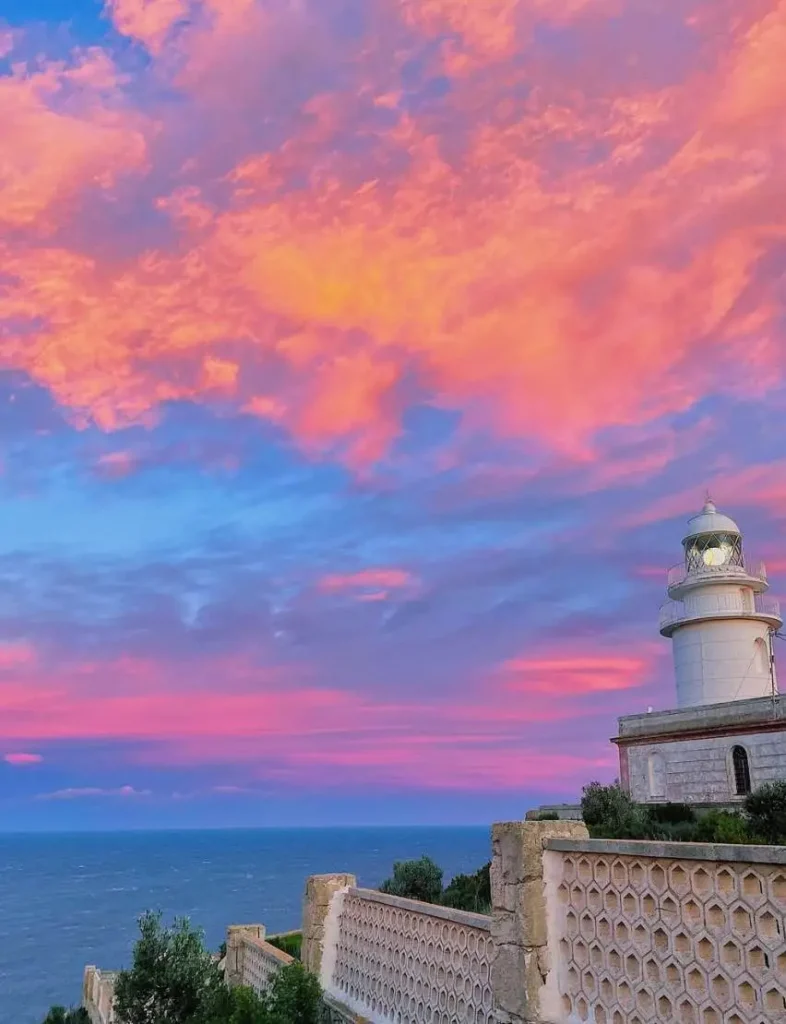
The lighthouse is the visual symbol of Cape San Antonio.
Positioned above the cliffs, the white structure has watched over this section of the Mediterranean since the nineteenth century.
Its appearance is relatively modest compared with the dramatic landscape surrounding it.
And that contrast is part of its appeal.
Rather than dominating the headland, the lighthouse seems to belong naturally to the rocky coastal environment.
For visitors approaching by road, it also signals that they are arriving somewhere geographically significant: the point where the land ends and the open Mediterranean begins.
A Historic Landmark Above the Sea
Cape San Antonio Lighthouse entered service in 1855 and continues to function as an operational maritime lighthouse.
Its elevated position makes it an important landmark along this stretch of coastline.
Before modern electronic navigation became standard, coastal lighthouses played an essential role in helping vessels identify their position and avoid dangerous shorelines.
Cape San Antonio’s location made it particularly suitable for this purpose.
From the headland, the coast extends in different directions, with Xàbia to the south and the waters approaching Dénia to the north.
Today, the lighthouse adds historical character to what would already be an impressive natural viewpoint.
However, visitors should remember that it remains a working maritime installation rather than a conventional historic monument.
The View from the Cape
The viewpoint near the lighthouse is one of the main reasons people visit.
From this position, Xàbia’s bay opens out below the cliffs, with the Mediterranean stretching towards the horizon.
On clear days, the view can be exceptionally expansive.
The coastline is particularly impressive because of the contrast between the steep limestone headland and the comparatively sheltered bay to the south.
It is worth spending some time here rather than simply arriving, taking one photograph and leaving.
Different viewing angles reveal different parts of the coastline.
You can concentrate on the rocky cliffs immediately below, follow the shape of the bay or look farther towards the southern headlands.
The changing light also makes a considerable difference.
Morning and late afternoon can produce very different impressions of exactly the same landscape.
A New Chapter for the Lighthouse
There is also an important development for visitors.
In September 2026, Xàbia announced plans to open a new interpretation and observation space within the lighthouse grounds during October.
The project aims to introduce visitors to the natural environment of Cape San Antonio, including the protected landscapes of Montgó and the marine reserve.
It is also intended to support the observation of birds and marine wildlife.
This could make the lighthouse considerably more interesting for visitors who want to learn about the surrounding environment rather than simply enjoy the panorama.
However, the proposed opening concerns the designated interpretation and observation areas. It does not mean visitors will be able to enter the operational lighthouse tower.
At the time of writing, the definitive opening date, visiting hours and admission arrangements have not been confirmed. Visitors should therefore check the latest information before planning their day around the new facilities.
The traditional viewpoint and surrounding landscape remain the main reasons to visit, independently of the interpretation centre’s opening.
Why the Setting Matters More Than the Building
The lighthouse is an important landmark, but it would be a mistake to approach Cape San Antonio as though the building itself were the main attraction.
Its real appeal comes from its position.
Standing above the Mediterranean, surrounded by exposed coastal vegetation and dramatic limestone cliffs, you experience a landscape shaped by the meeting of mountain and sea.
This is also what distinguishes the cape from many other lighthouse destinations.
The surrounding natural park gives visitors opportunities to move beyond the viewpoint, explore the plateau and discover how the coastal environment changes farther inland.
In the next part of this guide, we will leave the immediate lighthouse area and explore Montgó Natural Park, the walking routes around Les Planes and the marine environment that makes Cape San Antonio such an important protected coastal landscape.

Cape San Antonio and the Montgó Natural Park
The lighthouse may be the most recognisable feature of Cape San Antonio, but the surrounding landscape is what makes the area worth exploring.
To understand the cape properly, you need to look inland.
Behind the cliffs lies Les Planes, a relatively flat area of Mediterranean countryside that contrasts sharply with the steep coastline. Beyond it rises Montgó, one of the most recognisable mountains in the northern Costa Blanca.
Together, these landscapes form part of Montgó Natural Park, a protected area extending between Xàbia and Dénia.
For visitors coming from Benidorm, this combination creates an interesting opportunity. You can experience a substantial natural environment without necessarily undertaking a demanding mountain hike.
Rather than climbing Montgó itself, you can explore its eastern coastal extension, where the terrain is gentler and the Mediterranean remains a constant presence.
Understanding the Landscape
Montgó rises to approximately 753 metres above sea level, dominating the surrounding coastal landscape. Its distinctive shape is visible from numerous locations around the Marina Alta.
Cape San Antonio occupies a very different position within the same natural environment.
Here, the mountain landscape gradually gives way to a coastal plateau before ending abruptly above the Mediterranean.
This transition explains why the area is so varied.
You can walk through relatively sheltered pine-covered sections and, a short distance later, find yourself surrounded by exposed vegetation with expansive sea views.
The contrast is especially noticeable on windy days.
Some inland sections feel comparatively protected, while the headland itself can be much more exposed.
The vegetation changes with these conditions. Trees become less dominant near the coast, where plants must tolerate strong sunlight, dry ground and the influence of salty sea air.
It is a landscape that rewards observation, particularly if you are accustomed to seeing the Costa Blanca mainly from its beaches.
Les Planes: A Different Side of Cape San Antonio
Les Planes is particularly interesting because it gives visitors somewhere to explore beyond the lighthouse.
The area contains traditional rural paths, Mediterranean vegetation, old buildings and several locations connected with the region’s agricultural history.
Unlike Montgó’s higher mountain routes, much of the walking here is relatively gentle.
That makes Les Planes suitable for visitors who want to spend a couple of hours outdoors without turning their day into a strenuous hiking expedition.
There is another advantage.
Because the landscape is comparatively open, you can appreciate the relationship between the mountain, the plateau and the coastline much more easily.
You begin to understand that Cape San Antonio is not simply a spectacular cliff with a lighthouse.
It is the eastern edge of a much larger landscape.
Mediterranean Vegetation and Wildlife
The natural environment around the cape is not particularly dramatic in terms of dense forests or large wildlife.
Its interest is more subtle.
Mediterranean shrubs, aromatic plants, pine trees and low vegetation adapted to dry conditions dominate different parts of the landscape.
Some plants survive in surprisingly exposed locations, growing directly from rocky ground where little soil appears to exist.
For visitors interested in nature, this provides an opportunity to appreciate an environment that can initially seem quite ordinary.
The longer you spend walking through it, the more varied it becomes.
Birdwatching is another possibility, particularly around the cliffs and open coastal areas.
However, this is not a wildlife park. Sightings are never guaranteed, and much of the enjoyment comes from the landscape itself.
Visitors should remain on established paths, avoid disturbing animals and leave plants and geological features where they find them.
Do You Need to Climb Montgó?
No.
This is an important distinction because some visitors associate Montgó Natural Park primarily with its mountain summit.
The summit is an entirely different hiking experience.
Reaching it involves significantly more physical effort and requires appropriate preparation.
Cape San Antonio and Les Planes offer a much more accessible introduction to the park.
You can explore the coastal landscape, enjoy panoramic views and discover some of its historical features without attempting a major ascent.
For most visitors planning a relaxed excursion from Benidorm, that is one of the area’s biggest advantages.
If your main objective is to climb Montgó, organise that as a separate hiking day rather than trying to combine it with a leisurely visit to the cape.
The Best Walks Around Cape San Antonio
Walking is probably the best way to transform Cape San Antonio from a short viewpoint visit into a worthwhile half-day experience.
Fortunately, you do not need to undertake a difficult hike to appreciate the surrounding landscape.
The most interesting option for many visitors is the route through Les Planes towards the historic windmills overlooking Xàbia.
There are also opportunities for shorter walks around the recreational area and the surrounding countryside.
However, it is important to distinguish between established walking routes and unofficial paths leading towards the cliffs.
Not every visible track is suitable for visitors.
Les Planes and the Historic Windmills
If you only choose one walk around Cape San Antonio, the Les Planes route is an excellent candidate.
This relatively easy circular itinerary begins near the recreational area on the road leading towards the lighthouse.
It crosses the plateau and reaches the historic windmills overlooking Xàbia before returning towards the starting point.
The route is approximately 4.5 kilometres long, with an estimated walking time of around two hours.
Its greatest advantage is variety.
Rather than following the coastline continuously, you experience several different aspects of the landscape.
The walk begins among Mediterranean vegetation before passing through an area with a surprisingly interesting human history.
Eventually, the old windmills appear.
Their position above Xàbia is immediately striking, and the surrounding panorama provides another perspective on the bay.
This is where the route becomes especially rewarding.
You have already enjoyed the coastline from the lighthouse, but the windmills offer a different experience, combining traditional architecture with views of the Mediterranean and the mountains.
The walk also gives you a sense of how people lived and worked in this exposed landscape long before the arrival of modern tourism.
Starting from the Recreational Area
The Cape San Antonio recreational area is a convenient starting point.
It is situated along the road towards the lighthouse, approximately 700 metres before reaching the headland.
The area contains picnic tables and some shade, making it useful for a short break before or after walking.
It is also a more natural starting point for exploring Les Planes than attempting to begin every excursion directly from the lighthouse.
From here, paths lead through the plateau towards the windmills and other points of interest.
The surroundings feel relatively peaceful, particularly outside the busiest holiday periods.
However, visitors should not assume that every recreational facility will necessarily be available.
Bring your own drinking water and anything else you need for the walk.
The Molins de la Plana
The historic windmills, known locally as the Molins de la Plana, are among the most distinctive cultural features of this part of Xàbia.
Their location is not accidental.
The exposed plateau receives the winds that once made these structures useful for grinding grain.
Today, their surviving stone towers create an unusual landscape, particularly when viewed against the Mediterranean.
They also provide a fascinating connection between the area’s natural environment and its agricultural past.
It is easy to concentrate entirely on the coastline when visiting Cape San Antonio, but the windmills offer something different.
They remind you that these exposed hills were working landscapes long before they became recreational destinations.
The surrounding viewpoints are another reason to visit.
From this elevated position, Xàbia’s bay opens out below, with the surrounding coastline and mountains providing an impressive backdrop.
Allow enough time to enjoy the setting rather than treating the windmills as a quick photographic stop.
The Sanctuary of Mare de Déu dels Àngels
Another interesting feature of the Les Planes area is the sanctuary of Mare de Déu dels Àngels.
Its setting adds an unexpected historical and cultural dimension to a landscape otherwise dominated by natural scenery.
The sanctuary occupies a peaceful position among the roads and paths crossing the plateau.
Its presence also helps explain why Les Planes contains more than isolated walking trails.
This part of the landscape has a long history of human activity, reflected in its religious buildings, rural tracks and surviving agricultural structures.
You do not need to organise your visit around entering the sanctuary.
Simply incorporating the surrounding area into your walk adds variety and gives the excursion another point of interest.
Is the Les Planes Route Difficult?
The standard recreational-area-to-windmills circuit is generally considered an easy walk.
Its relatively gentle terrain makes it particularly suitable for people who enjoy walking but do not want a challenging mountain hike.
That does not mean every surface is perfectly smooth.
You should still expect natural paths, occasional uneven ground and sections exposed to sunlight.
Comfortable walking shoes are recommended.
During summer, the main consideration is likely to be heat rather than physical difficulty.
Although some parts of the route offer shade, others are open and can become uncomfortable during the hottest hours.
Spring and autumn are especially pleasant periods for exploring the area.
Can You Walk from the Lighthouse to the Windmills?
The two locations are relatively close, and it is possible to build a longer walking excursion around the wider Les Planes area.
However, you should distinguish between the official circular itinerary and any additional walking you decide to include.
The standard 4.5-kilometre route begins at the recreational area rather than at the lighthouse itself.
If you want to visit both locations on foot, check the available paths and calculate the additional distance before starting.
For visitors primarily interested in the scenery, there is nothing wrong with visiting the lighthouse by car and then driving the short distance back towards the recreational area to begin the walk.
That approach keeps the day straightforward.
Other Walking Possibilities
Les Planes contains additional paths and connections towards the surrounding landscape, but visitors should avoid assuming that every route is as easy as the windmills circuit.
Some trails descend towards the coastline or connect with more demanding sections of Montgó Natural Park.
These are separate hiking experiences requiring their own planning.
The historic route towards the area of Cala del Tango is one example of how dramatically the terrain changes when you leave the plateau and approach the sea.
Coastal descents can involve steep or unstable sections, and access conditions may change.
For a first visit, there is little reason to complicate the day.
The lighthouse viewpoint and Les Planes circuit already provide an enjoyable combination of scenery, walking and history.
Which Walking Experience Should You Choose?
For someone coming from Benidorm, I would separate the options into three experiences.
A short nature visit: Explore the lighthouse viewpoint and take a gentle walk around the recreational area. This is suitable for visitors who mainly want panoramic views and some time outdoors.
A relaxed half-day excursion: Combine the lighthouse with the Les Planes circular route and the historic windmills. This provides the strongest balance of walking, scenery and cultural interest.
A dedicated hiking day: Explore more demanding routes within Montgó Natural Park, using proper route information and treating the excursion as a mountain activity rather than casual sightseeing.
For this particular guide, the second option is the most interesting.
It gives Cape San Antonio enough substance to justify the journey from Benidorm without turning the day into an unnecessarily demanding adventure.

The Marine Reserve and Wildlife
One of Cape San Antonio’s most interesting characteristics is that its protected landscape does not end where the cliffs meet the Mediterranean.
The waters surrounding the headland are also environmentally significant.
The Cape San Antonio Marine Reserve protects a section of the Mediterranean coastline with important underwater habitats and marine biodiversity.
This creates an interesting relationship between the land and sea.
From the lighthouse, you experience the area as a dramatic coastal panorama.
Below the surface, however, the landscape continues through rocky seabeds and marine ecosystems that are largely invisible from the viewpoint.
Understanding this protected environment adds another dimension to the visit.
What Makes the Marine Reserve Special?
The coastline around Cape San Antonio includes underwater rock formations and habitats that support a variety of Mediterranean marine life.
Marine vegetation, fish and numerous smaller organisms form part of this ecosystem.
Protecting the environment is important because coastal habitats can be particularly vulnerable to pollution, uncontrolled anchoring, overfishing and intensive recreational activity.
The reserve is intended to preserve these natural resources while regulating activities that could damage them.
For visitors, this means that the sea below Cape San Antonio should not be regarded as an unrestricted recreational area.
Its protected status has practical consequences.
Can You Go Snorkelling or Diving?
This is where it becomes particularly important to understand the local regulations.
Recreational scuba diving within the protected marine reserve requires the appropriate authorisation.
Fishing, anchoring and certain motorised nautical activities are also restricted or prohibited under the applicable rules.
Visitors should not assume that finding an attractive stretch of coastline automatically gives them permission to undertake any activity there.
Snorkelling, diving and boat excursions are different activities, and the rules applying to each may depend on the precise location and type of activity.
If you are specifically interested in exploring the underwater environment, the sensible approach is to contact an established local operator and confirm which authorised activities are available.
This is particularly relevant for recreational diving, where the marine reserve’s regulations must be respected.
For most visitors following this guide, however, the main experience will remain on land.
Watching the Mediterranean from Above
You do not need to enter the water to appreciate the marine environment.
Cape San Antonio is an excellent place to observe the relationship between the coastline and the Mediterranean from above.
The exposed viewpoint provides a broad perspective over the sea, while the cliffs create opportunities to watch coastal birds.
Depending on the season, weather and simple luck, visitors may also spot activity farther offshore.
Dolphins and other marine animals occur in Mediterranean waters, but sightings from the headland should never be expected or promised.
A visit is more enjoyable when you appreciate whatever nature happens to provide rather than arriving with a list of animals you expect to see.
Binoculars can be useful if you enjoy observing distant birds, boats or activity offshore.
The Importance of the Cliffs
The cliffs are one of Cape San Antonio’s most spectacular features.
They are also among its most sensitive and potentially dangerous environments.
Steep limestone formations create habitats for specialised plants and birds, but they can also contain unstable rock and exposed edges.
Trying to find unofficial access routes towards the sea is therefore a poor idea.
The designated viewpoints already provide excellent panoramic views without requiring visitors to approach dangerous sections.
For photographers, the temptation to move beyond barriers or follow informal tracks can be particularly strong.
There is little justification for doing so.
The landscape is impressive precisely because it is rugged, and that ruggedness deserves respect.
A Place to Appreciate Rather Than Consume
Perhaps the most interesting aspect of Cape San Antonio is that its natural attractions do not require much activity from the visitor.
You can walk through Les Planes, observe the vegetation, photograph the coastline and spend time looking out over the Mediterranean.
You do not need to climb every available viewpoint or descend towards the water.
The experience becomes more rewarding when you approach the area with that mentality.
Unlike destinations built around organised attractions, Cape San Antonio encourages you to pay attention to the landscape itself.
The protected park above the cliffs and marine reserve below them form two parts of the same natural environment.
Understanding that connection is one of the strongest reasons to dedicate more than a few minutes to the cape.
And once you have explored the lighthouse, Les Planes and the surrounding landscape, the next question is how to organise the excursion properly from Benidorm.

How to Get to Cape San Antonio from Benidorm
Getting to Cape San Antonio is relatively straightforward if you have a car. In fact, its accessibility is one of the reasons the headland works so well as a relaxed nature excursion.
Unlike some of the Costa Blanca’s more adventurous destinations, visiting the cape does not require a long mountain approach or a demanding hike. The road takes you through Xàbia and up towards the headland, where the Mediterranean landscape gradually becomes more prominent.
However, there is an important distinction between reaching Cape San Antonio and exploring the surrounding natural park.
Driving directly to the lighthouse is simple. Visiting the windmills, walking through Les Planes or exploring nearby Xàbia requires a little more planning.
The best approach is to decide what kind of day you want before leaving Benidorm.
Driving from Benidorm
Cape San Antonio is approximately 55 kilometres from Benidorm by road, depending on your starting point and the route you choose.
Under normal traffic conditions, the journey generally takes around 50 minutes to an hour. Allow more time during busy summer periods or if you plan to travel through several coastal towns.
You can approach Xàbia using the main road network towards the northern Costa Blanca before following local roads towards the town and the headland.
Once you reach Xàbia, follow signs towards Cap de Sant Antoni and the lighthouse.
The final section climbs through the landscape of Montgó Natural Park. As you gain elevation, residential areas gradually give way to pine trees, Mediterranean vegetation and increasingly impressive coastal views.
Although the road is paved, it has bends and some narrower sections. It is not a particularly difficult drive, but you should take your time, especially if cyclists or other visitors are using the road.
One advantage of driving is that you can easily combine the lighthouse with the Les Planes recreational area and Xàbia’s port without having to organise complicated transfers.
For most visitors travelling from Benidorm, this is the most practical option.
Where Should You Park?
Your parking choice depends on whether you are visiting the lighthouse or planning a longer walk.
If your main objective is the viewpoint, continue towards the designated parking areas near the headland. Parking availability may be limited during busy periods, so arriving earlier in the day is advisable.
Do not assume that every roadside space is suitable for parking.
The surrounding roads are used by local residents, cyclists and other visitors, and leaving a vehicle in an inappropriate location can create unnecessary problems.
If you intend to follow the Les Planes walking route, the recreational area is a more convenient starting point.
It is situated approximately 700 metres before the lighthouse, on the approach road.
This allows you to begin walking without first travelling all the way to the headland and then returning to the start of the trail.
A particularly practical arrangement is to complete the Les Planes walk first and visit the lighthouse afterwards.
That way, you enjoy the more active part of the excursion while you are fresh and finish with the panoramic coastal views.
Can You Visit Without a Car?
Yes, but the experience becomes considerably less convenient.
Public transport connections exist between Benidorm and Xàbia, although schedules and journey times depend on the services available on your chosen date.
The main difficulty is that reaching Xàbia does not automatically get you to Cape San Antonio.
The lighthouse and Les Planes are situated above the town, away from its main transport connections.
You would therefore need to arrange onward transport, potentially by taxi, or undertake a substantially longer walking excursion.
This is possible, but it changes the character of the day.
Instead of a relaxed visit combining several natural attractions, you would need to organise transport around the beginning and end of your walk.
For visitors without a car, a sensible alternative is to reach Xàbia by public transport and arrange a taxi to the recreational area or lighthouse.
However, confirm your return arrangements in advance rather than assuming that a taxi will be readily available when you finish.
If you are mainly interested in hiking and have limited transport options, other natural areas closer to Benidorm may offer a simpler excursion.
Cape San Antonio becomes particularly attractive when you have the freedom to move between its different points of interest.
Best Time to Visit and Practical Planning
Cape San Antonio is accessible throughout much of the year, but the experience changes considerably with the weather and season.
Unlike a beach excursion, where warm temperatures may be the main attraction, visiting the cape is often more enjoyable when conditions are mild.
The headland is exposed to the Mediterranean, and the surrounding walking routes contain sections with relatively little shade.
Choosing the right day can make a surprisingly large difference.
Spring: An Excellent Time for Walking
Spring is one of the most attractive seasons for exploring Cape San Antonio.
Temperatures are generally comfortable for walking, the surrounding vegetation is often at its most appealing and the landscape can feel especially fresh after the cooler months.
This is an excellent period for combining the lighthouse with the Les Planes circuit.
You can spend several hours outdoors without experiencing the intense heat that sometimes makes summer walking uncomfortable.
Visibility can also be excellent, although this depends more on atmospheric conditions than the season itself.
If you are staying in Benidorm during spring and looking for an easy nature excursion, Cape San Antonio is a particularly appealing option.
Summer: Visit Early
Summer presents a different set of circumstances.
The lighthouse viewpoint itself remains attractive, particularly if you combine the visit with lunch or an afternoon in Xàbia.
However, walking through Les Planes during the hottest part of the day can be uncomfortable.
The plateau contains exposed sections where shade is limited.
Strong sunlight and high temperatures can make a relatively easy walk feel much more demanding.
If you visit in summer, start early.
Complete the walking route during the cooler morning hours, visit the lighthouse and consider spending the remainder of the day in Xàbia.
This is a much more enjoyable arrangement than beginning a two-hour walk shortly after lunch.
Always check weather conditions and any temporary restrictions affecting the natural park before setting out.
Autumn: Quieter and More Comfortable
Autumn is another excellent season.
Temperatures become more suitable for outdoor activities, and the area often feels considerably more relaxed than during the busiest summer weeks.
For digital nomads and long-stay visitors, this is a particularly good time to explore the northern Costa Blanca.
You can visit popular natural destinations without organising every excursion around avoiding the midday heat.
Cape San Antonio works especially well as a spontaneous autumn day trip, provided the weather forecast is favourable.
Winter: Clear Views and Exposed Conditions
Winter can produce some of the most impressive coastal panoramas.
On clear days, the atmosphere may offer excellent visibility across the Mediterranean and the surrounding mountains.
However, the headland is exposed.
Strong winds can make the lighthouse viewpoint considerably less comfortable than conditions in central Benidorm might suggest.
The same applies to the walking routes around Les Planes.
Check the forecast carefully, particularly wind warnings.
A calm winter morning can be wonderful. A day with strong winds and poor visibility is much less rewarding.
Morning or Afternoon?
For visitors planning to walk, morning is generally the better choice.
Starting early gives you cooler conditions, more flexibility and enough time to explore without rushing.
It also allows you to finish around lunchtime and continue towards Xàbia.
Late afternoon can be attractive for photography, particularly when the changing light gives the cliffs and surrounding landscape a different appearance.
However, photographers should remember that the direction of the light and the position of the sun will influence which parts of the coastline are illuminated.
If you plan to remain until the evening, allow enough time to return safely.
Natural paths are much less convenient to navigate after dark.
What Should You Bring?
The equipment required depends largely on whether you are visiting the lighthouse or walking through Les Planes.
For a short viewpoint visit, comfortable shoes and basic sun protection will usually be sufficient.
If you intend to complete the walking circuit, bring water, suitable footwear and protection against the sun.
A lightweight jacket can also be useful when the wind is strong, particularly outside summer.
There is no reason to carry extensive hiking equipment for the standard Les Planes circuit, but you should still treat it as an outdoor activity rather than an urban promenade.
A downloaded map is useful if you intend to explore beyond the main recreational area.
And although Cape San Antonio is an excellent photography destination, consider bringing binoculars if you enjoy observing coastal birds or the wider marine landscape.
How Much Time Should You Allow?
This is probably the most useful planning question.
The answer depends on how much of the surrounding environment you want to experience.
A straightforward lighthouse visit may take approximately 30–45 minutes.
If you include the Les Planes circular route, allow around two hours for walking, plus additional time for photographs and breaks.
Combining both experiences creates a satisfying half-day excursion.
Add lunch and a visit to Xàbia, and you have an enjoyable full-day trip from Benidorm without needing to travel between numerous separate destinations.
The main thing is to resist the temptation to fit too many activities into the same day.
Cape San Antonio rewards a relatively unhurried approach.
What Else Can You Visit Nearby?
One advantage of Cape San Antonio is that you do not need to travel far to find something interesting after exploring the natural park.
Xàbia provides several possibilities, from relaxed waterfront restaurants to historic streets and additional coastal scenery.
However, not every nearby attraction should automatically become part of your itinerary.
The objective is to create a coherent day, not collect destinations simply because they appear close together on a map.
Xàbia Port: The Most Natural Addition
For most visitors, Xàbia’s port is the easiest place to continue after visiting Cape San Antonio.
Situated beneath the headland, it offers a completely different perspective on the landscape you have just explored.
From above, the port appears as part of the wider coastal panorama.
At street level, it becomes an attractive Mediterranean neighbourhood with fishing boats, restaurants, cafés and a waterfront atmosphere.
This contrast makes the two locations work particularly well together.
You can spend the morning walking through Les Planes and enjoying the lighthouse viewpoint, then descend towards the port for lunch.
After several hours outdoors, sitting at a restaurant overlooking the harbour feels like a natural continuation of the excursion.
There is no need to organise another major activity.
Simply exploring the waterfront provides enough variety.
Xàbia Historic Centre
If you enjoy traditional towns, Xàbia’s historic centre is another worthwhile addition.
Located inland from the waterfront, it has a different character from the port and beach areas.
Narrow streets, historic buildings and traditional architecture provide an interesting contrast with the natural landscape of Cape San Antonio.
It is particularly suitable for visitors who want a little culture without committing to a museum-heavy afternoon.
You can walk through the streets, stop for coffee and appreciate a side of Xàbia that many beach visitors overlook.
For a full-day excursion, combining the cape, lunch at the port and a relaxed walk through the historic centre creates a pleasantly varied itinerary.
However, if you have already completed the Les Planes circuit and feel tired, there is nothing wrong with leaving the historic centre for another day.
Arenal Beach
Arenal is Xàbia’s best-known sandy beach and one of its main leisure areas.
Its appeal is quite different from Cape San Antonio.
Where the cape is rugged, exposed and relatively undeveloped, Arenal offers an accessible beach environment with restaurants, cafés and a lively promenade.
This contrast can be useful if you are travelling with someone who enjoys outdoor scenery but also wants to spend time near the sea.
During the warmer months, you could complete the natural part of the excursion in the morning and finish with a swim at Arenal.
However, the beach becomes considerably busier during summer.
If your objective is to escape crowds, the port or a quieter inland stop may be more appealing.
Cova Tallada: A Separate Adventure
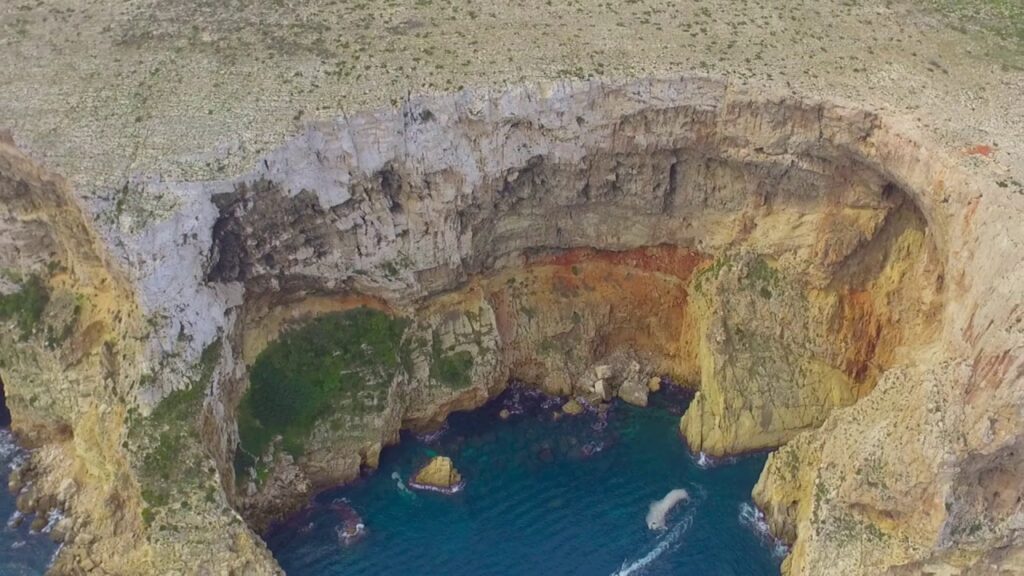
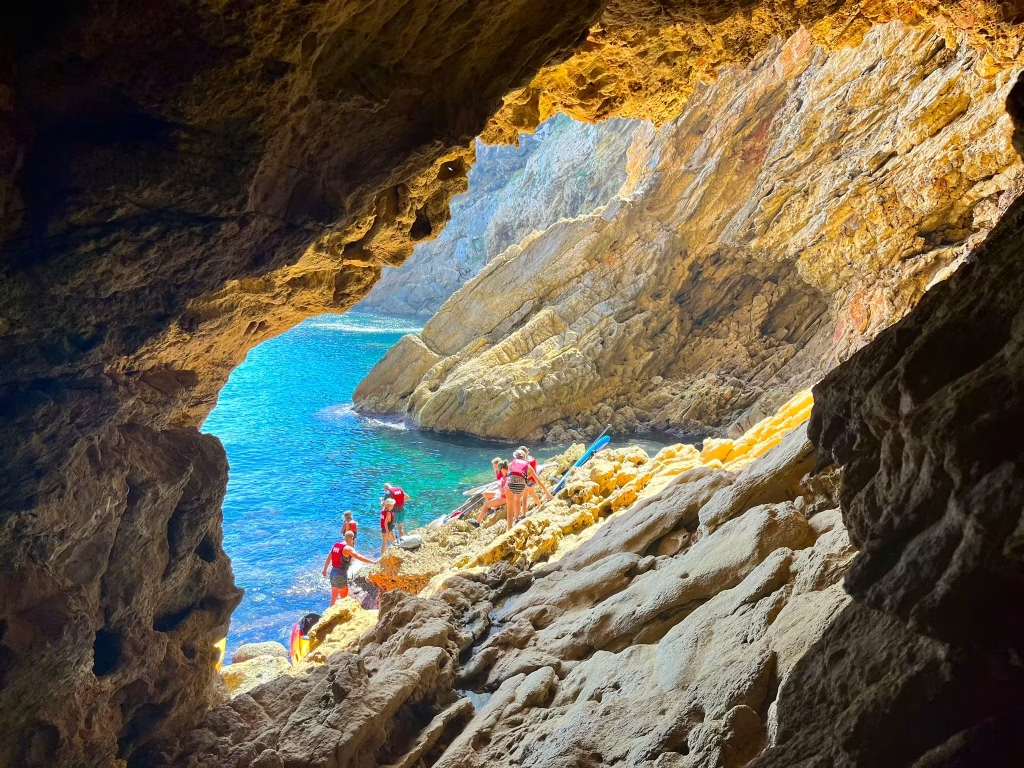
Cova Tallada is one of the most interesting natural attractions in the wider area between Xàbia and Dénia.
This impressive coastal cave combines geological interest, historical stone extraction and a spectacular position beside the Mediterranean.
However, it is important not to underestimate the excursion.
Visiting Cova Tallada involves a substantially different experience from walking through Les Planes.
The coastal access route includes rocky and potentially exposed terrain, and access may be regulated during busy periods.
Sea conditions also affect the safety of activities around the cave.
For these reasons, I would generally treat Cova Tallada as a separate adventure rather than adding it casually to a Cape San Antonio itinerary.
Trying to combine both destinations without allowing enough time can transform an otherwise relaxing nature excursion into an unnecessarily demanding day.
If you are particularly interested in caves and coastal hiking, Cova Tallada deserves proper planning and an excursion of its own.
Dénia and the Northern Side of Montgó
Dénia is another possible addition, particularly if you are interested in exploring the opposite side of Montgó.
The town offers a historic centre, castle, marina and a substantial selection of restaurants.
However, combining Cape San Antonio, the Les Planes walk and Dénia creates a more ambitious itinerary.
It can certainly be done if you enjoy driving and want to explore a broader section of the northern Costa Blanca.
But it is not essential.
For a first visit, concentrating on Cape San Antonio and Xàbia generally creates a more coherent experience.
Dénia deserves enough time to appreciate its own attractions rather than becoming a hurried final stop.
What About the Other Jávea Viewpoints?
This is where planning becomes particularly important.
Cape San Antonio is also the northern starting point of Xàbia’s famous coastal viewpoint network.
That makes it tempting to continue south towards Portitxol, La Falzia, Cap Negre and Cap de la Nau.
These are outstanding locations, but combining the complete viewpoint route with a proper exploration of Cape San Antonio would create a very long day.
The two experiences are better treated separately.
If you want to explore the wider network, our dedicated Jávea Viewpoints from Benidorm guide provides a complete scenic itinerary.
For this excursion, however, I would concentrate on the lighthouse, Les Planes and the immediate surroundings.
That approach gives Cape San Antonio the attention it deserves.
Instead of visiting ten places briefly, you spend meaningful time exploring one protected coastal landscape.
And that is ultimately what makes this destination interesting.
Common Mistakes and Safety
Cape San Antonio is considerably easier to visit than many of the Costa Blanca’s mountain destinations. However, its accessibility can create the misleading impression that the entire area is suitable for casual exploration without preparation.
The lighthouse viewpoint is straightforward, but the surrounding natural park, cliffs and coastal paths deserve more attention.
Most visitors will experience no difficulties if they follow established routes, choose suitable weather and organise their day sensibly.
The mistakes worth avoiding are generally simple ones.
Travelling from Benidorm Just to See the Lighthouse
This is probably the most common planning mistake.
Cape San Antonio offers spectacular coastal scenery, but the main viewpoint does not require several hours to explore.
If you drive from Benidorm, spend fifteen minutes taking photographs and immediately return, you may wonder whether the journey was worthwhile.
The experience becomes considerably more interesting when you incorporate the surrounding landscape.
Walking through Les Planes, visiting the historic windmills or stopping for lunch in Xàbia transforms a short viewpoint visit into a proper excursion.
That does not mean you need to organise a complicated itinerary.
Two or three carefully chosen activities are enough.
Confusing the Lighthouse Visit With Access to the Building
The lighthouse is one of the area’s most recognisable landmarks, but it remains an operational maritime installation.
Visitors should distinguish between the public viewpoint, any designated visitor facilities and the lighthouse tower itself.
The planned interpretation and observation space may provide additional opportunities to learn about the natural environment, but access arrangements should be checked before travelling.
Do not assume that visiting Cape San Antonio automatically includes entering the lighthouse or climbing its tower.
Fortunately, the surrounding views are the principal attraction regardless of which facilities are open.
Getting Too Close to the Cliffs
Cape San Antonio’s dramatic coastal landscape is also one of its main safety considerations.
The headland rises steeply above the Mediterranean, with substantial drops in places.
This creates extraordinary photographic opportunities, but it also means visitors should remain within designated viewing areas and established paths.
Avoid crossing protective barriers or following informal tracks towards exposed edges.
Some sections of coastal limestone can be unstable, and the apparent accessibility of a location does not mean it is safe.
There is little reason to take unnecessary risks when the established viewpoints already offer excellent panoramas.
Starting a Walk During the Hottest Hours
The Les Planes circuit is relatively easy, but summer heat can make it considerably less comfortable.
Some sections are exposed, with limited protection from direct sunlight.
Starting around midday during a heatwave can turn an otherwise enjoyable two-hour walk into an exhausting experience.
If you visit during summer, complete the walking portion early.
You can spend the warmer hours enjoying lunch, exploring shaded streets in Xàbia or relaxing near the waterfront.
The same route can feel completely different depending on the time of day.
Underestimating Wind
Cape San Antonio is an exposed Mediterranean headland.
Even when conditions are comfortable in central Benidorm, strong coastal winds can make the viewpoint unpleasant.
Wind also affects walking conditions, particularly near exposed sections of the landscape.
Check the forecast before leaving and take any official weather warnings seriously.
If conditions are particularly poor, postpone the excursion rather than attempting to follow the original schedule regardless of the weather.
One advantage of staying on the Costa Blanca for an extended period is that you can choose a better day.
Exploring Unfamiliar Coastal Paths Without Preparation
The recreational routes through Les Planes are relatively accessible.
Other paths within Montgó Natural Park can be significantly more demanding.
Do not assume that every visible trail leads to a convenient viewpoint or a straightforward return.
This is particularly important around coastal descents, where the terrain can become steep and rocky.
For a first visit, the established Les Planes circuit provides an excellent introduction without requiring complicated navigation.
If you want to explore a more demanding route, research it separately and treat it as a proper hiking excursion.
Assuming You Can Descend to the Sea
Looking down from Cape San Antonio, the Mediterranean can appear remarkably inviting.
However, there is a considerable difference between admiring the coastline from above and finding safe, authorised access to the water.
The cliffs are steep, the marine environment is protected and some coastal routes involve difficult terrain or access restrictions.
Do not improvise a descent simply because a track appears to lead towards the sea.
If swimming or snorkelling is an important part of your day, choose an established, accessible beach and check the relevant local conditions and regulations.
Trying to Visit Too Many Places
Cape San Antonio is close enough to several interesting destinations that it is tempting to keep adding them to your itinerary.
The lighthouse.
Les Planes.
The windmills.
Xàbia’s historic centre.
The port.
Arenal.
Perhaps another viewpoint.
Eventually, you risk spending more time moving between destinations than enjoying them.
The solution is to decide what kind of excursion you want.
If you are interested in nature, prioritise the lighthouse and Les Planes.
If you want a more relaxed day, combine the viewpoint with lunch and a walk around Xàbia.
Trying to do everything usually produces a less satisfying experience.
Forgetting That You Are Visiting a Protected Area
Montgó Natural Park and the Cape San Antonio Marine Reserve are protected for good reasons.
Visitors should respect established paths, avoid disturbing wildlife and leave natural features undisturbed.
Do not remove plants, collect geological specimens or leave rubbish.
Flying drones, organising certain activities and accessing particular areas may also be subject to specific restrictions or authorisation requirements.
If you are planning anything beyond ordinary walking and photography, check the applicable rules beforehand.
The easiest way to enjoy the area responsibly is to approach it as a natural landscape rather than an outdoor attraction where every activity is automatically permitted.
Suggested Half-Day and Full-Day Itineraries
Cape San Antonio works particularly well because you can adapt the experience to your interests, fitness level and available time.
Unlike a destination built around one long hiking route, the headland allows you to create several different excursions without changing your starting point substantially.
For someone travelling from Benidorm, I would concentrate on two main options.
The first combines the lighthouse with a relatively easy nature walk.
The second incorporates Xàbia and creates a more complete day exploring this section of the Costa Blanca.
There is also a shorter alternative for visitors who prefer sightseeing to walking.
Half-Day: The Lighthouse and Les Planes
<text weight=”semibold”>Best for: nature, light hiking, photography and an escape from Benidorm.</text>
This is probably the most rewarding way to experience Cape San Antonio without dedicating an entire day to the excursion.
Leave Benidorm in the morning and drive towards Xàbia, continuing up to the Les Planes recreational area.
Rather than heading directly to the lighthouse, begin with the walking route towards the historic windmills.
Starting with the walk has several advantages.
You have more energy, temperatures are usually more comfortable and you avoid spending the most active part of the excursion during the hottest hours.
Follow the established route across Les Planes, enjoying the contrast between the Mediterranean vegetation and the more exposed sections of the plateau.
The historic windmills make an excellent destination.
Spend some time exploring their surroundings and appreciating the views over Xàbia before completing the circuit.
Allow approximately two hours for the walk, with additional time if you enjoy photography or prefer a relaxed pace.
Once you return to the recreational area, continue towards Cape San Antonio Lighthouse.
By this point, you will already have experienced some of the landscape surrounding the headland.
The coastal panorama provides a natural conclusion to the excursion.
Spend approximately 30–45 minutes enjoying the viewpoint and exploring whichever public areas are accessible during your visit.
You can then return directly to Benidorm or stop in Xàbia for lunch.
This itinerary offers an excellent balance between activity and relaxation.
It is substantial enough to justify the journey without making the day unnecessarily complicated.
Full Day: Cape San Antonio and Xàbia
<text weight=”semibold”>Best for: combining nature, coastal scenery, local culture and Mediterranean food.</text>
If you have an entire day available, Cape San Antonio combines particularly well with Xàbia.
Begin exactly as you would for the half-day excursion.
Drive from Benidorm to the Les Planes recreational area and complete the circular walk towards the historic windmills.
Afterwards, continue towards the lighthouse.
There is no need to rush.
Allow yourself enough time to appreciate the coastal landscape and understand how the headland relates to the surrounding mountains and Xàbia’s bay.
Once you have finished exploring the cape, descend towards Xàbia’s port.
This is an excellent location for lunch.
The atmosphere is completely different from the exposed natural landscape you have just visited, and the harbour provides a pleasant setting for a substantial break.
Rather than eating quickly and immediately continuing to another attraction, take your time.
A relaxed lunch is part of what makes this itinerary work.
During the afternoon, you have two particularly appealing options.
If you enjoy historic towns, explore Xàbia’s old centre.
Its traditional streets and architecture provide an interesting cultural contrast with the morning’s nature excursion.
Alternatively, if you prefer to remain near the Mediterranean, spend the afternoon around the port or continue towards Arenal.
During warmer months, you could even incorporate a swim.
Both alternatives work well.
The important thing is choosing one rather than trying to complete every possible activity.
You have already enjoyed the main natural attractions of Cape San Antonio, so the afternoon should provide a different experience rather than become another sightseeing challenge.
Return to Benidorm when you are ready.
This is a particularly satisfying full-day itinerary because it moves naturally between three different environments: the protected landscape of Les Planes, the dramatic coastal setting of Cape San Antonio and the Mediterranean atmosphere of Xàbia.
A Shorter Alternative: Lighthouse and Lunch
Not everyone wants to spend two hours walking.
Fortunately, you can still enjoy Cape San Antonio without completing the Les Planes circuit.
Drive directly to the lighthouse viewpoint and spend time appreciating the coastal panorama.
Explore the designated public areas and any visitor facilities that are open.
Afterwards, descend towards Xàbia’s port for lunch and a relaxed waterfront walk.
This is the simplest version of the excursion.
It works particularly well for visitors who enjoy photography, coastal scenery or leisurely sightseeing but are not especially interested in hiking.
However, it is worth being realistic about what you are getting.
The lighthouse visit itself is relatively short.
The experience becomes a worthwhile outing primarily because you combine it with time in Xàbia.
If you have already explored Xàbia extensively, you may prefer to incorporate the Les Planes walk to give the day a stronger sense of purpose.
Should You Include Other Jávea Viewpoints?
You certainly can, but I would be selective.
Cape San Antonio is already included in the wider network of Xàbia’s coastal viewpoints, so it makes geographical sense to continue south.
However, that creates a different type of excursion.
Instead of spending several hours exploring one natural environment, you begin moving between multiple coastal locations.
Both experiences are enjoyable, but they should not be confused.
If you want a dedicated scenic drive, follow the separate Jávea Viewpoints itinerary.
If you want to explore Cape San Antonio properly, concentrate on the lighthouse, Les Planes and the surrounding natural landscape.
For long-stay visitors, there is another advantage to keeping the experiences separate.
You have an excellent reason to return to Xàbia on another day.
The Itinerary I Would Choose
For a first visit from Benidorm, the full-day combination of Cape San Antonio and Xàbia offers the most balanced experience.
The morning provides natural scenery and light physical activity.
The lighthouse adds a memorable coastal panorama.
Lunch at the port gives you time to relax.
And the afternoon offers enough flexibility to explore the old town, enjoy the waterfront or simply return to Benidorm without rushing.
However, if your main interest is nature rather than sightseeing, the half-day itinerary may actually be more satisfying.
A relatively simple excursion focused on Les Planes and the lighthouse allows you to appreciate the area without introducing activities that distract from the landscape.
Ultimately, Cape San Antonio works best when you resist the temptation to turn it into a complicated schedule.
Choose your main experience, leave some flexibility and allow the natural environment to determine the pace of your visit.

Cape San Antonio for Digital Nomads and the BenidormNomads Verdict
Cape San Antonio is an interesting destination for digital nomads precisely because it does not require a particularly complicated day.
You can leave Benidorm in the morning, spend a couple of hours walking through a protected natural landscape, enjoy some of the most expansive coastal views around Xàbia and still have time for a relaxed lunch.
There are no demanding schedules to follow, no major attractions competing for your attention and no need to spend the entire day moving between different destinations.
That simplicity is one of its greatest strengths.
However, Cape San Antonio is also a destination where expectations matter. Someone arriving exclusively to photograph the lighthouse may find the experience rather short. A visitor who combines the viewpoint with Les Planes and Xàbia will discover considerably more.
For remote workers and long-stay residents, the second approach makes much more sense.
A Natural Escape from Remote Work
One of the advantages of living in Benidorm is having a large selection of outdoor destinations within relatively easy reach.
However, spending time outdoors does not automatically mean disconnecting from work.
Some excursions involve busy tourist attractions, crowded promenades or cafés where the temptation to open your laptop remains surprisingly strong.
Cape San Antonio offers something different.
Walking through Les Planes requires very little organisation once you have chosen your route. The surrounding landscape gives you enough to concentrate on without constantly looking for the next attraction.
You can appreciate the vegetation, discover the historic windmills and enjoy the transition between the inland plateau and the exposed Mediterranean headland.
At the lighthouse, the experience becomes even simpler.
You stop walking and look out towards the sea.
There is no particular activity to complete.
For someone accustomed to spending much of the working week in front of a computer, that change of pace can be surprisingly valuable.
Can You Work During the Excursion?
Cape San Antonio itself is not a particularly suitable remote working location.
The main attraction is an exposed natural environment, and the surrounding walking routes are obviously intended for outdoor recreation rather than productive computer sessions.
Carrying a laptop through Les Planes would add unnecessary weight and distract from the experience.
However, Xàbia provides a useful alternative if you genuinely need to combine work and leisure.
You could spend the morning working from an appropriate café or other suitable location in town, then visit Cape San Antonio during the afternoon.
Alternatively, complete your outdoor excursion first and reserve some time for work afterwards.
That flexibility makes the destination particularly convenient for people who control their own schedules.
Nevertheless, I would recommend treating Cape San Antonio as a genuine break whenever possible.
The experience is much more rewarding when you are not constantly checking the time.
An Excellent Destination for a Flexible Schedule
One of the less obvious advantages of remote working is being able to visit popular places outside traditional weekend hours.
Cape San Antonio is a good example.
You can choose a clear weekday morning, avoid the busiest holiday periods and experience the headland at a much more relaxed pace.
This flexibility also helps with weather conditions.
Because the lighthouse is exposed, choosing a calm day can significantly improve your visit.
Rather than committing to a fixed excursion weeks in advance, long-stay residents can monitor the forecast and select a suitable morning.
The same applies to the Les Planes walk.
Comfortable temperatures, good visibility and relatively quiet trails can make a substantial difference to the overall experience.
Who Will Enjoy Cape San Antonio Most?
Cape San Antonio is particularly suitable for visitors who appreciate natural scenery without necessarily wanting a physically demanding adventure.
Its combination of road access, relatively easy walking routes and spectacular coastal views gives it broad appeal.
Photographers will appreciate the elevated coastline and changing Mediterranean light.
Nature lovers can explore the protected landscape and learn about the relationship between the terrestrial park and marine reserve.
Visitors interested in history will find the lighthouse, old windmills and rural landscape particularly appealing.
And anyone who simply wants a few hours away from Benidorm’s urban environment can enjoy an uncomplicated change of scenery.
It also works well for couples or small groups whose members have different interests.
Some may prefer the walking route, while others will be perfectly happy enjoying the viewpoint and spending more time in Xàbia.
Who Might Find It Disappointing?
Cape San Antonio is less suitable for visitors expecting a long sequence of organised attractions.
The lighthouse is visually attractive, but the building itself should not be confused with a conventional museum or historic monument offering extensive public access.
Likewise, the surrounding natural environment is beautiful without being continuously spectacular.
The Les Planes route includes sections of relatively ordinary Mediterranean countryside between its more interesting historical features and viewpoints.
Someone who enjoys the experience of walking through a landscape will appreciate that.
Someone expecting dramatic scenery around every corner may find the route less exciting.
The destination is also unlikely to satisfy visitors seeking a challenging mountain adventure.
For that type of experience, Sierra de Bernia or a dedicated Montgó summit hike offers a very different proposition.
Cape San Antonio’s strongest quality is not intensity.
It is the opportunity to enjoy a remarkable coastal setting at a comfortable pace.
BenidormNomads Verdict
<text weight=”semibold”>Coastal Scenery: 9.5/10</text>
The elevated Mediterranean panorama is the main attraction. The relationship between the limestone cliffs, Xàbia’s bay and the surrounding mountains creates an impressive setting.
<text weight=”semibold”>Walking Experience: 8.5/10</text>
The Les Planes circuit offers an enjoyable and relatively accessible introduction to the natural park. Its combination of countryside, historic windmills and panoramic views adds considerable value to the lighthouse visit.
<text weight=”semibold”>Natural Environment: 9/10</text>
The combination of Montgó Natural Park and the protected marine environment makes Cape San Antonio particularly interesting for visitors who appreciate Mediterranean landscapes.
<text weight=”semibold”>Photography: 9.5/10</text>
The lighthouse, cliffs, open sea and historic windmills provide excellent opportunities. Clear weather and favourable lighting make a considerable difference.
<text weight=”semibold”>Historical Interest: 8/10</text>
The nineteenth-century lighthouse, traditional windmills and cultural landscape provide an interesting historical dimension without dominating the experience.
<text weight=”semibold”>Accessibility from Benidorm: 8.5/10</text>
The journey is manageable by car, and the principal attractions are relatively close together. Travelling without a vehicle requires considerably more organisation.
<text weight=”semibold”>Value for Money: 9.5/10</text>
The landscape, viewpoints and standard walking routes can be enjoyed without purchasing attraction tickets. Transport, food and any optional activities will account for most of your spending.
<text weight=”semibold”>Accessibility Without a Car: 5/10</text>
Although reaching Xàbia by public transport is possible, organising onward transport to the headland makes the excursion less convenient.
<text weight=”semibold”>Remote Work Compatibility: 5/10</text>
The headland itself is better suited to recreation than working. However, nearby Xàbia offers possibilities for combining a working session with an afternoon excursion.
<text weight=”semibold”>Digital Detox Value: 9.5/10</text>
An excellent destination for spending several hours outdoors without complicated planning or continuous stimulation.
<text weight=”semibold”>Relaxation: 9/10</text>
Outside the busiest periods, the combination of gentle walking, extensive sea views and an unhurried visit creates a particularly relaxing experience.
<text weight=”semibold”>Overall Rating: 9/10</text>
Cape San Antonio earns its place among the Costa Blanca’s most worthwhile coastal excursions when you explore the surrounding landscape rather than treating the lighthouse as an isolated attraction.
Its flexibility, accessible walking opportunities and proximity to Xàbia make it especially suitable for long-stay visitors.

Is Cape San Antonio Worth the Trip from Benidorm?
Yes, particularly if you enjoy coastal landscapes and want an excursion that combines nature with a relaxed Mediterranean atmosphere.
However, the way you organise the visit determines how rewarding it will be.
If you drive directly to the lighthouse, take a few photographs and return to Benidorm, you will enjoy an impressive viewpoint. But the experience may feel rather brief compared with the time spent travelling.
If you approach Cape San Antonio as a natural landscape rather than a single attraction, the situation changes.
You can begin your morning walking through Les Planes, discovering an environment that is quite different from Benidorm’s familiar coastal scenery.
The historic windmills introduce an unexpected connection with the area’s agricultural past, while the surrounding paths reveal how closely the landscape is connected to Montgó.
Then comes the lighthouse.
After exploring the plateau, arriving at the headland feels like reaching the natural conclusion of the morning. The landscape suddenly opens towards the Mediterranean, and the contrast between the exposed cliffs and the sheltered bay below becomes much more noticeable.
You also have the option of continuing towards Xàbia.
Lunch beside the harbour, a walk through the historic centre or simply spending some time near the waterfront provides a satisfying change of atmosphere after the morning’s outdoor activities.
That combination is what makes Cape San Antonio particularly attractive for digital nomads and long-stay residents.
It is not an excursion that requires exceptional fitness, expensive activities or elaborate planning.
And unlike destinations that demand an entire day to justify the journey, Cape San Antonio gives you considerable freedom.
You can spend a few hours exploring the natural park and return to Benidorm.
You can combine the lighthouse with Xàbia and enjoy a complete day out.
Or you can return on another occasion to explore different parts of Montgó Natural Park.
Perhaps the most important thing is to recognise what Cape San Antonio offers.
It is not the most adventurous hike in the region, nor is it a destination packed with attractions.
Its appeal is quieter.
A historic lighthouse above the Mediterranean.
A natural park extending towards the mountains.
Traditional windmills overlooking Xàbia.
And the freedom to enjoy an impressive coastal landscape without feeling obliged to complete a long itinerary.
For visitors staying in Benidorm who appreciate nature, photography and relaxed outdoor experiences, that is more than enough reason to make the journey.