

Last Updated: September 2026
Buying property in Benidorm does not necessarily mean paying the full price in cash.
Foreign buyers can apply for a Spanish mortgage, including people who are not resident in Spain.
However, obtaining financing is not automatic.
Spanish banks assess the buyer’s financial situation, the property being purchased and the overall risk of the loan before deciding whether to lend and on what terms.
That means two buyers looking at the same €250,000 apartment may receive very different mortgage offers.
Your residence status, income, existing debts, savings, age, employment situation and even the currency in which you earn money can all affect the assessment.
This guide explains how the process works, what documents you may need, how Spanish mortgage offers are structured and what foreign buyers should check before committing to a purchase in Benidorm.

Can Foreign Buyers Get a Mortgage in Spain?
Yes.
You do not need to be a Spanish citizen to obtain a mortgage from a Spanish bank.
Foreign residents and non-residents can both apply.
What changes is how the bank assesses the application.
Residents and non-residents
A foreign buyer who lives and earns income in Spain may be relatively straightforward for a Spanish bank to assess because employment, tax and banking information is often easier to verify domestically.
A non-resident can also obtain financing, but the bank may need to analyse:
- income earned abroad;
- foreign tax returns;
- overseas bank accounts;
- employment in another country;
- other properties or debts;
- and exchange-rate risk.
This can mean more documentation and, in some cases, more conservative lending criteria.
You will often see claims online that Spanish banks lend a fixed percentage to residents and a lower fixed percentage to non-residents.
Treat these figures as general market observations rather than legal rules.
There is no universal mortgage percentage guaranteed to every buyer.
Each lender applies its own credit policy.
EU and non-EU buyers
Being an EU citizen does not automatically guarantee better mortgage terms, and being from outside the EU does not automatically prevent you from obtaining finance.
The bank’s central concern is whether the mortgage is affordable and whether the borrower represents an acceptable level of risk.
Your nationality may be relevant to documentation or compliance procedures, but your financial profile is fundamental.
Income from another country
Many foreign buyers in Benidorm continue earning income abroad.
Spanish banks can consider foreign income, but they may require additional evidence.
For example, a buyer employed in the UK may need to provide:
- employment documentation;
- payslips;
- tax records;
- bank statements;
- and possibly translated documents.
Self-employed applicants may need considerably more financial information.
The bank wants to understand not just how much you earn, but how stable and verifiable that income is.
Income in another currency
Currency also matters.
If your mortgage is in euros but your salary or pension is paid in pounds, dollars or another currency, exchange-rate movements can change the real cost of your mortgage.
A payment of €1,000 per month may become more expensive in your home currency if that currency weakens against the euro.
This is particularly important for long-term borrowers.
The mortgage should remain affordable even if exchange rates move against you.

What Spanish Banks Look at Before Approving a Mortgage
The property itself is important because it acts as security for the loan.
But a valuable apartment does not automatically produce mortgage approval.
The bank must also assess whether you can realistically repay the debt.
Income and employment
Stable, documented income is one of the main factors.
The lender may consider:
- salary;
- pension income;
- self-employed earnings;
- business income;
- investment income;
- and other regular sources of income.
How predictable that income is can matter as much as the headline amount.
Someone with a long employment history may be viewed differently from someone who has only recently started a business or relies on irregular income.
Existing debts and commitments
The bank will also look at what you already owe.
This may include:
- other mortgages;
- personal loans;
- car finance;
- credit-card balances;
- maintenance obligations;
- and other recurring commitments.
A high income does not necessarily mean strong borrowing capacity if much of that income is already committed elsewhere.
Savings and available cash
Banks usually want to see that the buyer has sufficient funds available for the part of the purchase price that will not be financed.
You also need money for purchase taxes and other acquisition costs.
This is one reason mortgage buyers should avoid calculating their budget solely around the deposit.
You need enough liquidity to complete the transaction and still retain a sensible financial reserve afterwards.
Age and mortgage term
Age can influence the maximum mortgage term a lender is prepared to offer.
This matters particularly for older buyers or retirees.
A shorter mortgage term usually produces higher monthly payments, even if the amount borrowed is the same.
Banks have their own criteria, so there is no single maximum age rule that applies universally across the market.
Credit and borrowing history
Spanish lenders may review credit information and existing financial commitments as part of their affordability assessment.
If you already have borrowing in Spain, information may be available through the Banco de España’s CIRBE database.
Foreign buyers may also be asked to provide information about debts or credit history in their home country.
The property
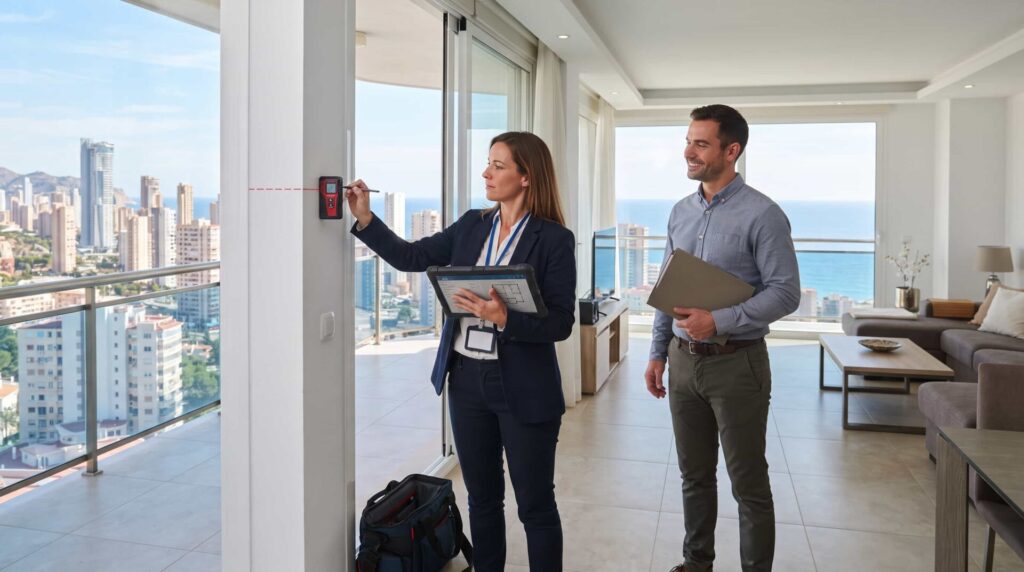
The bank will also assess the property itself.
That generally includes an official valuation.
The valuation helps determine how much the property is considered worth for mortgage purposes.
Importantly:
A valuation is not the same thing as mortgage approval.
A property may value well while the bank still rejects the application because of the borrower’s financial profile.
Likewise, a buyer may have strong finances but find that a low valuation limits the amount the bank is willing to lend against that particular property.
How Much Deposit Will You Need?
There is no single answer.
Spanish banks do not all lend the same percentage of a property’s price or valuation.
The amount offered may depend on:
- whether you are resident;
- income stability;
- loan term;
- property type;
- valuation;
- existing debts;
- currency of income;
- and the bank’s own lending policy.
Rather than relying on a generic percentage, it is better to work backwards from an actual mortgage offer.
A simple example
Imagine you want to buy a resale apartment in Benidorm for:
€250,000
Suppose a bank is willing to lend:
€175,000
You would need to provide:
€75,000
towards the purchase price yourself.
But that is not your total cash requirement.
You would also need money for:
- ITP or other applicable purchase taxes;
- notary and Land Registry costs relating to the purchase;
- legal or professional fees;
- the property valuation;
- and any other acquisition expenses.
You may also want money available for:
- furniture;
- repairs;
- moving costs;
- insurance;
- and an emergency reserve.
That is why a buyer with €75,000 in savings should not assume that a €175,000 mortgage automatically makes a €250,000 property affordable.
The deposit is only one part of the cash calculation.
Our separate guide, How Much Does It Really Cost to Buy Property in Benidorm?, explains the wider purchase costs in detail.
The safest approach is to establish two figures before making serious offers:
How much is the bank realistically prepared to lend?
and
How much of your own capital can you comfortably use without leaving yourself financially stretched?
Those two numbers define a much more realistic property budget than the maximum mortgage figure alone.

Documents You May Need for a Spanish Mortgage
There is no single universal document list that every bank will request.
The exact requirements depend on your financial profile, residence status, employment situation and where your income comes from.
However, foreign buyers should normally expect to provide evidence covering three main areas:
- identity;
- income and employment;
- savings, debts and financial position.
Identification and residence documents
Banks may ask for documents such as:
- passport or national identity document;
- NIE;
- proof of address;
- evidence of tax residence;
- and, where relevant, Spanish residence documentation.
If you are not resident in Spain, the bank may request additional information about your home-country address and tax position.
Income and employment
Employees may be asked for:
- recent payslips;
- employment contract;
- tax returns;
- bank statements;
- and evidence of how long they have worked for the employer.
Retired applicants may need to provide pension statements and supporting tax or banking documentation.
Self-employed buyers can expect a more detailed review.
The bank may request:
- personal and business tax returns;
- accounts;
- proof of business activity;
- bank statements;
- and evidence showing that income is stable rather than temporary.
Foreign documents may need to be translated or presented in a form the bank can verify.
Requirements vary considerably between lenders.
Savings and existing debts
The bank also needs to understand your wider financial position.
You may therefore be asked to provide:
- current bank balances;
- savings statements;
- investment accounts;
- details of other mortgages;
- personal loans;
- credit commitments;
- and information about other financial obligations.
This serves two purposes.
First, the bank wants to confirm that you have enough cash to complete the purchase.
Second, it wants to understand whether your existing financial commitments leave enough room for the new mortgage.
Property documentation
Once you have identified the property, the bank will also need information about the home being financed.
This can include documents relating to:
- ownership;
- Land Registry details;
- property description;
- purchase price;
- and the valuation.
The mortgage is not assessed in isolation from the property.
The lender needs to know what it is taking as security.

Fixed, Variable or Mixed Mortgage?
Spanish mortgages are commonly offered with fixed, variable or mixed interest structures.
The right option depends on your priorities and tolerance for interest-rate changes.
There is no universally best choice.
Fixed-rate mortgage
With a fixed-rate mortgage, the interest rate is established for the agreed period and does not change with normal market-rate movements.
This generally provides greater predictability.
You know how interest is calculated and, subject to the contractual terms, the monthly payment remains much more stable.
This can appeal to buyers who value certainty and want to avoid future increases caused by interest-rate changes.
The trade-off is that a fixed mortgage may initially be priced differently from a variable alternative.
What matters is the complete offer, not simply which rate looks lower on the first page.
Variable-rate mortgage
A variable mortgage usually combines a reference rate with a contractual margin.
The interest rate is reviewed periodically.
If the reference rate rises, the mortgage payment can increase.
If it falls, the payment may decrease.
This means the borrower accepts more interest-rate risk.
Anyone considering a variable mortgage should ask:
Would this mortgage still be comfortable if the payment increased?
Affordability should not depend on today’s rate remaining unchanged for the entire loan.
Mixed mortgage
A mixed mortgage combines both structures.
For example, the mortgage may have a fixed rate during an initial period and then become variable.
This can provide payment certainty during the early years while introducing interest-rate risk later.
Again, the important issue is not the label.
It is understanding exactly:
- how long the fixed period lasts;
- what happens afterwards;
- which reference rate applies;
- what margin is added;
- and how the payment could change.
Do not compare only the headline interest rate
Two mortgages with similar advertised rates can have different overall costs.
When comparing offers, look at:
- nominal interest rate;
- APR or TAE;
- commissions;
- compulsory or optional linked products;
- insurance requirements;
- bank-account conditions;
- early repayment terms;
- and how long any discounted rate lasts.
A lower advertised rate may depend on taking additional products.
Those products also have a cost.
The mortgage should therefore be assessed as a complete package.

The Mortgage Process: From Application to Notary
The exact timetable varies between banks and buyers, but the process normally follows several broad stages.
1. Compare lenders and establish a realistic budget
Ideally, mortgage research begins before you commit to a property.
At this stage, you can compare lenders and get an initial idea of:
- how much you may be able to borrow;
- the likely term;
- interest-rate structure;
- and the documentation required.
This is useful for setting a realistic property budget.
But an initial discussion or affordability estimate is not the same as final mortgage approval.
2. Submit the financial documentation
The bank analyses your income, savings, debts and employment or pension situation.
For foreign buyers, this stage can take longer if documents come from another country or need additional verification.
Responding quickly to document requests can help prevent unnecessary delays.
3. Identify the property
Once you have found the apartment or house, the bank needs information about the specific property.
This matters because final financing depends not only on you as borrower, but also on the property being accepted as adequate security.
4. Obtain the valuation
The property is normally valued by an authorised valuation company.
The buyer generally pays this cost.
The valuation gives the bank an independent basis for assessing the property.
If the valuation is lower than expected, the amount the bank is willing to lend may also be affected.
A buyer who has already signed a binding purchase contract can therefore face difficulty if the financing no longer covers the expected amount.
This is another reason to be careful when signing reservation or arras agreements before the mortgage position is clear.
5. Receive the FEIN and FiAE
Once the lender is ready to make the formal mortgage offer, you should receive important pre-contractual documentation.
Two of the central documents are:
FEIN — Ficha Europea de Información Normalizada
and
FiAE — Ficha de Advertencias Estandarizadas
The FEIN contains the key conditions of the mortgage offer.
It allows you to see information such as:
- loan amount;
- interest structure;
- term;
- payments;
- commissions;
- and other relevant conditions.
The FiAE highlights important legal and financial warnings associated with the mortgage.
Under Spain’s mortgage-credit rules, this documentation must be provided sufficiently in advance of signing so that the borrower has time to review it.
The FEIN is especially important because it allows you to compare the actual mortgage being offered rather than relying on advertising or an earlier verbal estimate.
6. Review the mortgage with the notary
Before the mortgage is signed, there is a separate notarial stage designed to ensure that the borrower has received the required information and understands the main conditions.
The notary checks the documentation provided and explains relevant clauses.
This takes place before the final mortgage deed is signed.
The purpose is to give the borrower an opportunity to clarify doubts before becoming contractually bound.
7. Sign the purchase and mortgage
If everything is in order, the property purchase and mortgage are normally completed before the notary.
The mortgage deed creates the loan and the security over the property.
The purchase deed transfers ownership.
Afterwards, the relevant deeds are processed for registration.
For the buyer, this is the end of the financing process — but not the end of ownership costs.
Mortgage payments, insurance, community fees, taxes and maintenance continue after completion.
The important point is that the process should not reach this stage with the buyer still uncertain about the loan conditions.
By the time you sign, you should already understand:
- how much you are borrowing;
- how interest is calculated;
- what the monthly payment can become;
- what additional products are involved;
- what early repayment may cost;
- and what financial commitments remain outside the mortgage itself.

Who Pays the Mortgage Costs?
This is an area where older online guides can be misleading.
Under the current Spanish mortgage framework, the formalisation costs of the mortgage are divided between borrower and lender.
The borrower normally pays
The borrower generally pays for:
- the property valuation;
- copies of the mortgage deed they personally request;
- and any opening commission if one is agreed in the mortgage contract.
The valuation is especially important because it is part of the lender’s assessment of the property being used as security.
The lender normally pays
For mortgages covered by the current rules, the lender generally pays the formalisation costs relating to:
- gestoría;
- the notary tariff for the mortgage deed;
- registration of the mortgage;
- and the applicable mortgage tax.
This distinction is important.
These are mortgage formalisation costs.
They are not the same thing as the taxes and other costs involved in buying the property itself.
A buyer may still need substantial cash for:
- the part of the purchase price not financed by the bank;
- ITP or other applicable purchase taxes;
- purchase-related notary and Land Registry costs;
- legal fees;
- moving costs;
- and initial property expenses.

Common Mortgage Mistakes Foreign Buyers Should Avoid
Mortgage problems often begin before the mortgage deed is signed.
Many can be avoided by separating what the bank has actually approved from what the buyer hopes it will approve.
Assuming the mortgage is approved too early
An initial conversation with a bank, affordability estimate or pre-assessment is useful.
It is not necessarily final approval.
The final decision may still depend on:
- complete financial documentation;
- internal credit approval;
- the property;
- the valuation;
- and any additional checks required by the lender.
Do not treat an informal indication as guaranteed financing.
Signing arras before the financing position is clear
This is one of the most important risks for mortgage buyers.
If you sign an arras agreement and later fail to obtain the mortgage you expected, you may still be bound by the terms of the contract.
Do not assume that mortgage refusal automatically releases you without financial consequences.
If the purchase depends on financing, the contract should be reviewed carefully before you commit.
Using all your savings for the deposit
A buyer may focus so heavily on reaching the required deposit that very little cash remains after completion.
That can create problems immediately.
Homeownership brings:
- community fees;
- insurance;
- repairs;
- maintenance;
- furniture;
- utilities;
- and unexpected expenses.
A mortgage should not leave you with no financial buffer.
Comparing mortgages only by interest rate
The lowest headline rate is not necessarily the cheapest overall mortgage.
Look at:
- TAE;
- commissions;
- insurance;
- linked products;
- account requirements;
- early repayment conditions;
- and how long any discounted rate lasts.
A mortgage with a slightly lower rate may cost more if maintaining that rate requires expensive additional products.
Ignoring exchange-rate risk
If your income is not in euros, currency movements can affect affordability.
A mortgage payment that feels comfortable today may become more expensive in your home currency if exchange rates move against you.
This is particularly important for buyers whose income comes from abroad over many years.
Paying for a valuation without understanding where you are in the process
A valuation costs money and does not guarantee mortgage approval.
Before paying for one, understand whether the lender has already completed enough of its financial assessment to make the expense worthwhile.
The valuation is one stage of the process, not a substitute for the bank’s credit decision.

Should You Get Mortgage Approval Before Finding a Property?
Ideally, you should have a realistic understanding of your borrowing capacity before making serious offers.
That does not mean you need final approval for a specific mortgage before viewing homes.
It means knowing roughly:
- how much you may be able to borrow;
- how much cash you need;
- what documentation the bank requires;
- and whether your financial profile is likely to fit the lender’s criteria.
This can prevent you from viewing properties that are outside your realistic budget.
Pre-assessment is useful
An initial affordability assessment can help you establish a working price range.
That can make the search much more efficient.
It also gives you time to prepare documents before you are under pressure from a seller or estate agent.
Final approval depends on the actual transaction
Final mortgage approval normally requires more.
The bank needs to know:
- who the borrower is;
- what property is being purchased;
- what the property is worth;
- and whether all conditions are satisfied.
That is why a buyer should distinguish carefully between:
“The bank thinks I may be able to borrow this amount.”
and
“The bank has formally approved this mortgage for this property.”
Those are not the same thing.
Frequently Asked Questions
Can a non-resident get a mortgage in Spain?
Yes.
Spanish banks can lend to non-resident buyers, although documentation requirements and lending criteria may differ from those applied to residents.
The exact conditions depend on the lender and the borrower’s financial profile.
Do I need an NIE before applying for a mortgage?
Banks may allow initial discussions or affordability assessments before every administrative step is complete.
However, an NIE is generally required for the property purchase and related legal and tax procedures.
If you are seriously planning to buy, obtaining it early can prevent delays later.
Can I get a Spanish mortgage with income from abroad?
Yes, potentially.
Banks can assess foreign income, but they may require additional proof such as payslips, tax returns, bank statements and employment documentation.
The currency and stability of that income may also affect the assessment.
How long does mortgage approval take?
There is no universal timetable.
The process depends on:
- the lender;
- how quickly documents are provided;
- whether foreign documentation needs additional verification;
- valuation;
- internal credit approval;
- and the complexity of the application.
Foreign buyers should avoid building a purchase contract around an unrealistically short mortgage timetable.
Can I use my own property valuation?
Spanish mortgage rules allow borrowers to provide a valid valuation from an authorised valuation company, subject to the applicable requirements.
The bank can still perform its own checks, but it should not simply reject a compliant valuation solely because the lender did not commission it.
Should I sign arras before the mortgage is approved?
Only with great care.
If financing is essential, understand what happens under the contract if the mortgage is refused or does not provide enough money.
Do not assume that a failed mortgage application automatically cancels your obligations.
Getting a mortgage in Spain to buy property in Benidorm is not fundamentally complicated, but it does require preparation.
The strongest applications usually begin before the buyer finds the final property.
Understand your finances.
Prepare the documentation.
Establish a realistic borrowing range.
Compare complete mortgage offers rather than headline rates.
Keep enough cash for taxes, acquisition costs and a financial reserve.
And do not sign binding purchase agreements on the assumption that financing will work out later.
The most important figure is not necessarily the maximum amount a bank is prepared to lend.
It is the mortgage you can comfortably repay while still being able to afford the rest of your life — and the ongoing costs of owning the property.