
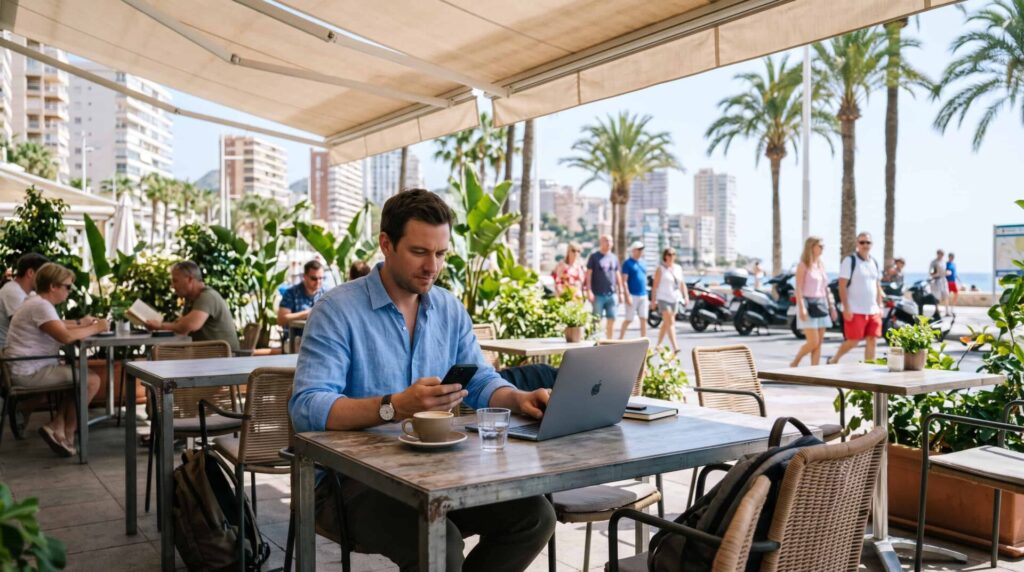
A smartphone can make everyday life in Benidorm considerably easier, but how much do you actually need one? For someone spending a week on holiday, the answer may be very different from that of a resident managing appointments, transport, banking and administrative paperwork.
Benidorm is a modern, well-connected city, yet it still offers plenty of opportunities to handle everyday activities in person. You can buy groceries, visit cafés, use local shops and enjoy much of the city without constantly looking at a screen. At the same time, an increasing number of services are designed around mobile applications, digital identification and online communication.
The interesting question is not whether smartphones are useful. It is whether living comfortably in Benidorm now requires you to organise your life around one.
Where Your Smartphone Makes the Biggest Difference
Getting around Benidorm and the Costa Blanca
Transport is one area where a smartphone can be particularly valuable. Navigation applications help visitors understand Benidorm’s street layout, locate bus stops and compare routes to neighbouring towns.
For people using public transport, checking timetables before leaving home can save unnecessary waiting. This becomes more useful when travelling outside Benidorm, where connections may be less frequent and journeys sometimes involve changing services.
A smartphone is also convenient when driving. Finding parking facilities, checking traffic conditions and navigating unfamiliar streets can make travelling around the Costa Blanca more straightforward.
However, none of this means that public transport is exclusively digital. Conventional tickets and other purchasing arrangements remain available on various services, depending on the operator. The smartphone primarily reduces uncertainty and makes journey planning easier.
Banking and everyday payments
Spain has a well-established electronic payment system, and contactless cards are widely accepted in Benidorm’s supermarkets, restaurants and shops. Mobile wallets offer another convenient way to pay, but carrying a physical bank card remains perfectly practical.
Banking is where smartphone dependence becomes more noticeable. Many Spanish banks use their mobile applications to authorise transfers, confirm online purchases and verify account activity.
Even customers who prefer managing their finances on a computer may occasionally need their phone to approve a transaction.
For foreign residents, this can become particularly important when opening a Spanish bank account or managing payments between countries. Access to the registered mobile number may be essential for receiving verification messages or completing security checks.
The practical lesson is simple: your smartphone does not need to replace your wallet, but losing access to your phone can temporarily complicate banking.
Restaurants, menus and reservations
Benidorm’s restaurant scene combines traditional establishments with businesses that increasingly use digital tools.
QR-code menus are familiar in many Spanish restaurants, allowing customers to browse food and drink options on their phones. Online reservations and messaging services can also make arranging a table more convenient.
Nevertheless, smartphone use is rarely the only way to enjoy eating out. Many restaurants still provide printed menus, accept telephone reservations and welcome customers without advance bookings.
The situation is more variable with smaller businesses. Some cafés, bars and independent restaurants communicate through Instagram, Facebook or WhatsApp rather than maintaining a comprehensive website.
For long-term residents, having access to these channels can make it easier to check announcements, contact a business or discover changes to its services.
That does not mean every restaurant requires digital interaction. It simply reflects how smaller businesses increasingly communicate with customers.

Healthcare and Public Administration: Where Digital Access Matters More
The biggest difference between occasional visitors and permanent residents often appears when dealing with healthcare and government services.
Medical appointments and prescriptions
Residents registered with the Valencian public healthcare system can use the official GVA +Salut application to manage primary care appointments, consult certain medical records and review prescribed medication.
This can be particularly useful for people managing regular appointments or treatments. However, access depends on being registered with the relevant healthcare system, and the application is not a replacement for medical services themselves.
The more important issue is identification. Digital healthcare services may require personal details, a registered telephone number or electronic credentials. For a newcomer, arranging these correctly can be more challenging than learning to use the application.
Administrative procedures and digital identity
Spain’s public administration increasingly encourages online procedures. Municipal registrations, certificates, tax matters and other official tasks may involve electronic identification systems such as Cl@ve or a digital certificate.
These are not necessarily smartphone-only services. Many procedures can be completed on a computer, and in-person assistance remains available for various administrative matters.
Nevertheless, a phone may be needed to receive verification codes or confirm identity. Benidorm also has in-person administrative assistance services, so residents are not entirely dependent on digital channels.
For someone planning to settle in Spain, setting up reliable digital identification is generally more important than installing dozens of local applications.

The Less Obvious Problem: Depending on One Phone Number
One aspect of digital life that newcomers sometimes underestimate is the importance of their telephone number.
Your number may be connected to your bank, healthcare account, government identification, delivery services and other online accounts. If you change numbers without updating these services, receiving verification codes can become difficult.
This is particularly relevant for international residents who maintain accounts in more than one country. A foreign number may work perfectly well for many services, but individual providers can have their own registration and verification requirements.
Using a Spanish SIM or eSIM can be convenient, although it is not automatically necessary for every visitor. The priority is ensuring that whichever number you use remains active and accessible.
It is also sensible to maintain an alternative way of accessing important accounts. Losing a smartphone is inconvenient; losing access to banking, email and identification services at the same time can be much more disruptive.

Can You Live Comfortably in Benidorm Without Using Apps?
Yes, particularly if your daily activities are relatively straightforward.
A resident who prefers shopping locally, paying by card, making telephone calls and visiting businesses in person can manage many aspects of everyday life without depending heavily on applications.
Benidorm is not a city where every activity requires a QR code, an online booking or a digital wallet.
However, avoiding smartphones entirely becomes less convenient when dealing with banking security, online administration, travel arrangements and certain healthcare services.
There is also a difference between avoiding applications and avoiding digital services altogether. Someone who prefers using a laptop can complete many online tasks without relying on a mobile application, although occasional telephone verification may still be necessary.
For older residents or people who are uncomfortable with technology, the availability of in-person services remains important. Digital convenience should not be mistaken for universal digital accessibility.

How Much Smartphone Dependence Is Actually Sensible?
The most practical approach is to use your smartphone selectively rather than allowing it to become the centre of every daily activity.
For someone moving to Benidorm, a small number of reliable digital tools is usually more valuable than a large collection of applications. Navigation, banking, communication and access to essential services cover most practical requirements.
At the same time, keeping a physical bank card, knowing how to contact important services by telephone and maintaining secure access to accounts from another device can reduce unnecessary dependence.
Digital nomads may already spend much of their working day connected to technology. One of the attractions of living in Benidorm is that ordinary leisure activities do not have to involve another screen. Meeting friends, visiting local markets, walking along the seafront or enjoying a restaurant can remain pleasantly uncomplicated.
Ultimately, Benidorm is smartphone-friendly rather than smartphone-dependent. You can enjoy much of the city without constantly using your phone, but the administrative and financial aspects of long-term living increasingly reward people who are comfortable with digital tools.
The real advantage is not having an application for everything. It is knowing which services genuinely make life easier and retaining practical alternatives when technology is unavailable.